



Behind the three fastest-growing chains in May sits a governance takeover, a protocol-level fee removal, and a reliability crisis that the headline numbers do not show.
Key Takeaways
- On-Chain Footprint: TON’s fee cut to $0.0005 per transaction followed a full governance overhaul.
- Historical Parallel: Sui grew 34.8% despite three mainnet halts at the window’s end.
- Macro Overlap: Volume is leaving Ethereum and Polygon for cheaper execution layers.
- Systemic Milestone: Base leads absolute volume among the three growth leaders at 287.6M.
TON: A Fee Cut With a Larger Backstory
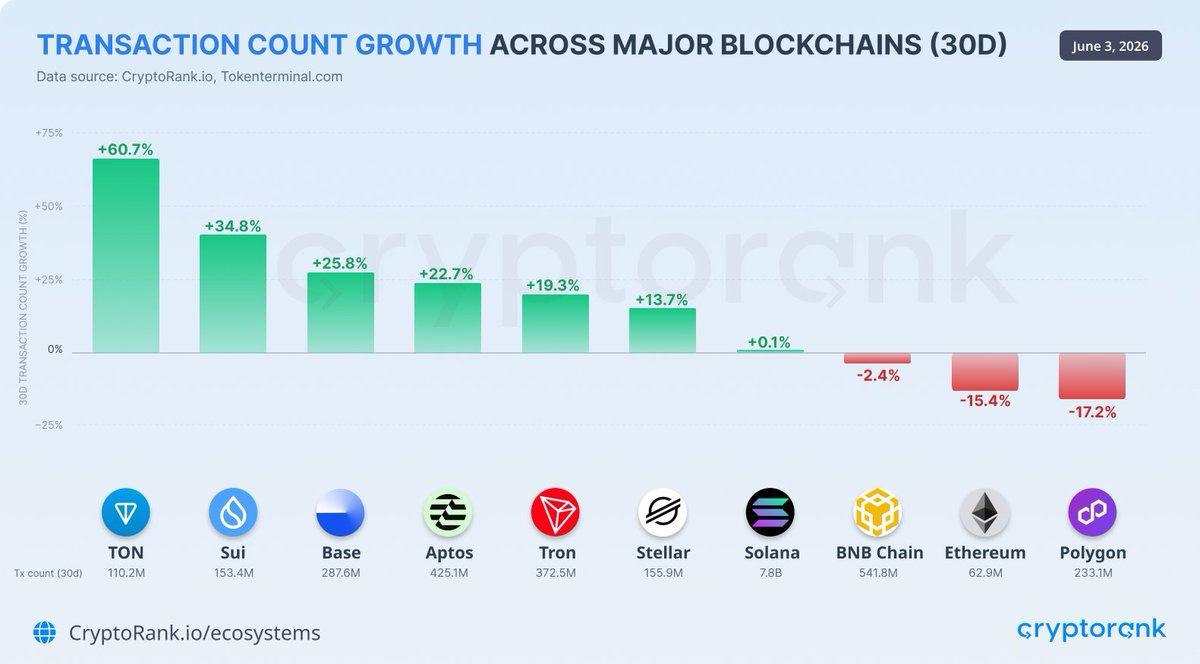
TON’s 60.7% transaction growth over 30 days is the most straightforward number on the chart to explain, but the mechanism behind it goes deeper than a routine technical update. On May 4, 2026, Pavel Durov announced that Telegram was replacing the TON Foundation as the primary driving force behind the network, simultaneously becoming its largest validator. The fee reduction, which brought transaction costs down approximately 6x to roughly 0.00039 TON per transaction, or about $0.0005, was not a standalone decision. It was the third step of a seven-step governance and development roadmap Durov called MTONGA.
That context matters for reading the growth figure accurately. The 60.7% increase is not purely organic user demand responding to a cheaper network. It is the measurable output of a coordinated infrastructure and governance shift that repositioned Telegram as the central actor in TON’s development. With Telegram’s user base as a potential distribution channel and fees at effectively zero, the structural conditions for sustained volume growth are in place in a way they were not six months ago.
The throughput side was also addressed earlier in the year. A TON v4 upgrade in March 2026 introduced sharding capable of handling over 100,000 transactions per second, providing the technical headroom to absorb the volume that near-zero fees would inevitably generate. The 110.2M transaction count is operating well within that capacity ceiling.
Sui: Strong Growth, Complicated by Outages
Sui’s 34.8% growth and 153.4M transactions over the 30-day window reflects two simultaneous developments that pull in opposite directions. On May 21, Sui launched gas-free stablecoin transfers at the protocol level, a structural change rather than a promotional subsidy. Supported assets at launch included USDC, USDT, and five additional stablecoins, with infrastructure provider Fireblocks supporting the rollout. The feature removes the requirement for users to hold SUI to pay gas when transacting in stablecoins, which directly lowers the friction barrier for the cohort of users most likely to transact frequently.
What makes the growth figure more complex is what happened at the end of the measurement window. On May 28 and 29, Sui’s mainnet halted three times in 2 days. The first two outages stemmed from how the v1.72 upgrade handled mixed gas payments, while the third was traced to a latent bug in the on-chain randomness protocol triggered during validator restarts. No funds were lost and the network recovered each time, but SUI fell roughly 19% over that week.
The practical implication for the 30-day chart is that the +34.8% growth figure almost certainly reflects activity before those outages rather than through them. Two days of halted transactions at the tail end of a 30-day measurement window would suppress the final reading, meaning the underlying growth trend may be stronger than the published number reflects. That is an unusual situation: a metric that likely understates momentum because the outages interrupted what was otherwise an accelerating activity curve. The reliability incidents are the third major failure since Sui’s 2023 mainnet launch and represent a structural credibility question that the transaction growth alone does not resolve.
What adds a separate dimension to Sui’s story in 2026 is institutional access. Four SUI exchange-traded products from 21Shares, Grayscale, and Canary Capital launched globally this year, expanding the investor base alongside the protocol-level fee changes. Growing retail usability and institutional access expanding simultaneously creates a demand dynamic that neither development would produce independently.
The Broader Picture: Where Volume Is Going
The networks on the negative side of the CryptoRank.io chart are instructive. Ethereum at -15.4%, BNB Chain at -2.4%, and Polygon at -17.2% are not collapsing in absolute terms, with Ethereum’s 62.9M and BNB Chain’s 541.8M still representing substantial volume. But the directional signal is consistent: transaction activity is migrating toward environments where costs are lower and throughput is higher. Base’s 287.6M transactions at +25.8% growth, the highest absolute volume among the three leading networks, confirms that Coinbase’s L2 is absorbing a meaningful share of that migration without requiring a governance overhaul or fee restructuring to do it.
The information provided in this article is for educational purposes only and does not constitute financial, investment, or trading advice. Coindoo.com does not endorse or recommend any specific investment strategy or cryptocurrency. Always conduct your own research and consult with a licensed financial advisor before making any investment decisions.


Be the first to comment