



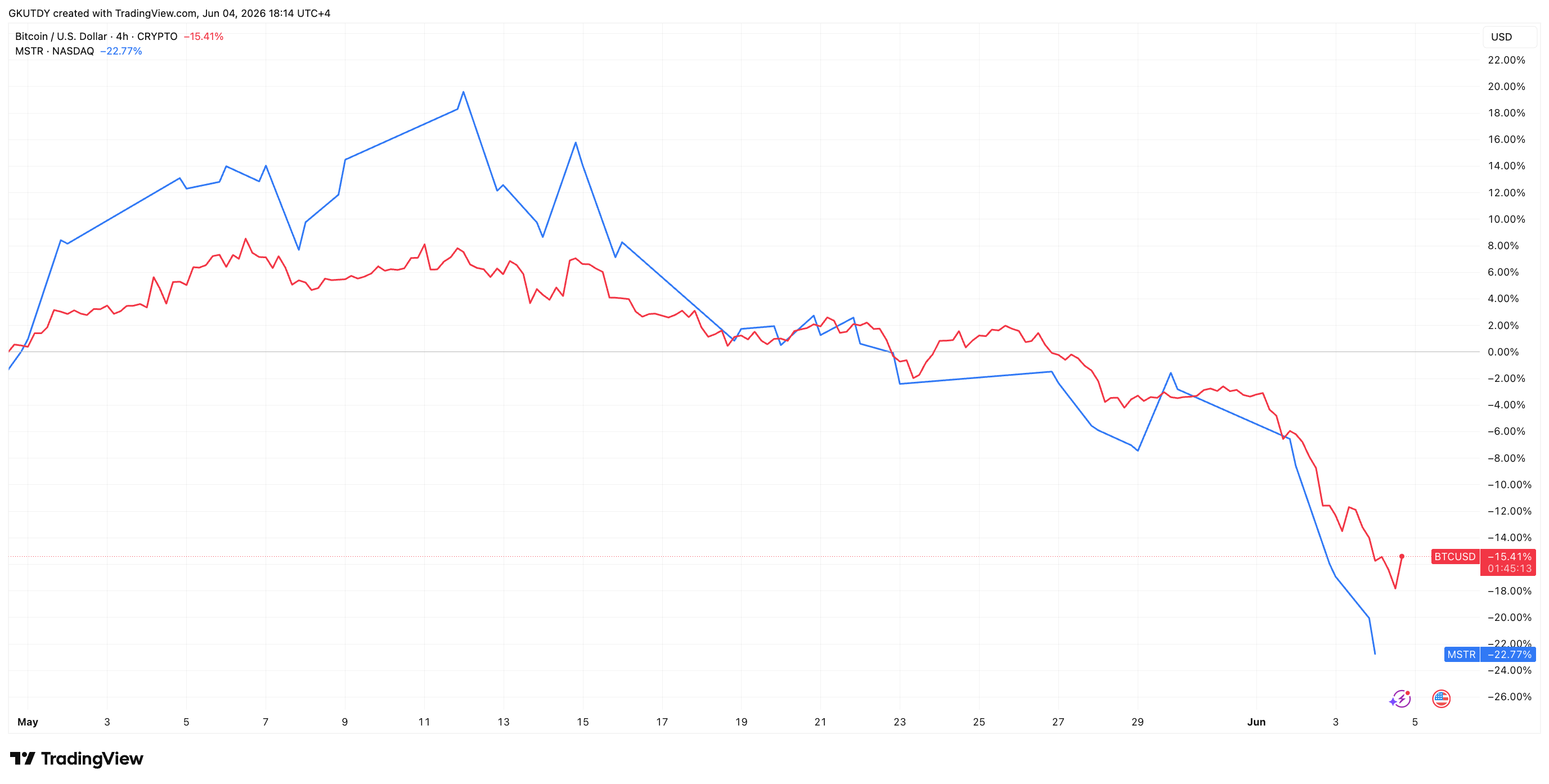
Strategy chairman Michael Saylor publicly commented on the prolonged decline in the crypto market, which has caused the price of Bitcoin and the company’s stock, MSTR, to lose more than 10% since the beginning of June 2026.
According to Saylor, the current downtrend is not caused by a systemic crisis or a loss of confidence in digital gold, but by the largest global liquidity rotation into the artificial intelligence sector in history.
The $400 billion rotation
Over the past six months, global capital markets have directed an unprecedented $400 billion toward financing AI infrastructure, Saylor says, and this massive technology boom has directly impacted spot Bitcoin ETFs, which have recorded around $4 billion in net outflows since May 14.

The head of Strategy emphasized that the observed liquidity shortage is a temporary reallocation of resources, not a fundamental devaluation of cryptocurrency, adding that short-term price swings only create new opportunities for long-term investors.
Despite market pressure, Strategy currently holds 843,706 BTC on its balance sheet, worth $53.3 billion, of which 171,209 BTC, or 25.5%, have been purchased since the beginning of the current year. With total spending of $63.87 billion, the average purchase price stands at $75,702 per BTC, which indicates that Saylor’s position is currently sitting on an unrealized loss of $11 billion.
How Saylor and Strategy monetize the AI boom
At the same time, the AI boom is not bad for the company itself, which, as many seem to forget, is primarily an information services provider. In parallel with accumulating Bitcoin, Strategy is actively monetizing corporate AI through its Mosaic platform, solving key business problems in the adoption of large language models, or LLMs.
You Might Also Like

Moreover, the company’s Universal Semantic Layer prevents AI hallucinations by providing algorithms with verified business metrics, while Data Governance tools control data security when working with autonomous AI agents.
Thus, Saylor is building a symbiotic model in which operational IT software generates stable revenue, while Bitcoin serves as the core reserve asset protecting capital from fiat inflation.


Be the first to comment