



FG Nexus has transferred another 10,000 Ether worth about $17.8 million, extending a series of treasury sales that have reduced its Ethereum holdings as the asset trades more than 50% below the company’s average purchase price.
Summary
- FG Nexus moved another 10,000 ETH worth about $17.8 million, extending a series of treasury sales after previously disposing of more than 21,000 ETH.
- Ether trades about 54% below FG Nexus’s average purchase price of $3,860, leaving the company’s original investment down by more than $100 million in value.
- While FG Nexus continues to reduce its holdings, BitMine and other institutional holders have kept adding Ether despite the asset’s recent price weakness.
According to onchain data identified by Arkham, a wallet linked to the Nasdaq-listed Ethereum (ETH) treasury company moved 10,000 ETH on Wednesday. The transfer follows earlier disposals totaling more than 21,000 ETH, which were sold for roughly $55 million.

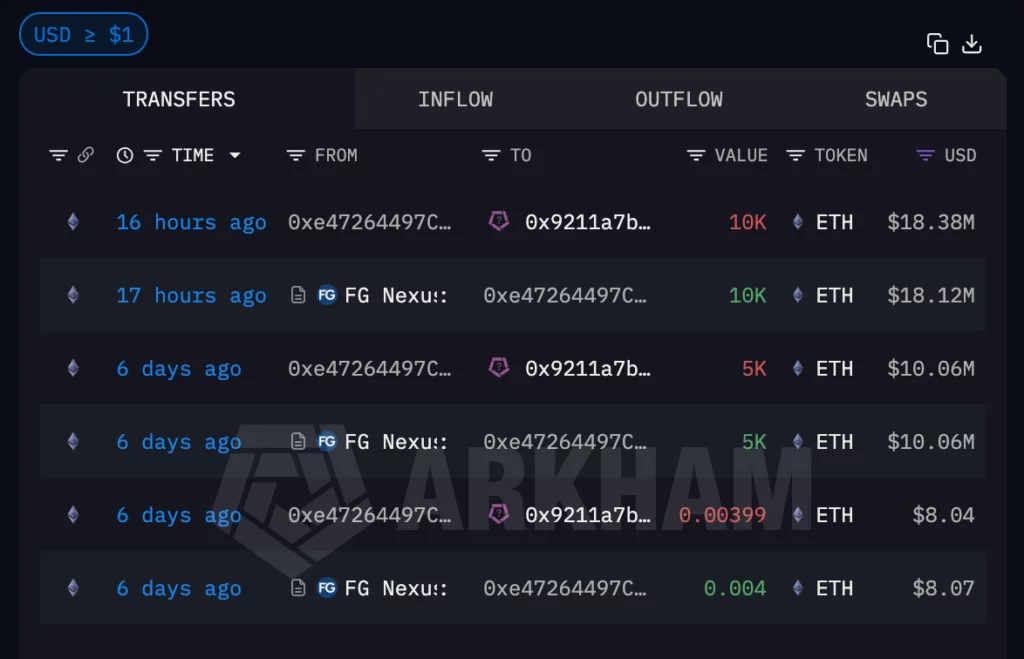
Transfers from FG Nexus wallet. Source: Arkham.
Corporate filings show FG Nexus accumulated 50,770 ETH between August and September 2025 at an average cost of $3,860 per coin. With Ether changing hands near $1,765 at the time of reporting, based on CoinGecko data, the company’s original position has fallen by more than $100 million in value compared with its purchase price.
Market pressure has also appeared in the company’s stock. Yahoo Finance data showed FG Nexus shares fell 13.40% in pre-market trading Thursday to $7.11 after closing at $8.21 on Wednesday.
Public disclosures released in December 2025 showed the company held approximately 40,093 ETH. Since then, FG Nexus has not publicly commented on the sales activity identified by blockchain tracking services, and subsequent company statements have not addressed the transfers.
Institutional buyers take a different approach
While FG Nexus continues to reduce its holdings, several other public companies have remained committed to Ethereum treasury strategies despite the asset’s price weakness.
Among the largest buyers, BitMine recently expanded its position with a purchase valued at approximately $52 million. The company currently holds more than 5.4 million ETH, making it the largest publicly traded corporate holder of Ethereum.
BitMine also announced plans on Wednesday to issue dividend-paying preferred shares, adding another funding mechanism to support its Ethereum accumulation strategy.
The divergence between sellers and buyers comes as Ethereum’s long-term outlook remains a topic of debate among investors and analysts.
In May, Bankless co-founder David Hoffman disclosed that he had sold his ETH holdings after concluding that the long-running “ETH is money” investment thesis had largely reached maturity. In a post on X, Hoffman argued that Ethereum continues to succeed as infrastructure for decentralized applications, stablecoins, tokenized assets, and layer-2 networks, but said not all of that growth necessarily translates into value for ETH itself.
His comments arrived as Ethereum’s ecosystem continued expanding. Earlier this year, Ethereum’s stablecoin supply reached a record $180 billion, accounting for nearly 60% of global stablecoin supply, according to previously reported industry data.
Others remain optimistic about Ether’s prospects despite recent price performance. Last week, Standard Chartered reaffirmed its long-term $40,000 Ether price target, citing strengthening network fundamentals, rising onchain activity, and Ethereum’s continued position in decentralized finance.
The bank compared Ethereum’s development stage to Amazon during its early growth years and argued that current market valuations have not fully accounted for those underlying trends.
Recent market data has nevertheless highlighted areas of caution. A May analysis from Glassnode identified a significant concentration of investor cost basis around the $2,800 level, while Santiment contributor ShayanMarkets reported weakening derivatives market sentiment through a declining Ethereum Taker Buy-Sell Ratio.
Even with those concerns, institutional accumulation has continued among several large holders, leaving corporate Ethereum treasuries divided between companies reducing exposure and others still increasing their bets on the asset’s long-term future.


Be the first to comment