

You have just made your first crypto sale. The customer paid, the transaction cleared, and you feel good about avoiding credit card fees. But now comes the real question. Where do the funds actually go from here?
This decision between custodial and non-custodial processing determines how fast you can access your money, who holds the security risk, and what happens when you want to cash out. With NOWPayments, new accounts start with custodial processing enabled by default, meaning your crypto sits safely in your account balance until you withdraw or convert it. In this article, we will explain how custodial and non-custodial wallets work for merchants, how NOWPayments Custody fits in, and what you need to consider before your next payout.
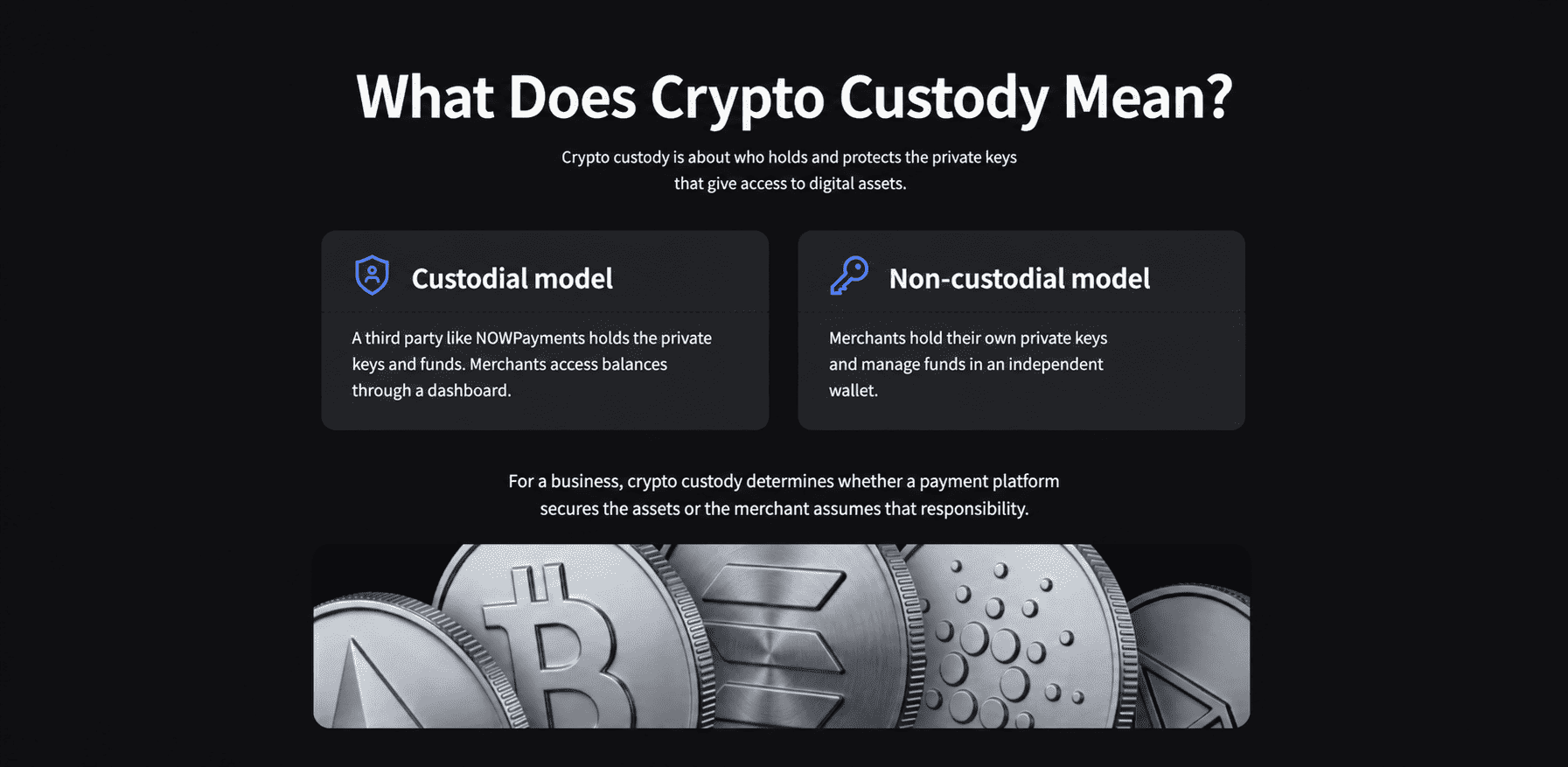
What Does Crypto Custody Mean?
Crypto custody refers to the party responsible for holding and safeguarding digital assets. In a custodial model, a third party such as NOWPayments manages the private keys and funds on behalf of the merchant. The merchant accesses the balance through an account dashboard without directly handling the underlying keys.
In a non-custodial model, the merchant holds the private keys and operates an independent wallet. No intermediary participates in the storage or movement of funds. For a business, crypto custody ultimately determines whether a payment platform secures the assets or the merchant assumes that responsibility directly.

Custodial Crypto Services Explained
A custodial provider holds and manages crypto funds for merchants, offering balances, conversions, withdrawals, payouts, and security controls. Businesses avoid manual transaction tracking and gain efficient treasury management without running their own blockchain infrastructure.
Typical features include:
- Consolidated account balances for all incoming payments.
- Hot and cold storage combined for active and long-term funds.
- Withdrawal controls with limits, approvals, or automation.
- Fiat settlement before withdrawal.
- Mass payouts to multiple wallets or bank accounts.
- Off-chain conversions with no network fees per swap.
- Lower network fees by batching or storing funds off-chain.
The table below summarizes the key benefits and limitations of custodial services for merchants:
| Benefits | Limitations |
| Easier setup, no wallet configuration | Funds held by a third party |
| Account recovery options | Merchant depends on platform security and policies |
| Lower daily operational complexity | KYC or verification may be required |
| Simplified withdrawals to bank or external wallets | Less private key control than non-custodial |
| Built-in conversion and mass payout tools | Counterparty risk if the platform becomes insolvent |
Non-Custodial Crypto Services Explained
Non-custodial services give users control of their own private keys, with funds sent directly to an external wallet and no third party managing the assets. Common examples include hardware wallets like Ledger, software wallets like MetaMask, and payment setups where crypto goes straight from customer to merchant wallet.
The list below outlines where non-custodial services work best and where they fall short:
| Benefits | Limitations |
| Full control of private keys with no third party | Slower onboarding with manual wallet setup |
| No KYC or account verification required | Every transaction pays network fees individually |
| Funds cannot be frozen or seized by a platform | No mass payouts or fiat settlement options |
| Direct settlement to your own wallet address | Higher operational complexity for treasury management |
How NOWPayments Custody Works
NOWPayments is a custodial crypto payment gateway. For new accounts, custodial processing is enabled by default, so merchants can receive payments immediately without attaching an external wallet. Customer payments are credited directly to the merchant’s custody balance.
Here is why businesses choose NOWPayments custody:
- No external wallet needed to start.
- Accumulate small payments and withdraw together to cut network fees.
- Built-in conversion and fiat settlement from one balance.
- Mass payouts without moving funds externally.
Which Model Should Your Business Choose?
Choose custodial processing if:
- Faster onboarding, no external wallet needed
- Lower network fees through batched withdrawals
- Manage all balances in one account
- Need conversions, mass payouts, or fiat settlement
Choose non-custodial processing if:
- Funds go directly to your own wallet with full key control
- You already have wallet infrastructure
- You prefer managing withdrawals and security independently
For most new NOWPayments merchants, custodial processing is the default and most convenient starting point.
Conclusion
Custodial services prioritize easier business operations and balance management, while non-custodial wallets focus on direct self-custody. NOWPayments is a custodial gateway with custody enabled by default for new accounts, letting merchants receive crypto payments immediately and manage funds efficiently. Merchants can still switch to non-custodial processing anytime.
FAQ
What is crypto custody?
Crypto custody refers to the party responsible for holding and safeguarding digital assets. In a custodial model, a third party manages private keys and funds on behalf of the merchant.
Is NOWPayments custodial or non-custodial?
NOWPayments is a custodial crypto payment gateway. Custodial processing is enabled by default for new accounts.
Is custody enabled by default on NOWPayments?
Yes. New accounts start with custodial processing enabled, so merchants can receive payments immediately without attaching an external wallet.
Do I need a payout wallet to start accepting payments?
No. With custodial processing enabled, funds are credited directly to your NOWPayments custody balance. No external payout wallet is required.
What operations are available within Custody?
Merchants can store funds, convert crypto to other coins or fiat, withdraw to external wallets in batched transactions, and send mass payouts to multiple recipients.




Be the first to comment