

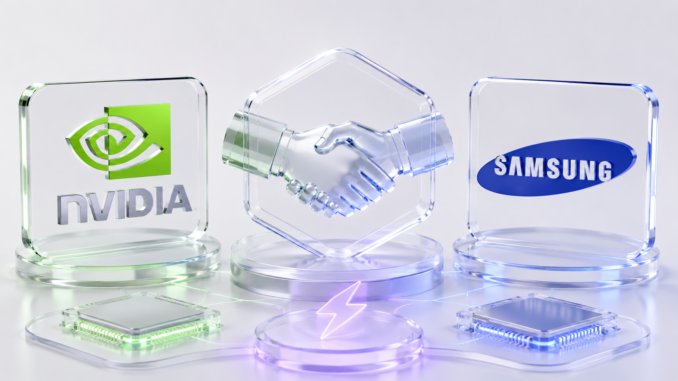

Nvidia CEO Jensen Huang is set for a packed June 8 schedule in South Korea, with new announcements expected as the AI chip giant deepens ties with Samsung, SK Group and other major Korean technology companies.
Huang is expected to meet Samsung Electronics Vice Chairman Jeon Young-hyun on June 8, putting high-bandwidth memory, digital twins and robotics cooperation back at the center of Nvidia’s Korea push. Jeon leads Samsung’s Device Solutions division, the business responsible for semiconductors, memory and advanced chip manufacturing.
The same day is also expected to bring a separate Nvidia-SK update. SK Hynix confirmed that Huang and SK Group Chairman Chey Tae-won plan to brief media on a cooperation plan on Monday morning. Huang has already said Nvidia is working across AI supercomputers, CPUs, new PCs and robotics, adding that there may be announcements on June 8.
HBM Supply Is The Core Market Issue
The Samsung meeting matters because Nvidia’s AI roadmap depends heavily on advanced memory. High-bandwidth memory sits beside GPUs inside AI accelerators and helps move data fast enough for large model training, inference and high-performance computing. Without enough HBM, Nvidia cannot scale AI systems at the pace customers want.
South Korea is critical to that supply chain. Samsung Electronics and SK Hynix are two of the world’s most important memory suppliers, while Nvidia’s next AI platforms require more bandwidth, packaging capacity and memory integration than earlier GPU generations. Huang has also warned that shortages will persist across wafers, packaging, silicon photonics and other parts of the AI supply chain because demand remains extremely high.
That is why a Samsung meeting and SK announcement are being watched together. SK Hynix has become a leading HBM supplier for Nvidia, while Samsung has been pushing to strengthen its position in next-generation HBM and AI memory. Any deeper cooperation could affect Nvidia’s future supply, Samsung’s AI chip recovery story and the wider semiconductor trade.
Nvidia’s Korea Push Goes Beyond Chips
Huang’s Korea schedule is not limited to memory. He is also expected to meet leaders from LG, Hyundai Motor Group, Naver and AI robotics companies. That broader itinerary matches Nvidia’s expanding strategy around physical AI, where AI systems move from data centers into factories, robots, vehicles and industrial software.
The robotics angle is important for both Nvidia and South Korea. Korean companies already have deep manufacturing, electronics and automotive experience. Nvidia supplies the AI compute, software platforms and simulation stack needed to train and deploy robots, autonomous systems and digital twins.
That makes the trip bigger than a single chip-supply negotiation. Nvidia is trying to connect its AI platform to Korea’s manufacturing base, memory industry, electronics giants and robotics ambitions. The same AI infrastructure cycle has already lifted related chip names, with Marvell rallying after Jensen Huang’s trillion-dollar call as investors look beyond GPUs into networking, custom silicon and data-center connectivity.
AI Capital Keeps Pulling Market Attention
The timing also matters for markets. Nvidia remains one of the strongest symbols of the global AI trade, while capital continues rotating toward companies tied to chips, data centers, power, networking and private AI infrastructure. That shift has already weighed on crypto risk appetite, with Bitcoin slipping behind major AI and semiconductor assets during the latest market reset.
Nvidia’s Korea announcement could strengthen that rotation if investors see a clearer path to more supply, more memory capacity or deeper AI deployment in robotics and industrial computing. It could also raise expectations for Samsung if the meeting signals progress around HBM supply for future Nvidia platforms.
The confirmed facts remain narrow before June 8. Huang is set to meet Samsung’s Jeon Young-hyun. Nvidia and SK are expected to discuss a cooperation plan publicly. The potential announcement has not been fully detailed yet.
The market focus is clear anyway: Nvidia needs memory, packaging and industrial partners to keep the AI buildout moving. South Korea has the memory suppliers, manufacturers and robotics base to make that buildout larger. June 8 now becomes the next catalyst for NVDA traders, Samsung investors and the broader AI infrastructure trade.


Be the first to comment