

If you’re a trader, you’ve probably already seen the Cardano chart. ADA hovering around $0.15 – a level not seen since late 2020. A 70% drop over the past year and more than 93% from its all-time high. Nothing new in crypto, right? Wrong.
What’s happening with Cardano right now isn’t just a bear market. It’s a systemic collapse of its entire ecosystem. And here’s the unsettling part: XRP and Ethereum might be walking down a similar path, albeit for different reasons.
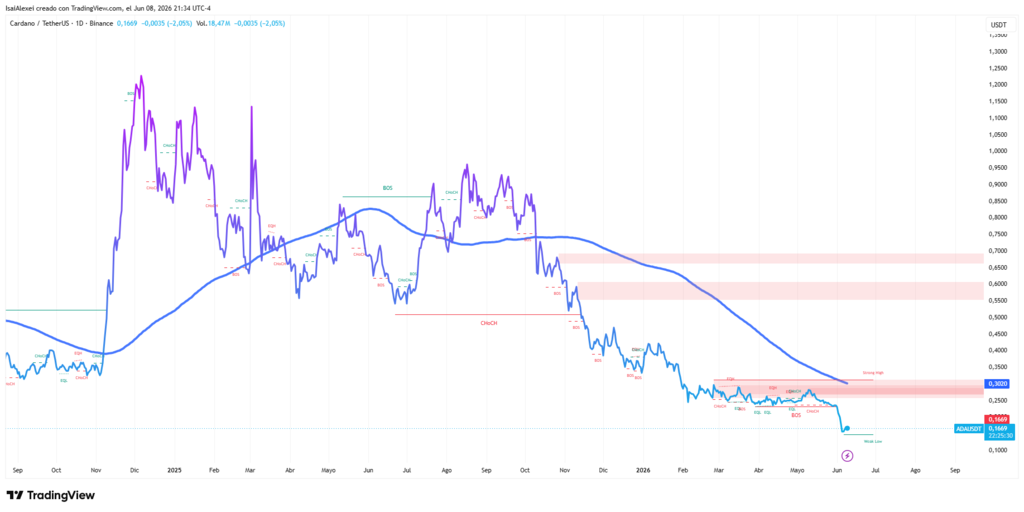
Let me explain why, as a trader, you should stop staring only at support and resistance levels and start paying attention to the real power structure of each network.

The Real Problem With Cardano: A King Without a Crown
The official narrative says Cardano is one of the most decentralized, peer-reviewed blockchains out there. The reality we’re witnessing is much uglier. In the last six weeks, two critical pieces of its infrastructure – TapTools and JPG.Store – shut down. Not because they ran out of money, but because their teams lost confidence in the project’s direction.
Then came the knockout punch: founder Charles Hoskinson announced he was taking a break. “I’m taking a break. TTYL.” Within hours, ADA dumped an extra 10%.
The most grotesque part? Hoskinson then said he “has no governance keys, can’t initiate a hard fork, has no access to the treasury.“ Some people sold that as proof of decentralization. I read it differently: he has all the responsibility and zero real power to save the ship. That’s the worst possible governance design. A leader the market still holds accountable, but with no tools to act. A dead end.
If you’re trading ADA right now, you’re not betting on technology. You’re betting that a demoralized, rudderless community finds a miracle. The odds aren’t good.
XRP: Stability or a Corporate House of Cards?
Many look at XRP and see an asset that, despite everything, seems “steady.” Ripple has communicated well through 2026. The CLARITY Act is moving forward, the SEC and CFTC have both classified XRP as a commodity, and spot ETFs have seen over $1.42 billion in inflows. The result? XRP is still down 29% on the year.
Something doesn’t add up.
In my opinion, the market is already discounting something many ignore: XRP isn’t a decentralized network – it’s a company with a token. All of its governance, liquidity, development, and regulatory standing depend on a single entity: Ripple Labs. That’s a massive single point of failure. If Ripple announced a restructuring, an internal lawsuit, or just a strategic shift tomorrow, XRP could suffer the same confidence collapse as Cardano – but multiplied by ten.
Because Cardano at least has the excuse of failed decentralization. XRP doesn’t even have that excuse. It’s a corporate product tied to one company. And companies can go bankrupt, change CEOs, or lose relevance. We saw what happened with Terra, Celsius, and FTX. Concentrated power always ends badly in this market.
Ethereum: The Most Deceptive Case
Ethereum is, without a doubt, the strongest of the three. The Ethereum Foundation holds only 0.16% of the total ETH supply – an enviable figure. There are thousands of active developers and the largest DeFi liquidity in the market. In theory, ETH could easily survive without Vitalik Buterin.
But the reality is that the market doesn’t believe it.
When Buterin hinted at reducing his central role, the community erupted with uncomfortable questions: who will govern the treasury? who will set priorities? how will hard fork decisions be made? That nervousness shows that, in practice, Ethereum’s institutional credibility is still tied to its founder. It’s a psychological dependency, not a technical one – but just as dangerous.
On top of that, Buterin himself has warned that the heavy reliance on Layer-2 networks – Optimism, Arbitrum, zkSync – puts user funds at risk. If an L2 fails or gets attacked, the only solution is a hard fork of the base layer. And that’s anything but simple.
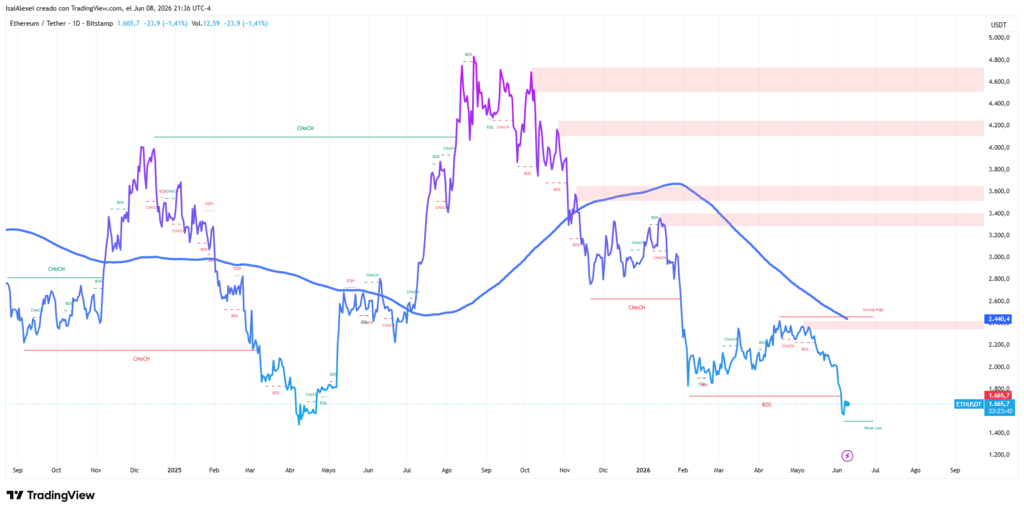
Ethereum has dropped 70% from its August 2025 high, trading near $1,500. It’s not just the macro environment. It’s because investors are starting to ask: what if Vitalik actually leaves?
Let’s not fool ourselves: all of this is happening against a brutal macroeconomic backdrop. Inflation isn’t letting up, interest rates remain high, and global liquidity has pulled back like a tide. Bitcoin fell to approximately $61,000, and about 38% of all altcoins are trading near their all-time lows.
But that doesn’t excuse each network’s specific problems.
In fact, the macro environment acts as an amplifier. When capital is abundant, no one looks at governance. When there’s a drought, projects with fragile power structures are the first to crumble.
So, What Comes Next?
In my opinion, as a trader who has seen several cycles, here’s the bottom line:
- Cardano is already in no-return territory unless a community miracle happens. Selling at $0.15 might be painful, but holding could be worse.
- XRP has regulatory tailwinds, but its corporate model is a time bomb. Beware of confusing good legal news with structural resilience.
- Ethereum is the only one with a real chance to reinvent itself without its founder, but the transition will be brutally painful for the price. Traders should prepare for unpredictable volatility.
Stop looking at candlestick charts and start looking at governance org charts. Because when the market gets serious, blockchains don’t die from bad prices. They die from bad power design.
And that’s a lesson Cardano is teaching us in real time. Hopefully XRP and Ethereum learn it before it’s too late.



Be the first to comment