



Seven of the ten largest AI agent tokens gained this week, led by Allora’s 109% surge, while SIREN and BankrCoin unwound earlier speculative runs.
Key Takeaways
- Allora gains 109% in seven days, the category’s top performer.
- SIREN sheds 24% after a near-200% surge toward a $1 billion FDV.
- Seven of the ten largest AI agent tokens closed the week higher.
- Sector leader FET slips 4.15% despite a $425 million market cap.
The AI agent token sector is closing a sharply divided week. According to CoinMarketCap data from June 12, seven of the category’s ten largest tokens posted seven-day gains, led by Allora’s 109% run, while the two former momentum favorites, SIREN and BankrCoin, gave back double-digit percentages. The split tells a familiar story inside crypto’s most speculative narrative: capital is rotating between projects within the sector rather than leaving it.
What AI Agent Tokens Actually Are
AI agents are software programs that act autonomously toward a goal: executing trades, negotiating payments, retrieving data, or coordinating with other agents without a human approving each step. AI agent tokens are the crypto assets attached to that stack. Some power the infrastructure agents run on, covering memory, identity, payments, and verifiable data.
Others fund marketplaces where agents are created and traded, and a few are little more than meme coins wearing an AI narrative. The distinction matters for risk: infrastructure tokens tend to move on adoption milestones, while narrative tokens move on attention. This week displayed both behaviors side by side.
Seven-Day Scoreboard
Seven-Day Scoreboard
| Token | Price | 7d % | Market Cap |
|---|---|---|---|
| Artificial Superintelligence Alliance (FET) | $0.1884 | -4.15% | $425.6M |
| Virtuals Protocol (VIRTUAL) | $0.6136 | +8.30% | $403.2M |
| Siren (SIREN) | $0.5014 | -24.13% | $363.9M |
| Kite (KITE) | $0.1870 | +7.7% | $336.8M |
| Unibase (UB) | $0.1337 | +24.9% | $334.3M |
| OriginTrail (TRAC) | $0.3541 | +4.8% | $177.1M |
| AI Rig Complex (ARC) | $0.09983 | +34% | $99.8M |
| Allora (ALLO) | $0.3982 | +109% | $79.8M |
| OpenServ (SERV) | $0.06867 | +26.8% | $52.9M |
| BankrCoin (BNKR) | $0.0004754 | -12.3% | $47.2M |
Data source: CoinMarketCap, as of time of writing on June 12, 2026 • Compiled by Coindoo Editorial Team
The Gainers: Utility Catalysts Did the Lifting
Allora (ALLO) +109%
The week’s standout runs a decentralized machine intelligence network where independent models contribute predictions and are rewarded by accuracy.
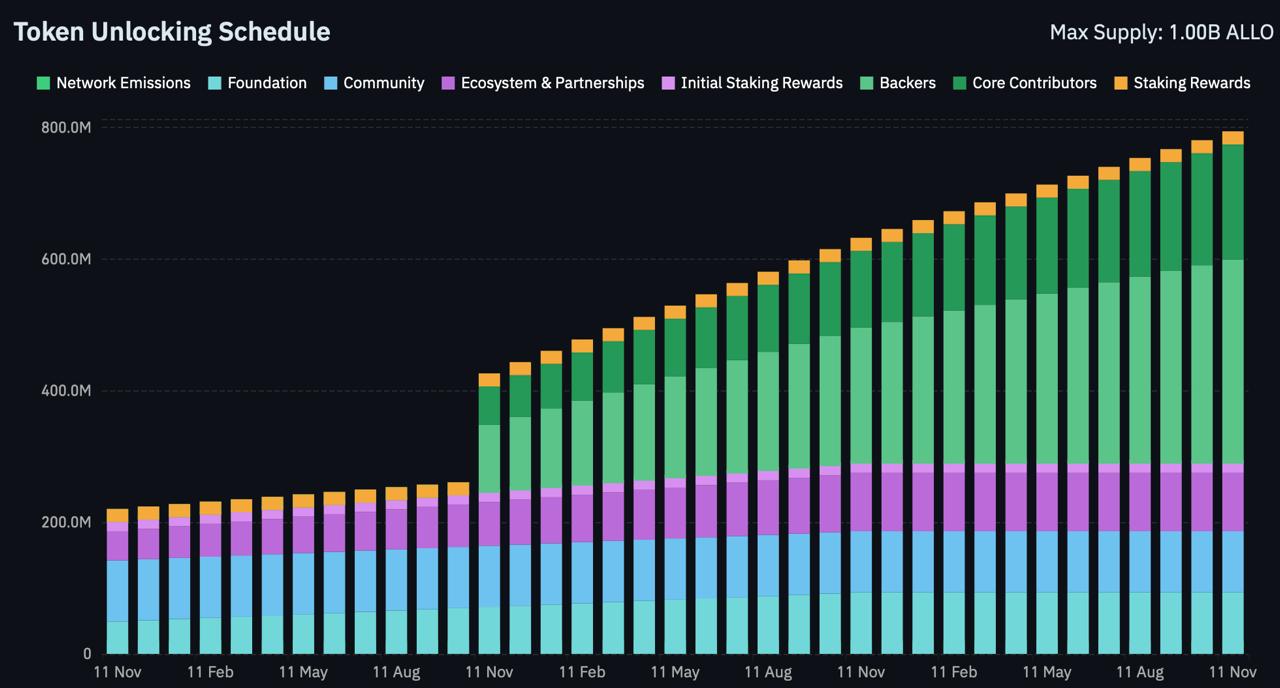
The catalyst was concrete: Cobot, the first major trading product built on Allora’s inference layer, went live via Cobot’s Kalshi prediction market integration in early June, allowing autonomous agents to execute real-world trades driven by Allora’s decentralized machine intelligence. Volume briefly exceeded the token’s entire market cap several times over. One structural caution: according to Coinglass data, only around 22.63% of ALLO’s supply circulates, and backer and team unlocks loom over the next several years, which historically amplifies both directions of a move like this.
AI Rig Complex (ARC) +34%
ARC develops rig, an open-source Rust framework for building AI agents, plus an emerging marketplace layer for agent applications. The token extended a month-long run that has it up well over 100% in 30 days, driven by sustained developer-tooling narrative and rising volume rather than a single announcement.
OpenServ (SERV) +26.8%
OpenServ builds a platform for orchestrating teams of AI agents that collaborate on multi-step work tasks. As the smallest gainer on the list by market cap, its 27% move reflects how quickly capital reaches down the risk curve once a sector narrative heats up.
Unibase (UB) +24.9%
Unibase addresses one of agentic AI’s genuine bottlenecks: agents forget everything between sessions. Its decentralized memory layer, Membase, gives agents persistent, verifiable long-term memory, while its interoperability protocol lets agents on different frameworks communicate.
From a technical standpoint, this tackles the problem of Large Language Models (LLM) context window bloat. LLM operate on a context window, which acts like short-term working memory. Without an external memory layer, an autonomous agent must cram its entire multi-day history of interactions, data, and past execution steps back into the prompt every time it runs a new task. This causes token costs to skyrocket and introduces “lost in the middle” syndrome, where the LLM degrades in accuracy due to data overload.
Membase fixes this by offloading historical data into vector embeddings stored on a decentralized database. When the agent acts, it uses semantic retrieval to pull only the highly specific, 3-sentence snippet of historical context needed for that exact moment. By slashing the active context window required for a run, Unibase dramatically lowers LLM API compute costs and slashes processing latency, turning sluggish agents into efficient, real-time processors.
The token’s strong week probably tracked rising attention on this exact type of agent infrastructure following Mastercard’s June 10 launch of its Agent Pay for Machines network, which pushed the entire machine-payments and agent-utility theme up the news cycle.
Virtuals Protocol (VIRTUAL) +8.3%
Virtuals operates the largest launchpad for tokenized AI agents, where users create, co-own, and trade revenue-generating agents. As the category’s most liquid pure-play, it tends to function as the sector’s beta trade, and an 8% week roughly matched the category average.
Kite (KITE) +7.7%
Kite is building a blockchain for the agent economy itself: identity, authorization, and stablecoin payments for autonomous agents. The agentic payments news flow this week, from Mastercard’s launch to Ripple’s XRPL AI Starter Kit for example, sits directly on Kite’s narrative.
OriginTrail (TRAC) +4.8%
The oldest project on the list runs a Decentralized Knowledge Graph that gives AI systems verifiable, source-attributed data, a direct answer to hallucination risk in enterprise AI. Its modest gain fits its profile: TRAC trades more like infrastructure and less like a momentum vehicle.
The Losers: Momentum Unwinding
Siren (SIREN) -24%
The week’s biggest decline followed the sector’s most extreme run-up. SIREN, a BNB Chain token, attempts to bridge meme culture with an AI trading assistant that utilizes a “dual-personality” framework: a conservative Golden Persona for low-risk market tracking alongside an aggressive Crimson Persona built for volatile trading strategies. After surging roughly 200% toward a $1 billion fully diluted valuation in early June, the momentum reversed hard.
On-chain analysts have repeatedly flagged that a single wallet cluster controls the overwhelming majority of circulating supply, a structure that produces exactly this boom-bust signature. Until its automated trading agent toolset proves long-term utility beyond initial launch hype, the asset remains strictly in the highly speculative attention category rather than the sustained utility one.
BankrCoin (BNKR) -12.3%
BNKR is tied to Bankr, an AI agent that executes crypto trades through social platform commands. The 12% pullback reads as profit-taking in one of the sector’s lower-liquidity names after earlier strength, with no single negative catalyst visible.
Artificial Superintelligence Alliance (FET) -4.15%
The sector’s largest token by market cap had its weakest large-cap week. FET represents the merged Fetch.ai, SingularityNET, and Ocean Protocol ecosystems, spanning autonomous agents, AI services marketplaces, and data exchange. Its underperformance against smaller rivals continues a pattern visible across this cycle: in AI agent tokens, size has not conferred momentum, and traders have consistently rotated toward newer, lower-float names.
Separating Hype From On-Chain Adoption
Because the AI agent sector is heavily driven by narrative shifts, tracking token price alone is a trailing indicator. To identify which projects are building true longevity versus those riding temporary momentum, developers and investors should anchor their analysis in three primary on-chain metrics:
- Developer Tooling Activity: For infrastructure plays like AI Rig Complex (ARC), track GitHub repository forks and active contributors. Real utility leaves a footprint of developers actively building on top of the framework, rather than just speculating on the asset.
- Daily Active Agents (DAA) & Query Volume: For decentralized intelligence and memory layers like Allora and Unibase, the key metric is query volume. Price appreciation should ideally correlate with a rising number of autonomous calls hitting the inference network. If volume drops while the price pumps, the move is entirely speculative.
- Smart Contract Wallet Clusters: As seen with SIREN, checking explorer data for wallet concentration is non-negotiable. High concentration in a few closely linked addresses means high liquidity risk, making the token susceptible to violent, cascading pullbacks when early insiders choose to realize profits.
What to Watch From Here
A detail worth sitting with: Mastercard’s Agent Pay for Machines partner roster names Coinbase, Stripe, Polygon, Solana, and Ripple, yet not one of the ten tokens on this list appears on it. Furthermore, on June 12, Coinbase launched its own “Coinbase for Agents” developer tool, allowing users to connect autonomous AI agents directly to regular Coinbase exchange accounts to trade and execute workflows within predefined limits. The institutions building actual agentic execution layers are, so far, routing around the micro-cap tokens that trade purely on the narrative. This means sector headlines could keep lifting these assets without any of that real-world infrastructure ever touching them. The gap between a narrative beneficiary and an actual operational counterparty is the central risk in this category.
Float mechanics shape the next leg. Allora’s $80 million market cap sits against a fully diluted valuation above $500 million, with roughly 80% of supply still locked, and several of this week’s other gainers share similar structures. Low float makes triple-digit weeks possible on modest inflows, but it also means scheduled unlocks convert hype directly into sell pressure. Anyone tracking these tokens should treat the unlock calendar as a primary indicator, not a footnote.
The cleanest forward test arrives within weeks: whether Allora’s trading volume holds once the Kalshi integration stops being news, and whether FET, the sector’s largest and most diluted token, can stop underperforming its own category. If the biggest name keeps lagging while sub-$100 million tokens rotate violently, the sector remains a trading market rather than an investment one, whatever the infrastructure announcements say.
Disclaimer: This article is for informational purposes only and does not constitute financial advice. Consult a professional before making investment decisions.

Kosta has reported on cryptocurrency markets and blockchain infrastructure since 2020, bringing over six years of hands-on experience in the crypto industry built through daily tracking of markets, trends, and emerging blockchain developments. Specializing in Bitcoin on-chain analysis, institutional ETF flows, and digital asset price action, his work at Coindoo has been cited by other news agencies and consistently covers market developments with a focus on data-driven reporting across Bitcoin, Ethereum, Solana, and XRP.
Over the years, Kosta has contributed to multiple crypto media outlets in different regions, authoring over 6,000 articles across the sector. His reporting spans cryptocurrency markets and the broader fintech industry, tracking not only price action but also the technological and regulatory forces shaping the ecosystem.
To support his analysis, Kosta actively leverages on-chain data and metrics from leading platforms such as Santiment, Glassnode, and CryptoQuant, enabling deeper, evidence-based market insights. He believes in the power of transparency and the data that underpins the blockchain ecosystem.
His academic background in Marketing Management from Denmark further complements his analytical approach, adding a strong understanding of communication strategy and content positioning to his work.



Be the first to comment