

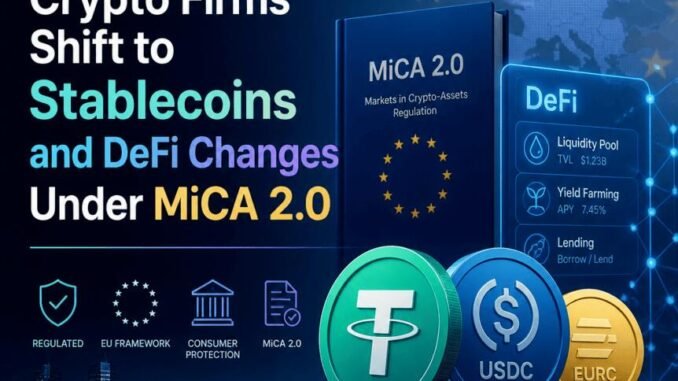

The European Commission has opened a public consultation on proposed updates to the EU’s Markets in Crypto-Assets (MiCA) framework, signaling that Brussels plans to refine how its landmark crypto rules address newer parts of the market. The consultation—initiated in May—comes as full application and enforcement of MiCA began on December 30, 2024, with the first licensing steps rolling out in the early months of 2025.
Some in the industry have already started calling the expected revision “MiCA 2.0,” with regulators aiming to tackle gaps left by the initial law. According to Katie Harries, director and head of policy for Europe at Coinbase, refinements could help keep the EU’s framework “competitive” as digital-asset regulation moves into a second phase—particularly for decentralized finance (DeFi), stablecoins, and tokenization-related activity.
Key takeaways
- Brussels’ consultation is structured to adjust MiCA’s scope and definitions, tighten rules for certain token categories, and broaden coverage to topics not addressed in MiCA 1.0.
- Stablecoin policy is expected to be highly political because the rules could change depending on whether stablecoins are treated like trading instruments or payment infrastructure.
- For DeFi, regulators are looking for practical ways to evaluate “how decentralized” a crypto-asset service provider (CASP) is, rather than treating decentralization as a simple yes-or-no concept.
- EU lawmakers are also seeking input on prediction markets, including whether existing EU regimes would apply and where potential conflicts between frameworks might arise.
- The consultation runs until Aug. 31, but industry observers expect the legislative process to take years, with concrete proposals unlikely before 2028.
MiCA set the baseline—now the EU wants to recalibrate
MiCA’s rollout marked the EU’s attempt to establish a unified approach across member states, replacing fragmented national rules. Harries told Cointelegraph that MiCA “helped set an early global benchmark for digital asset regulation” and gave the EU a “first-mover advantage” by delivering a single, harmonised rulebook for crypto.
In practical terms, Harries said the law is meant to give consumers more transparency and protection, while giving businesses enough regulatory clarity to plan investment and expansion across the bloc. For Coinbase, she added, MiCA has also served as a foundation to scale operations in Europe into the next stage of adoption for both retail and institutional users.

Even so, Brussels is now preparing changes ahead of revisions and additions to the framework. The Commission’s consultation is divided into four parts: updating regulatory scope and definitions for crypto assets other than asset-referenced tokens (ARTs) and e-money tokens (EMTs); setting requirements for EMTs, ARTs and their issuers; defining a legal framework for crypto-asset service providers (CASPs); and addressing areas that MiCA 1.0 did not cover—such as DeFi and prediction markets.
Stablecoins: the use-case determines the regulatory priority
One section of the consultation stands out for its potential downstream effects: stablecoins and related requirements. Catarina Veloso, director of regulatory and compliance at Notabene, described the stablecoin-focused part as the “longest and arguably the most politically charged” segment of the process.
Veloso noted that the way stablecoins are used—whether as a mainstream retail payment tool, a wholesale settlement rail, or as a supplement to existing cross-border payment methods—could heavily influence what rules the EU ultimately prioritizes.
In her view, if stablecoins are treated mainly as crypto trading instruments, regulators may concentrate on investor protection and market integrity. If they are treated more like payment infrastructure, the regulatory center of gravity shifts toward redemption mechanics, liquidity requirements, reserve management, operational resilience, and supervisory reporting.
That shift matters because the risk profile of stablecoins can vary depending on scale, who uses them, and where they sit inside the broader financial system. “What risks they carry,” Veloso said, “depend heavily on how they are used, at what scale, by whom, and in connection with which parts of the financial system.”
Coinbase’s policy priorities focus on making euro stablecoins more competitive within the EU rule set. Harries said Coinbase would like MiCA 2.0 to recalibrate elements including reserve rules, stablecoin rewards, and the multi-issuance model. She argued that allowing a larger share of reserves to be held in “high-quality sovereign assets” could reduce risk without undermining safety.
Another issue is rewards. Veloso pointed out that EMT issuers are currently prohibited from offering interest, which she said can weaken the competitiveness of euro-denominated stablecoins. In practice, that could push users either toward foreign-currency stablecoins or toward yield strategies that sit outside the regulated perimeter.
Harries said Coinbase wants MiCA to permit non-interest incentives—such as cashback and loyalty programmes—stating that these are common features in payments and may support consumer choice and competition.
DeFi under MiCA: regulators want measurable decentralization
A core limitation of MiCA 1.0 is that it does not cover CASPs that are “fully decentralized” and operate without intermediaries. But Veloso cautioned that decentralization is rarely binary in reality.
To build a workable policy, regulators need a way to assess the degree of decentralization and decide which indicators should matter. That includes whether the protocol is under particular control, who holds governance rights, the status of administrative keys, whether the front-end is controlled by a central party, who captures revenue, how upgrades are handled, and whether identifiable persons can materially influence outcomes.
Veloso also said regulators are looking for practical rules to determine when the EU should treat access to DeFi platforms as a regulated service. She explained that, even if platforms themselves are exempt because they are decentralized, the broader question is whether firms that connect users to those platforms should still conduct due diligence obligations vis-à-vis their clients.
Legal practitioners highlighted that this is already a live compliance question. Miroslav Đurić, a senior associate at Taylor Wessing, said many CASPs already connect clients with DeFi platforms, and because those platforms are exempt, regulators are now asking whether CASPs should meet fiduciary duty expectations through due diligence.
Đurić also noted that the Commission may consider different approaches, potentially including options that restrict client connections to DeFi platforms only if they are certified under a future certification regime.
Prediction markets: fitting them into EU frameworks may be tricky
Prediction markets are another area where MiCA’s initial scope is not fully settled. The EU currently lacks a unified regulatory structure for these markets, and they are banned in some member states.
The consultation seeks views on whether prediction markets provide economic benefits for consumers, and whether they should fall under MiCA or the Markets in Financial Instruments Directive (MiFID). Đurić said the answer depends on the specific contracts offered by each platform.
Because event contracts can have different characteristics, a platform operator could find itself subject to multiple, sometimes conflicting regimes—ranging from MiFID II rules to gambling-related regulation or potentially MiCA requirements—depending on contract structure.
Deadlines—and the long timeline ahead
Crypto industry observers say they plan to remain engaged with Brussels during the consultation process. Harries said an effective MiCA 2.0 will require ongoing “dialogue between industry, policymakers and regulators,” including learning from how the existing framework works in practice and refining parts where additional clarity or flexibility could support the next phase of growth.
While the comment period ends on Aug. 31, Đurić suggested the broader legislative process could take years. He said it is unlikely that concrete legislative proposals will be adopted before 2028, given both the complexity of the topics and the usual pace of EU lawmaking.
For market participants, the key next step is watching how regulators decide to translate stablecoin and DeFi policy questions into enforceable definitions—especially around how decentralization is assessed and how payment-versus-trading use cases shape the rules. Those choices will likely determine how quickly the EU’s second-phase framework can become operational for issuers, platforms, and intermediaries.


Be the first to comment