


AI Summary
- Global Digital Finance (GDF) completed an 18-month industry sandbox with over 70 firms — including BlackRock, JPMorgan, Goldman Sachs, State Street, Franklin Templeton, Lloyds Banking Group, LSEG and Commerzbank — testing tokenized money market funds for use as collateral.
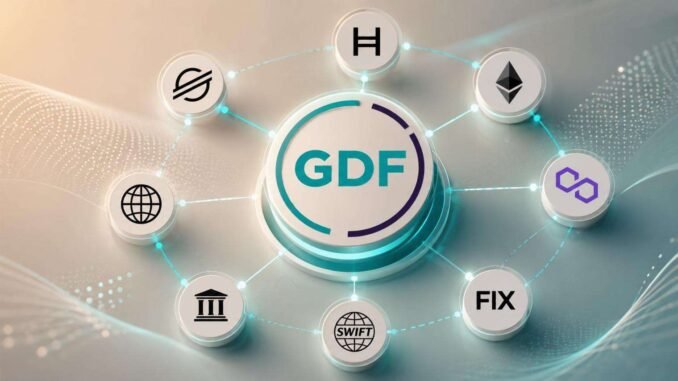
- Stellar and Hedera were named in the working DLT shortlist alongside Ethereum, Polygon and Canton, with the system interoperating with legacy rails like Swift and the FIX protocol.
- The sandbox ran 11 connection iterations, culminating in a live 10-minute repo between UBS and State Street collateralized by a tokenized money market fund.
- Tokenized money market funds are now production-ready in Europe and the UK, with the larger US market (around $2.2 trillion addressable) extending next.
Most crypto coverage talks about institutional adoption in the abstract. Global Digital Finance (GDF) just published concrete results from one of the most ambitious industry sandboxes ever conducted in this space and the participant list reads like a who’s-who of global finance.
Over 70 firms participated in the GDF working group on tokenized money market funds. The sandbox completed an 18-month effort focused on collateral mobility in tokenized money market funds across Europe and the UK. The conclusion: tokenized money market funds in Europe and the UK are production-ready, and the work is now extending to the US market.
Public distributed ledgers including Stellar, Hedera, Ethereum, Polygon, and the Canton network were tested directly in the sandbox alongside private permissioned environments. Money market funds are the backbone of short-term debt markets, and the GDF sandbox demonstrated that they can move on-chain at production grade with full institutional rigor.


99.9% Of People Have No Idea What's Coming For Hedera, Stellar Lumens, Chainlink And Quant Network!!
Who was actually in the sandbox
The working group spanned asset management, banking, market infrastructure, custody, legal, technology, and ratings. Named participants drawn from the GDF release include:
- Asset managers: BlackRock, State Street, Franklin Templeton, Federated Hermes, Goldman Sachs Asset Management, Apex Group, Northern Trust
- Banks: JPMorgan, Lloyds Banking Group, Commerzbank, UBS
- Market infrastructure: London Stock Exchange Group (LSEG), R3 (led by CEO Richard Brown), Archax
- Rating & pricing: S&P, Particula (token rating provider), Kaiko (pricing data)
- Custody, technology & legal: Fireblocks, Finastra, ISDA, O’Connor, Hogan Lovells, Ernst & Young
That is not a marketing roster. That is the actual operational stack of European and UK institutional finance, sitting down for 18 months to figure out how to make tokenized money market funds work as collateral.
What the sandbox actually demonstrated
From the post-sandbox briefing, the working group described an unconventional starting move — going to the receiving banks first (not the asset managers issuing the funds) and asking them what would need to be true for a tokenized money market fund to actually be accepted as collateral.
That generated a specific eligibility framework. Key requirements identified included:
- The fund must not be structured as a derivative
- It must not introduce counterparty risk
- It needs price transparency
- The underlying instrument and the token itself need AAA ratings (which is why Particula was brought in to provide token-level ratings, and Kaiko supplied pricing data)
- It needs to connect to existing collateral management systems — not replace them
That last point is what made the sandbox commercially credible. The working group explicitly framed it as integration with existing infrastructure rather than rip-and-replace:
“In this new brave tokenization landscape, we’re not going to rip up existing infrastructure. Since 2007, so much work has been done in terms of optimizing collateral management solutions, creating infrastructure to facilitate cheapest-to-deliver. We’re not going to rip that up and start again. We’re going to link into legacy systems.”
That meant connections to Swift, the FIX protocol, and existing collateral management platforms. Tokens used in the sandbox lived in production-ready environments that already speak to the rails institutions use every day.
The DLT shortlist that worked
The sandbox demonstrated cross-platform, cross-asset interoperability across multiple distributed ledger architectures. Per the briefing:
“We were able to show a connection to all DLTs. So whether it’s Ethereum, Canton private networks, Stellar, Polygon, Hedera, just to name a few — in a real sort of cross-asset platform interoperability.”
Three observations on that list:
1. Stellar and Hedera are publicly named alongside Ethereum. In an institutional sandbox built around AAA-rated tokenized money market funds being accepted as collateral by major banks, both Stellar and Hedera made the production-grade DLT shortlist. That is not a marketing slot. That is a working architecture conclusion. It also isn’t either chain’s first money market fund rodeo — BlackRock’s earlier money market fund tokenization work touched Hedera, and the Archax RWA money market fund launched on the XRP Ledger with related infrastructure players.
2. Canton represents private permissioned settlement. Canton is Digital Asset’s privacy-focused settlement network, widely used by traditional finance for confidential institutional transactions. Its inclusion alongside public chains shows the sandbox tested true hybrid architectures — exactly the model that Citi Institute’s Tokenization 2030 report describes as the near-term dominant pattern.
3. Polygon was tested as part of the public chain set. Polygon has been the EVM-compatible Layer 2 of choice for institutional tokenization pilots from BlackRock’s BUIDL to Franklin Templeton’s expansion.
Stress-tested across 11 connection iterations
This wasn’t a single-flow demo. The sandbox ran progressively complex scenarios across multiple weeks, reaching 11 different connection iterations by the final week. From the briefing on what the final iteration looked like:
“We moved assets from our fake hedge fund to Commerzbank, to UBS, and UBS then entered into a 10-minute repo with State Street against Finity cash and Elset cash.”
That’s a tokenized money market fund being used as collateral in a 10-minute repo trade between UBS and State Street. Real entities, real settlement workflows, real collateral mobility — just compressed onto on-chain rails. The reaction in the briefing was straightforward:
“This is incredible. This is game-changing. This is going to transform the way we look at liquidity managed in the new T+1 world.”
Why money market funds matter for the broader system
Money market funds are not a niche corner of finance. They are short-term debt-funded instruments — predominantly composed of government debt — that sit at the heart of how institutional cash gets parked, how repo collateral gets pledged, and how bank balance sheets get optimized. Tokenizing them isn’t just a technology project. It’s an attempt to address structural fragility in how cash and government debt move through the system.
The market sizes the GDF briefing cited:
- UK money market funds: approximately £3 billion equivalent
- EU money market funds: $1.2 to $1.7 trillion
- US money market funds: approximately $2.2 trillion of immediate scope for the next phase, with the broader US MMF market materially larger
The implication: as Europe, the UK, and the US converge on tokenized money market fund infrastructure that can plug into existing collateral management and Swift/FIX rails, several trillion dollars of short-term debt-backed liquidity becomes mobilizable on public distributed ledgers. That has macroeconomic implications beyond crypto particularly given current debt market dynamics where yields have been rising and the cost of carrying duration has been climbing.
Tokenized money market funds aren’t going to fix sovereign debt dynamics. But they can demonstrably improve collateral velocity, reduce settlement friction, and unlock liquidity in ways the current rails physically can’t. That’s why every major asset manager, custodian, and global bank in this group spent 18 months on it.
What this means for the chains named
Three takeaways for crypto investors, framed honestly:
1. The institutional shortlist for regulated tokenization is converging. Look across the recent announcements — DTCC connecting to Stellar, Hedera in Project Acacia, VersaBank tokenizing US deposits on Algorand, Ethereum, and Stellar, Citi’s Tokenization 2030 report naming Stellar, Ripple, and Chainlink, and now the GDF sandbox demonstrating production-ready interoperability across Stellar, Hedera, Ethereum, Polygon, and Canton. The same chains keep being selected, by different institutions, for different use cases, for technically-stated reasons. That’s a pattern, not a coincidence.
2. Interoperability is now table stakes. The GDF briefing made this explicit: “We were able to show a connection to all DLTs.” That means the chains that will capture the most institutional value over the next several years are the ones that interoperate well with both the broader DLT ecosystem AND legacy financial rails. Cross-chain standards become more strategically important as cross-chain settlement becomes the production requirement.
3. Production-ready in Europe and the UK means the US is the next domino. The briefing was explicit that the US is now ready to engage, and the next phase of work is extending the sandbox methodology to American money market funds. Given that the US MMF market is materially larger than the EU and UK combined, the next 12–18 months should see materially larger institutional dollar amounts flowing through the same tokenization infrastructure being validated now.
Bigger picture
The pattern across the last 60 days of institutional tokenization announcements is now unmistakable:
- RBA’s Project Acacia (Australia) — Hedera, XRP Ledger, Stellar, Ethereum tested for wholesale CBDC and tokenized asset settlement
- DTCC tokenization service — connecting to Stellar for $114 trillion+ worth of custodied US securities, with H1 2027 availability
- VersaBank USDVB pilot — bank-issued tokenized deposits on Algorand, Ethereum, Stellar (SEC-filed)
- Citi Institute’s Tokenization 2030 report — $5.5T base case projection by 2030, with Stellar, Ripple, and Chainlink explicitly named
- GDF tokenized money market fund sandbox — 70+ firms, production-ready in EU/UK, US extending next, Stellar and Hedera among DLTs used
Each announcement on its own is incremental. Read together, they are evidence of a phase change. Regulated finance is moving real workloads — settlement, collateral, deposits, money market funds, sovereign bonds — onto public distributed ledgers. The shortlist of chains chosen for compliance-grade enterprise work has narrowed, and the same names keep recurring.
If you’ve been watching the space waiting for “the moment” institutional adoption became real, you’re already late. The work is happening now. The GDF sandbox just put a production-grade flag on it.
Sources
- Global Digital Finance (GDF) — official press release: Tokenised Money Market Funds report (EU/UK), on collateral mobility in tokenized money market funds
- GDF working group post-sandbox briefing with participating institutions
- Working group members named in this article are drawn directly from the GDF participant list
- Particula — institutional token rating methodology
- Kaiko — institutional pricing data



Be the first to comment