

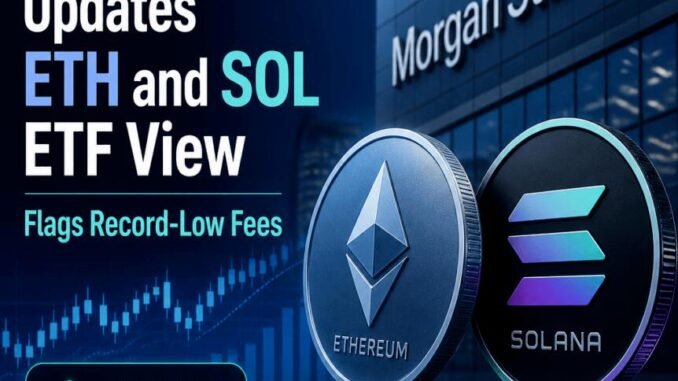

Morgan Stanley has amended its filings for spot Ether and spot Solana exchange-traded funds, setting fees it says are designed to be the lowest available in the US market for comparable products. The updates—made via amended Form S-1 statements—signal the firm is continuing to move toward an SEC decision that would allow the funds to begin trading.
According to the SEC filings lodged Thursday, Morgan Stanley plans to charge a fee of 0.14% for each ETF. If approved, the funds would expand Morgan Stanley’s presence in the fast-growing US spot crypto ETF lineup.
Key takeaways
- Morgan Stanley amended its SEC filings for both a spot Ether and a spot Solana ETF, targeting 0.14% fees.
- Farside Investors data cited in the article indicates existing lowest-fee spot products currently charge 0.15% for Ether and 0.19% for Solana.
- Amendments to Form S-1 have often been interpreted by the market as a sign of advancing SEC review and potential approval.
- Earlier, Morgan Stanley’s spot Bitcoin ETF launched with a 0.14% fee—matching its approach to undercut peers.
- Staking services for the proposed funds are set to involve Figment, Galaxy Blockchain Infrastructure, and Coinbase Canada, with a 5% staking fee on rewards.
Fees take center stage as SEC review advances
The core detail in Morgan Stanley’s latest updates is pricing. In the amended filings for each fund, the company states it intends to charge 0.14% annually. The move is particularly notable because it would place Morgan Stanley’s products at the low end of the fee spectrum for spot crypto ETFs in the US.
As background, Farside Investors data referenced in the article shows the current lowest-fee spot Ether ETF in the US is the Grayscale Ethereum Staking Mini ETF at 0.15%. For Solana, the lowest-fee spot offering cited is Franklin Templeton’s Franklin Solana ETF (SOEZ) at 0.19%, also based on Farside Investors’ figures.

Market watchers typically treat fee positioning as a proxy for how actively an issuer expects to compete for new assets. Lower expense ratios can make a fund more appealing to long-term allocators, especially when multiple spot crypto vehicles aim to track the same underlying assets.
Spot Ether and Solana proposals: what Morgan Stanley filed
The firm submitted amended Form S-1 statements for both proposed products on Thursday, as linked in the filings. The updates are the second set of amendments since Morgan Stanley first filed for the ETFs in January.
In practice, amendments are often read by the market as progress in negotiations and technical review—particularly because they generally appear closer to the moments when an issuer moves from preliminary review toward potential approval.
While the final SEC outcome is not guaranteed, the article notes that approval would add to the already expanding shelf of spot crypto products in the US, potentially bringing Morgan Stanley’s spot Ether ETF count to the 11th and spot Solana ETF count to the 7th among similar offerings, as described in the original coverage.
The specific fund naming and trading targets outlined in the article include:
- Morgan Stanley Ethereum Trust with ticker MSSE
- Morgan Stanley Solana Trust with ticker MSOL
Why “cheap” matters: Morgan Stanley’s Bitcoin playbook
Morgan Stanley has already used low fees as a market entry strategy in spot Bitcoin. Its Bitcoin ETF, launched in April, set its fee level at 0.14%, positioned below Grayscale’s 0.15% fee on its mini Bitcoin product, as noted in the article.
That fee decision appears to have been part of the firm’s early traction. The article references Cointelegraph coverage stating the fund recorded first-day inflows of $30.6 million and that total inflows have since reached $331 million, outpacing ETFs from Invesco, Franklin Templeton, and CoinShares that launched in January 2024.
Importantly, while inflow performance can be affected by many variables beyond fees—such as distribution reach, investor base, and timing—the repetition of a 0.14% expense ratio suggests Morgan Stanley is intentionally carrying forward a “competitive cost” approach across its crypto ETF expansion.
Staking services and the 5% reward fee
Morgan Stanley’s amended filings also address operational details tied to staking. The article says the filings indicate Figment, Galaxy Blockchain Infrastructure, and Coinbase Canada will provide staking services for each of the ETFs.
Under the structure described, each fund would apply a 5% staking fee to rewards earned by the product. This matters for investors because staking-related fees can change the effective return experienced by shareholders, particularly for spot products where staking can influence yield dynamics compared with a simple spot exposure approach.
Even with a low base expense ratio, staking economics can differ from the headline management fee. Investors generally look at both the fund’s stated expense level and any additional costs associated with custody, network participation, and reward allocation.
What to watch next
With Morgan Stanley’s spot Ether and Solana ETFs moving through an active amendment cycle—and with fees positioned at the low end versus currently available rivals—the next steps for investors are to monitor SEC feedback and any further filing updates that often precede approval decisions. The open question remains whether the SEC’s review will conclude in a timeframe that brings these products to market, and how staking-related costs ultimately shape investor outcomes versus existing offerings.


Be the first to comment