



The CLARITY Act has faced fresh opposition from a trafficking prevention group as Senate lawmakers continue weighing the crypto market structure bill ahead of a narrowing legislative window this year.
Summary
- AEHT has urged Senate leaders to revisit the CLARITY Act’s DeFi provision, citing illicit finance concerns.
- Section 604 would protect DeFi developers from money transmitter rules and user liability.
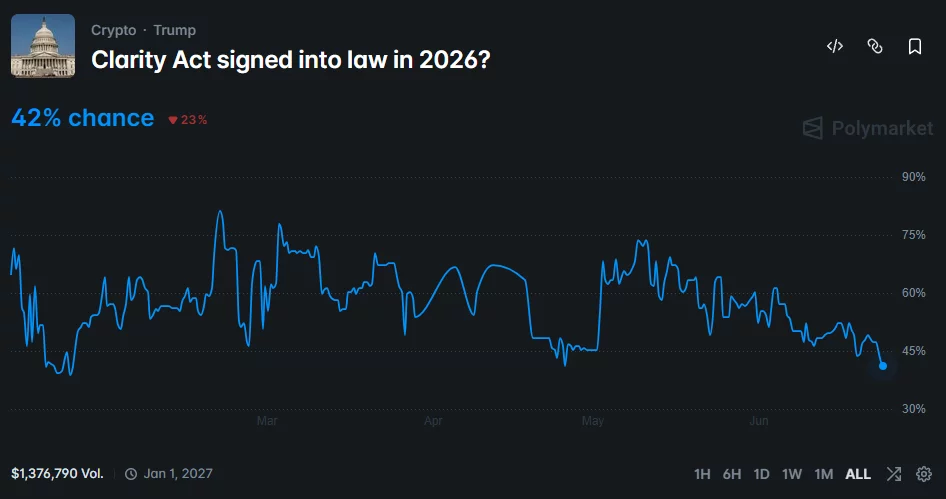
- Industry groups continue backing the bill, while Polymarket puts its 2026 passage odds at 42%.
According to a letter obtained by Punchbowl, the Alliance to End Human Trafficking (AEHT) has urged Senate Majority Leader John Thune and Senate Minority Leader Chuck Schumer to revisit a decentralized finance provision included in the CLARITY Act, arguing that it could weaken safeguards against illicit finance.

The concern centers on Section 604 of the bill, which would codify the Blockchain Regulatory Certainty Act (BRCA). Under that provision, software developers who build decentralized blockchain applications would not be held responsible for crimes committed by users of those platforms and would not be treated as money transmitters.
In its letter, the Catholic-backed anti-trafficking organization warned that the language could introduce regulatory gaps that make it harder for authorities to detect and track financial activity linked to crimes such as human trafficking.
AEHT argued that Congress should carefully assess whether the provision contains sufficient anti-money laundering protections and accountability measures before advancing the legislation.
“At a moment when Congress continues bipartisan efforts to strengthen anti-trafficking protections — including through legislation such as the Frederick Douglass Trafficking Victims Prevention and Protection Reauthorization Act — policymakers should avoid creating unintended loopholes that could undermine those efforts.”
Senate negotiations remain focused on unresolved provisions
Pressure on lawmakers has increased as competing interest groups continue lobbying around key sections of the crypto legislation.
Earlier this month, gaming organizations reportedly pushed senators to include language preventing prediction market platforms from offering sports betting products. The latest intervention from AEHT adds another layer of scrutiny to a bill that is already facing debate over ethics provisions and the treatment of decentralized finance participants.
Those discussions come as the Senate works within a limited timeframe before its August recess. While the U.S. House has scheduled a hearing on the CLARITY Act for July 17, the Senate has yet to set a date for a floor vote.
Recent comments from Senator Cynthia Lummis suggested lawmakers have made significant progress on negotiations, with previous estimates indicating that roughly 80% to 85% of the legislation had been finalized. Despite this, unresolved issues tied to ethics rules and the BRCA provision continue to complicate the path forward.
Crypto advocates continue pressing for passage
As opposition groups raise concerns, crypto industry organizations are stepping up efforts to secure support for the legislation.
In a June 23 X post, the Digital Chamber said it recently met with lawmakers to discuss the CLARITY Act and advocate for what it described as a clearer framework for digital asset markets. The organization confirmed that its outreach included discussions with Senator Lummis, one of the leading congressional supporters of crypto legislation.
Market participants appear increasingly uncertain about the bill’s chances of becoming law this year. Data from Polymarket currently assigns a 42% probability that President Donald Trump will sign the CLARITY Act before the end of 2026.
With both supporters and critics intensifying their campaigns, Senate lawmakers now face mounting pressure to resolve outstanding disputes before deciding whether the crypto market structure bill can advance to a final vote.


Be the first to comment