



MemeCore fell more than 74% in 24 hours, dropping to about $0.7169 on June 25, according to crypto.news price data.
Summary
- MemeCore’s 75% crash erased billions in value and pushed the token below key market-cap rankings.
- ZachXBT’s old warnings returned as traders questioned supply concentration, exchange listings, and thin liquidity.
- The M chart remains bearish, with RSI oversold and MACD still showing strong selling pressure.
The token traded between $0.5055 and $2.92 during the same period, with 24-hour volume at about $22.3 million.

The crash cut MemeCore’s market cap to about $940.9 million. Its fully diluted valuation fell to about $3.85 billion. The token also lost more than 75% over seven days and more than 76% over the past month.
M fell from nearly $3 to about $0.50 within hours, wiping out close to $3 billion in market value. There was no confirmed exploit, hack, or official announcement that explained the sharp move.
The crash also pushed M outside the top group of large-cap tokens after previously trading at much higher valuation levels. MemeCore reached an all-time high of $4.82 on Apr. 24, before the current drawdown.
ZachXBT questions MemeCore after crash
On-chain investigator ZachXBT said on Telegram that M’s FDV fell from about $14 billion to $3.8 billion after a sudden 75% decline on centralized exchanges. He said he, Mlm, and Wazz had earlier pointed to red flags around supply concentration and what he called deceptive user-growth practices.
ZachXBT also said Arkham data showed no single transfer above $50,000 on BSC in more than two weeks. He added that Dexscreener data showed less than $100,000 in total on-chain liquidity on BSC.
The investigator questioned why Binance and Bybit listed M perpetuals, and why Kraken and Bitget listed M spot. He said such “highly manipulated tokens” damage the industry and extract value from retail users.
ZachXBT also replied to MemeCore figure Rudy Rong on X, asking, “How many retail investors lost funds due to the MemeCore teams $M manipulation?” MemeCore had not issued a clear public response to the crash at the time of writing.
Earlier warnings centered on supply
As crypto.news reported in April, ZachXBT had already pressed MemeCore to explain how M reached a multibillion-dollar valuation while a large share of supply appeared concentrated among a few holders. He asked the project to provide data supporting its market cap and claims around insider holdings.
That report also cited blockchain data showing that a Binance deposit address was the largest holder, with about 41.3% of supply. Another wallet held 50 million M tokens, worth about $178 million at the time, or 21.77% of supply.
Previously, crypto.news explored MemeCore’s dilution risk by comparing it with Shiba Inu. The report said MemeCore’s FDV sat several times above its circulating market cap, leaving a large future-supply overhang.
That earlier article noted that only part of MemeCore’s supply was live in the market. It said future unlocks and FDV pressure could become important for price action if demand failed to keep pace.
The latest crash makes those earlier supply questions more urgent for traders. A token can fall fast when liquidity is thin, supply is concentrated, and selling begins on centralized venues.
Technical setup stays weak
The M/USDT daily chart shows a severe breakdown. Price fell from around $2.84 to $0.692 on the day, a drop of about 75.63%. The intraday low near $0.524 shows that buyers did not defend the prior range.
The move broke the sideways zone around $2.80 to $3.20. That shift changed the short-term trend from range-bound trading to a sharp bearish move. Volume rose to about 1.49 million, showing the selloff came with strong trading activity.
The RSI dropped to 18.18, far below its moving average near 45.71. That places M deep in oversold territory. An oversold RSI can support a short bounce, but it does not confirm a recovery after such a large break.
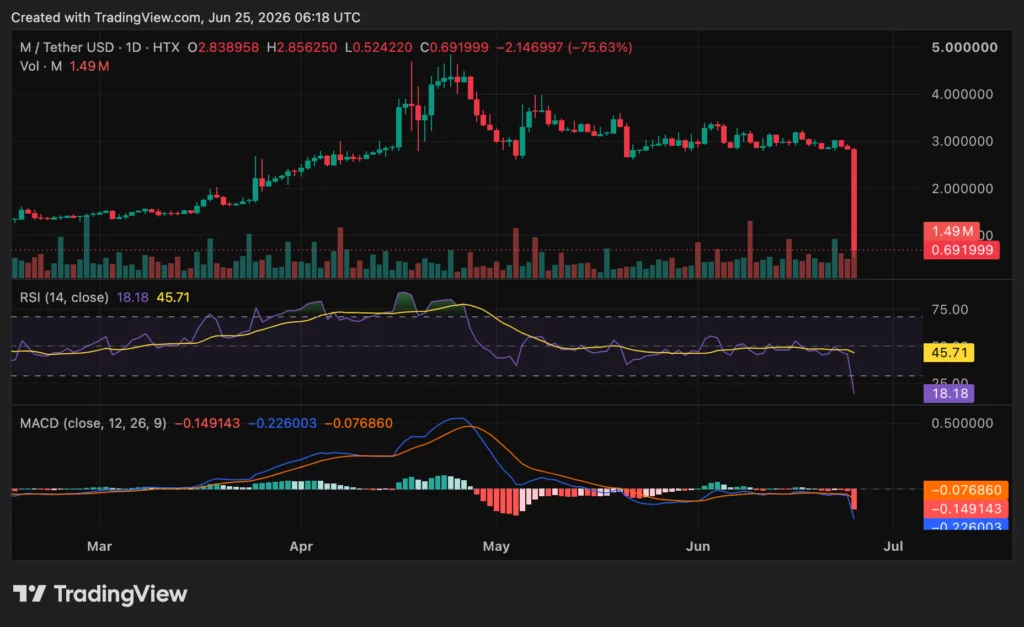
The MACD also remains bearish. The MACD line is around -0.2260, below the signal line near -0.0769. The histogram is negative at about -0.1491, showing sellers still control momentum.
M would need to reclaim lost levels and hold them before the chart looks stronger. A move back above the broken $2.80 area would matter more than a short relief bounce. Until then, the setup remains weak.
Exchange due diligence comes under focus
The crash has shifted attention from price alone to exchange screening. ZachXBT had questioned Kraken’s spot listing in April, citing $7.9 million in suspicious withdrawals to 18 newly created addresses and alleged team-linked transfers to Kraken deposit addresses.
The same April warning accused insiders of pushing M to a $6 billion market cap and $18 billion FDV. The claims remain allegations and have not been independently confirmed by all parties.
The key issue now is whether listed venues reviewed supply concentration, liquidity depth, and market structure before opening M markets. Perpetual futures can add more volatility when the spot market is thin or when real liquidity sits below headline market-cap numbers.
For retail traders, the case shows how fast a high-FDV token can collapse when confidence breaks. MemeCore still trades, but the crash has raised hard questions about liquidity, supply control, and whether exchanges gave users enough protection before listing M.
Disclosure: This article does not represent investment advice. The content and materials featured on this page are for educational purposes only.



Be the first to comment