


Key Takeaways
- Spark seeded $150M into Uniswap v4 pools on June 25, covering USDS/ USDT and USDS/PYUSD pairs.
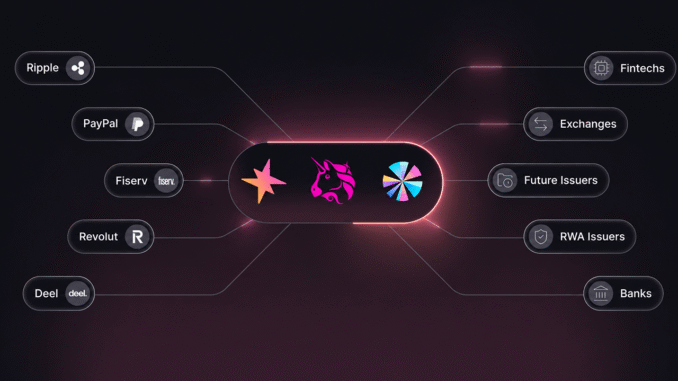
- The Stablecoin FX Layer targets banks and fintechs, as Paypal, Tether, and Sky join at launch.
- Spark plans to expand pools to additional issuers as cross-border stablecoin flows target $56.6T by 2030.
$150 Million to Start
The initial deployment seeds approximately $150 million in liquidity across two pools on Ethereum mainnet: USDS/ USDT and USDS/PYUSD. Spark, a lending and liquidity protocol within the Sky ecosystem, funded the migration from its stablecoin reserves, calling it “one of the largest AMM liquidity migrations in DeFi.”
Sky operates one of the largest stablecoin ecosystems in DeFi, with billions of dollars across USDS and DAI. That scale positions USDS as the foundational quoting asset within the new FX network.
The Problem It Aims to Solve
The stablecoin market has expanded rapidly, processing more than $28 trillion in economic transaction volume during 2025, according to Chainalysis. But as more entities issue their own tokens, including Paypal’s PYUSD, Ripple’s RLUSD, and planned offerings from Robinhood, Revolut, and major European banking consortiums, liquidity has become increasingly fragmented.
Each new stablecoin typically creates isolated pools on decentralized exchanges. That fragmentation drives higher slippage on large swaps, inconsistent pricing, and operational friction for institutions moving value between dollar-pegged assets.

Spark’s announcement frames the issue plainly: “The challenge facing stablecoins is no longer issuance. The challenge is building the liquidity and exchange infrastructure required for a multi-issuer stablecoin economy.”
How Uniswap v4 Makes This Possible
Uniswap v4’s hook architecture allows custom logic to be embedded directly into pool behavior. The DualPool hook used by Spark enables what the team calls “programmable liquidity,” where capital can be managed according to predefined inventory objectives and risk parameters rather than sitting idle between trades.
Uniswap has processed more than $4.4 trillion in cumulative trading volume, giving the infrastructure a battle-tested foundation for institutional use.
Institutional Use Case
The system is built to support treasury management, cross-border payments, and arbitrage between dollar stablecoins without relying on over-the-counter desks or centralized venues. Settlement runs 24 hours a day, seven days a week, onchain.
For institutions, the core pitch is straightforward: execute larger stablecoin swaps with less slippage and more consistent pricing, without needing to independently bootstrap liquidity.
What Comes Next
Spark and Uniswap have framed the $150 million deployment as a starting point. Future phases are expected to add more stablecoin issuers, additional trading pairs, and yield-generating functionality tied to short-term interest rates.
JPMorgan projects global cross-border payment flows will grow from approximately $194.6 trillion in 2025 to more than $320 trillion by 2032. Bloomberg Intelligence estimates annual stablecoin payment flows could reach $56.6 trillion by 2030. Both projections point to why the liquidity coordination challenge is drawing institutional attention now.
Risks remain. Shared pools introduce contagion exposure if any participating stablecoin loses its peg. The Uniswap v4 hook system requires rigorous smart contract audits, and $150 million in initial liquidity is modest relative to traditional FX market volume. Regulatory scrutiny of onchain FX-like activity could also emerge as the product scales.
Spark described the launch on X as “just the beginning,” with expectations that additional issuers will connect to the shared infrastructure rather than rebuilding liquidity from scratch.





Be the first to comment