


Retail investors appear to be rotating away from gold and Bitcoin ETFs and into semiconductor funds as artificial intelligence and chip exposure keep drawing capital from other major market themes.
Since April, U.S. gold and Bitcoin ETFs have posted about $12 billion in cumulative outflows. Over the same period, U.S. semiconductor ETFs have attracted about $20 billion in cumulative inflows, creating one of the clearest flow splits between defensive assets, crypto exposure and AI-linked equity products.
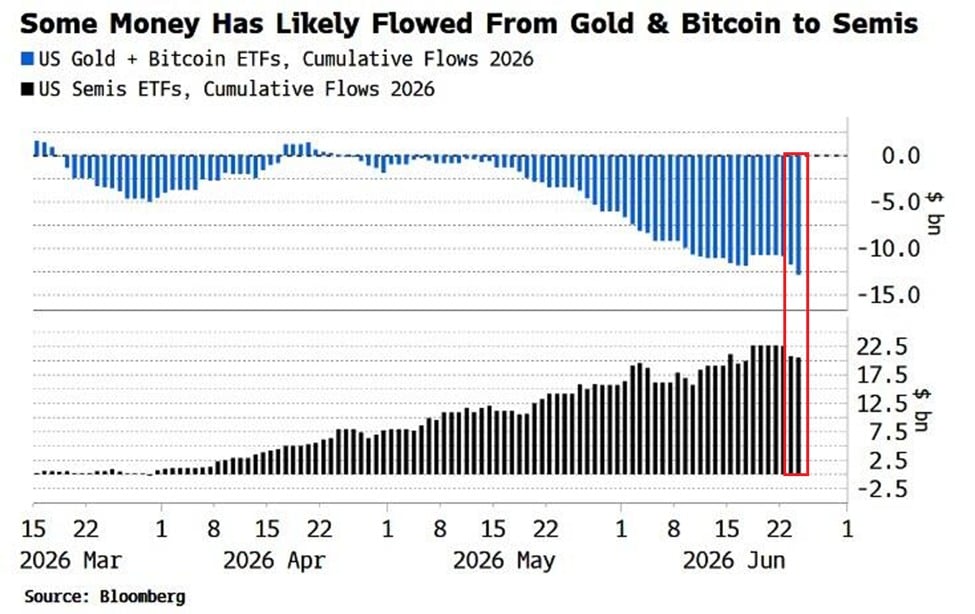
The flow gap widened in mid-May. Outflows from gold and Bitcoin funds more than tripled from earlier levels, while inflows into semiconductor ETFs doubled. The shift came as investors reduced exposure to assets tied to monetary stress and digital scarcity while increasing exposure to companies expected to benefit from AI infrastructure spending.
The largest U.S. gold-backed ETF, GLD, is down about 13% since the start of April. BlackRock’s Bitcoin ETF, IBIT, is down about 12% over the same period. The price action has matched the flow pressure, with both gold and Bitcoin losing momentum as fund investors pulled money from the products.
Semiconductor ETFs Capture The AI Trade
Semiconductor ETFs have moved in the opposite direction. SOXX is up about 81% since early April, while SMH is up about 60%, with both funds benefiting from strong demand for chipmakers tied to data centers, AI accelerators, memory, servers and high-end compute supply chains.
The retail push into semiconductors has already been visible beyond SOXX and SMH. Reuters reported that the Roundhill Memory ETF became the fastest-growing ETF launch on record after drawing billions into memory-chip exposure within weeks of launch. Vanda Research also tracked heavy self-directed buying into the fund as individual investors looked for broader access to the semiconductor boom.
Chip funds give retail investors a simpler way to buy the AI infrastructure trade without choosing between Nvidia, Micron, Broadcom, SK Hynix, Samsung or smaller semiconductor names. The same simplicity that helped Bitcoin ETFs pull money into BTC exposure is now helping sector ETFs concentrate demand around semiconductors.
The flow surge also shows how quickly retail capital can rotate. Investors who used ETFs to gain exposure to Bitcoin and gold during earlier macro cycles are now using the same structure to chase AI and chip-linked momentum.
Bitcoin ETF Outflows Add To Market Pressure
Bitcoin has already been under pressure from ETF redemptions. U.S. spot Bitcoin ETFs just recorded their worst weekly outflow after about $1.79 billion left the funds in five sessions, with IBIT posting the largest withdrawals.
The broader Bitcoin backdrop remains weak. BTC has traded near $60,000 while U.S. spot demand has softened, and the Coinbase premium stayed negative for 46 straight days. Large-wallet selling, ETF redemptions and weak U.S. demand have all hit at the same time.
Gold has faced a separate pressure channel. Bullion-backed ETFs saw outflows in May and early June as rate expectations turned more hawkish, while gold’s decline from its January peak pushed some investors back toward higher-growth equity themes.
The rotation into semiconductors does not mean every dollar leaving gold and Bitcoin funds is directly entering chip ETFs. It shows a clear change in marginal demand. Since April, gold and Bitcoin ETFs lost about $12 billion, semiconductor ETFs gained about $20 billion, GLD and IBIT fell, and SOXX and SMH delivered large gains as AI-linked retail risk appetite took control of ETF flows.



Be the first to comment