




TLDR
- Bitcoin fell over 1% on Tuesday, trading below $60,000 and under its 200-week moving average.
- The Japanese yen dropped to a four-decade low of 162.40 per dollar, pushing the U.S. Dollar Index higher.
- Strategy authorized a $1 billion stock buyback plan and a $1.25 billion program that includes selling BTC to raise cash.
- US spot Bitcoin ETFs lost $4.4 billion in June, the worst monthly outflow this year.
- Analysts say Bitcoin needs to hold $58,800 to avoid a slide toward $55,000-$56,000.
Bitcoin traded below $60,000 on Tuesday, falling more than 1% as currency markets reacted to a sharp move in the Japanese yen. The yen dropped to 162.40 per U.S. dollar, its weakest level since October 1986. That slide pushed the U.S. Dollar Index up to 101.32 from just under 101 the day before.
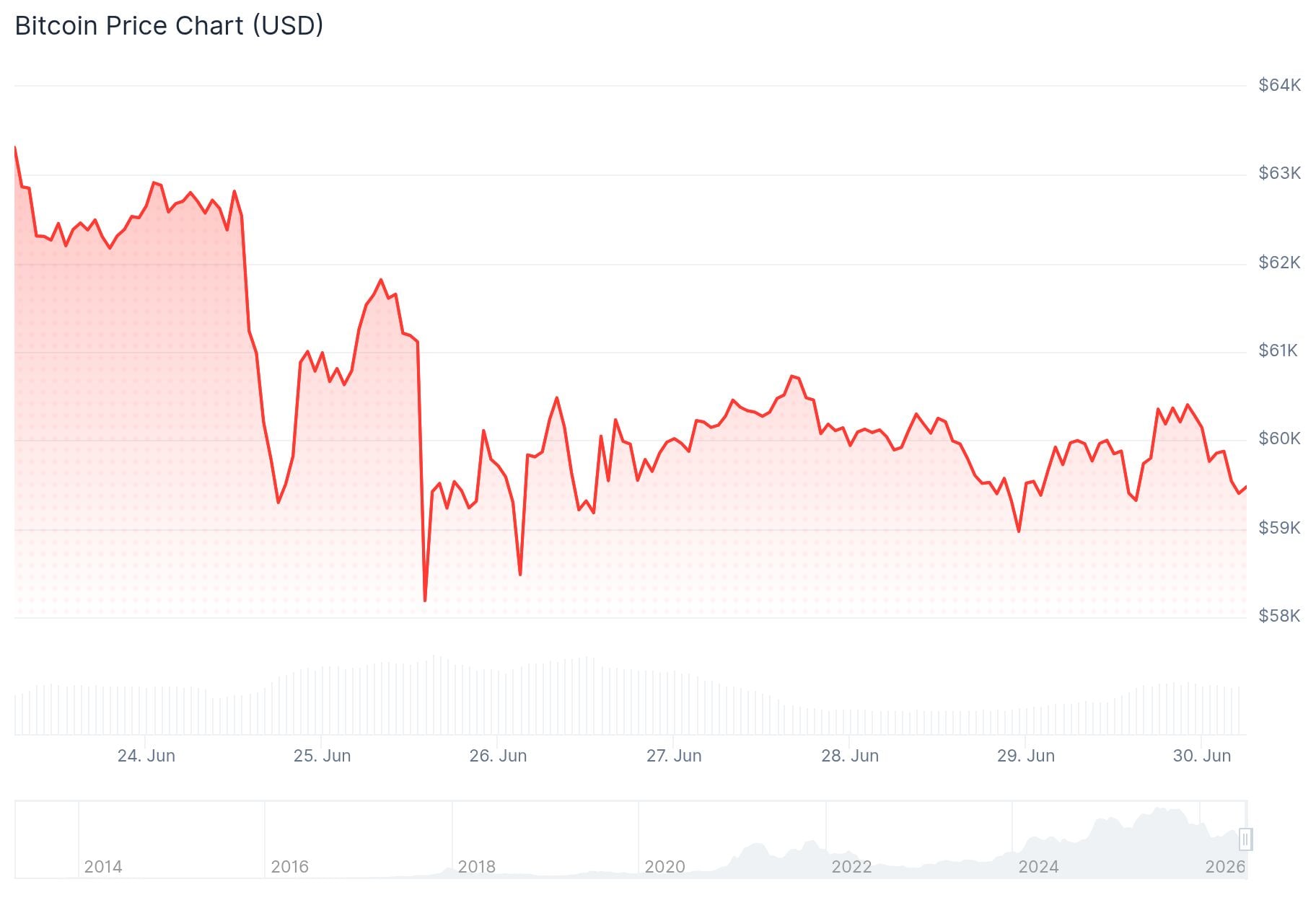
Bitcoin remained under its 200-week simple moving average during the session. This line is often watched as a sign of long-term market strength or weakness.
The yen’s decline is part of a longer trend. The currency has dropped roughly 57% against the dollar since 2021. This gap comes from different interest rate paths. The U.S. Federal Reserve raised rates above 5% at one point, while Japan kept rates near zero for years. The Bank of Japan only recently moved its rate to about 1%, still far below the U.S. rate of around 3.5%.
🚨 WE ARE GETTING DANGEROUSLY CLOSE TO ANOTHER YEN INTERVENTION.
The Japanese yen just hit its weakest level against the US dollar in 40 years, with USD/JPY trading at 161.96.
This matters because the Bank of Japan can’t let the yen stay this weak.
A weak yen feeds directly… pic.twitter.com/JFmNXZVdgr
— Bull Theory (@BullTheoryio) June 29, 2026
Strategy’s Funding Shift
On Monday, Strategy, the largest public holder of Bitcoin, approved plans to buy back up to $1 billion each of its preferred and Class A common shares. The company also launched a $1.25 billion program to raise money, which includes selling some of its Bitcoin holdings.
Strategy has established a $BTC Monetization Program under which we may sell BTC to fund our:
– USD Reserve ($1.25B cap)
– dividends and interest expense
– repurchases of our Digital Credit securities and $MSTR under our repurchase programs— Michael Saylor (@saylor) June 29, 2026
This marks a change from founder Michael Saylor’s long-standing position of never selling Bitcoin. Jeff Dorman, CIO of Arca, commented on the move in a post on X. He said the company has only delayed its problems rather than solved them.

Dorman wrote that “the can has been kicked down the road for a year or two.” He added that Strategy’s capital structure issues will likely return unless Bitcoin’s price rises sharply. He also pointed to a recent decision to pay down $1.5 billion in debt, which he said cost the company $40 billion in enterprise value.
Strategy’s preferred stock, STRC, has dropped in recent weeks. This has weakened one of the company’s main tools for raising money to buy more Bitcoin.
Retail Sellers, Institutions on Hold
Bitcoin is sitting near $60,300, a level where retail investors and large institutions appear split. The Crypto Fear and Greed Index reads 36 out of 100, showing fear in the market.
In June, investors pulled $4.4 billion from U.S. spot Bitcoin ETFs. This marks the worst month for outflows so far this year. Strategy kept buying Bitcoin during the month, purchasing 3,600 BTC for $236 million, though its pace has slowed.
Total open interest in Bitcoin futures sits at $19.92 billion, down slightly from $20.1 billion two weeks earlier. Borrowing costs for long positions dropped from 0.25% to 0.12%, a sign that forced selling has eased.
$BTC is hovering around the $60,000 level.
It seems like liquidation hunting has been going on as the price has been moving within a $2,000-$3,000 range for almost a week.
From here, Bitcoin needs to reclaim the $62,000 zone for any relief rally.
On the downside, losing the… pic.twitter.com/FdygZOykom
— Ted (@TedPillows) June 29, 2026
Traders are watching $58,800 as a key level. A drop below this point could trigger $500 million in forced selling, pushing Bitcoin toward $56,000. For a recovery, Bitcoin would need to climb back above $62,000.
Trading volume remains low, and open interest has barely changed. This points to a market where sellers may be finished but buyers have not stepped in with size.



Be the first to comment