

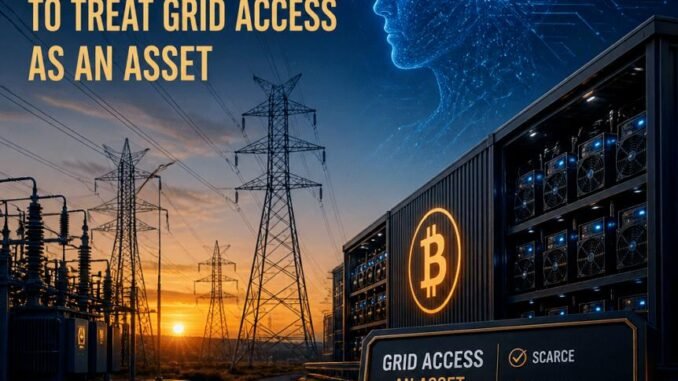

By the end of 2025, artificial intelligence data centers worldwide had accumulated roughly 29.6 gigawatts (GW) of power capacity—about equal to the electricity demand of New York state at peak, according to Stanford University’s annual AI Index report. The broader implication for crypto investors is straightforward: compute looks cheaper and easier to source, but grid-connected power remains the scarcest “hard” asset in the AI buildout.
One sector has been preparing for that bottleneck for years—Bitcoin miners. While the mining chips themselves cannot be repurposed for AI training or inference, miners’ larger advantage is the infrastructure around them: energized sites, power procurement, grid interconnection, and cooling capacity. As demand for AI-grade electricity accelerates, parts of the mining industry are positioning their facilities for AI and high-performance computing (HPC) work, with contracts increasingly tying valuation to compute pipelines rather than Bitcoin alone.
Key takeaways
- Stanford’s AI Index pegs AI data center power capacity at about 29.6 GW by end-2025, highlighting that power availability—not chip availability—is the binding constraint.
- AI efficiency gains have not reduced overall electricity demand; Stanford notes GPU computation costs fell sharply since 2006, while total demand grew as capacity is used for larger models.
- Miners can’t “swap” ASICs for AI, but they can potentially repurpose energized sites, power contracts, and cooling and grid infrastructure for AI workloads.
- AI-grade liquid-cooled infrastructure can be far more expensive than mining infrastructure (CoinShares estimates roughly $700,000–$1 million per MW for mining vs. $8 million–$15 million per MW for AI-grade).
- Market pricing is beginning to reward miners with AI/HPC contracts: CoinShares reports some AI-connected miners trade at materially higher revenue multiples than pure-play miners.
AI power is the bottleneck, not GPU availability
Stanford’s report frames an important mismatch in the economics of AI hardware. The cost of GPU computation dropped by more than 99% since 2006, and newer chips deliver far more work per watt than earlier generations. Yet that efficiency improvement has not translated into lower electricity use; Stanford says companies are effectively reinvesting those gains into building and training larger models, keeping pressure on the power system.
Stanford estimates that the most power-intensive training runs can consume upward of 100 megawatts (MW)—comparable to a small power plant. Capacity dedicated to AI has increased dramatically over a short window: Stanford estimates AI-focused capacity grew roughly 200-fold in three years, from under 1 GW in 2022. It also projects data center electricity demand to keep rising through 2030.

Geography matters as much as totals. Stanford says the United States hosts 5,427 data centers, more than ten times the next-highest country. But obtaining electricity is not the same as ordering servers. Stanford highlights that chips can arrive within months, whereas “energizing” a site—building the substation, securing interconnection approvals, and setting up cooling—can take years.
Looking at cumulative demand through 2024, Stanford estimates all-in AI power draw at about 9.4 GW. That figure is close to the national electricity use of Switzerland or Austria and roughly half of the estimated power consumed by Bitcoin mining, according to the report’s comparison using work attributed to de Vries-Gao and Stanford.
What Bitcoin miners can actually offer AI
Bitcoin mining isn’t interchangeable with AI at the hardware level. The ASICs used to solve Bitcoin’s hashing algorithm are purpose-built and do not translate into training or inference workloads. The potential overlap is in the surrounding infrastructure.
Mining operators already maintain sites with grid connections, power purchasing arrangements, and cooling setups designed to handle dense computing loads. For AI developers that need electricity that is already “permitted, grid-connected, ready-to-draw,” that can reduce the time and uncertainty required to stand up new capacity. Stanford’s broader theme—that the hard part is power—makes this operational advantage especially valuable.
There is also a geographic angle. Bitcoin miners often locate in U.S. regions with lower power costs, including states such as Texas and areas along the Gulf Coast—markets where AI capacity is also looking to expand. For AI firms, contracting with existing industrial power sites can be faster than starting from scratch.
At the same time, mining economics have been under pressure. JPMorgan recently estimated Bitcoin’s all-in production cost at about $78,000 per coin, while CoinGecko showed BTC trading around $53,400 at the time of writing referenced in the original coverage, implying the production cost estimate was above the market price. Earlier coverage from Cointelegraph noted that hashprice had fallen below break-even for many miners, putting about 20% of the industry in unprofitable territory.
From mining to HPC: contracts signal a valuation shift
The move toward AI and HPC has been visible in a series of large infrastructure deals involving miners and compute-focused counterparties. In November 2025, Iren signed a five-year GPU cloud agreement with Microsoft worth about $9.7 billion, served from a 750-MW campus in Childress, Texas, according to the company’s disclosure: Iren’s announcement.
In December, Hut 8 signed a 15-year lease with Fluidstack for 245 MW at its River Bend site in Louisiana, with the payments backstopped by Google, per the press release: Hut 8’s filing. TeraWulf, meanwhile, reported contracted HPC revenue of $12.8 billion and said it is earning more from leasing than mining, based on its SEC filings and investor updates: SEC disclosure and Q1 2026 results.
Core Scientific also expanded a CoreWeave agreement to $10.2 billion over 12-year terms, according to its investor materials: Core Scientific’s announcement.
CoinShares’ sector framing suggests the market is increasingly looking past near-term Bitcoin production and toward future compute contracts. CoinShares counts more than $70 billion in announced AI and HPC contracts across listed miners, while acknowledging much of that value is scheduled years out—Hut 8’s River Bend facility, for example, is not due to start commissioning until the second quarter of 2027, per the same Hut 8 press release.
Investors have responded. Reuters reported that Hut 8 shares jumped about 20% in premarket trading when the lease was announced: Reuters coverage. CoinShares also argues that valuation is differentiating inside the miner complex: it says miners with HPC contracts trade at about 12.3 times the value of their 12-month revenue, versus 5.9 times for pure-play miners. CoinShares adds that it projects AI-related revenue could represent up to 70% of revenue for some listed miners by the end of 2026, up from roughly 30% in Q1.
The pivot is expensive—and not fully “plug-and-play”
Repurposing mining infrastructure still comes with major costs and operational requirements. CoinShares estimates mining infrastructure costs approximately $700,000 to $1 million per MW, while AI-grade liquid-cooled infrastructure can cost around $8 million to $15 million per MW. That gap reflects the different engineering standards demanded by AI buyers: power density, redundancy, uptime guarantees, and cooling configurations designed for sustained high-performance workloads.
In other words, energized power is only the starting point. Hyperscalers and AI infrastructure customers want reliability and performance consistent with their compute pipelines, which can require upgrades that go beyond simply reactivating an existing data hall.
To fund that transformation, miners have been drawing on debt and new capital. The original coverage cites Iren disclosing $3.75 billion in convertible note debt at the end of March, then raising an additional $3 billion via another convertible note sale in May, referencing Iren SEC and company releases: SEC filing and Iren’s announcement.
There’s also a demand risk miners can’t ignore. If AI/HPC demand cools or customers renegotiate terms, projects could be delayed—or the ability to fall back on mining operations could be reduced, particularly for operators that removed ASIC equipment as part of their transition.
Ultimately, the unanswered question is whether these large contracts produce the earnings markets expect. Signing multi-billion-dollar agreements shows demand for compute capacity, but delivering the operating results investors price in depends on execution: capital spending, ramp schedules, and long-term customer utilization.
As AI facilities continue competing for grid power, readers should watch not only the announcement of new AI/HPC deals, but also commissioning timelines, upgraded infrastructure milestones, and whether miners can translate contracted capacity into steady cash flow without relying on perpetual optimism about the BTC cycle.


Be the first to comment