

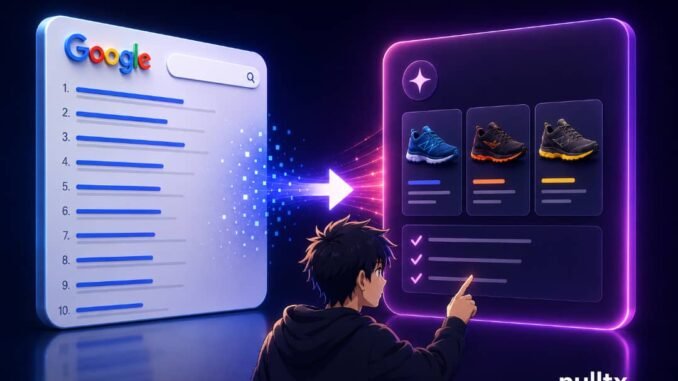

For over two decades, “Google it” wasn’t just a phrase, it was a reflex. You had a question, you typed a few words into that clean white box, and somewhere in the next ten blue links, the answer was waiting. Quietly, reliably, almost invisibly. The internet’s best filing cabinet.
That filing cabinet is gone now. Not slowly fading, gone. At Google I/O earlier this year, Google formally declared the end of the ten blue links era, replacing them with AI-generated answers, interactive visuals, and background agents that monitor the web on your behalf. The company didn’t frame it as an experiment. It framed it as the future. And given that AI Overviews already reach 2.5 billion people monthly, the future is already here.
I had already been living in it for a while before Google made it official.
Something Genuinely Different Is Happening
The best way I can describe the shift is this: Google used to be a brilliant librarian. You walked in, described what you needed, and it pointed you toward a shelf of books, ranked by popularity, curated by relevance. From there, the reading was on you.


AI search is closer to having a research assistant who has actually read the books. You ask the same question and instead of a list of sources, you get a synthesized answer, pulled from across the web, filtered for coherence, delivered in plain language, with citations attached if you want to verify anything.
The difference becomes obvious the moment you try something even mildly complex. Ask an AI engine to build you a week-long meal plan, low-carb, dairy-free, under thirty minutes per meal and what appears is the actual meal plan, structured by day, with ingredient notes. Google, handed the same request even a year ago, returned a list of food blogs to work through manually. Neither approach was wrong. They were just solving different problems. The question is which one respects your time.
The Multi-Tab Era Is Over
The old workflow had a hidden cost that we normalized without realizing it. Serious research on Google meant managing a parallel browser ecosystem, seven tabs, ten tabs, fifteen if the topic was contentious and sources conflicted. You were comparing dates across articles, triangulating advice, cross-checking one claim against three others.
AI search collapses that sprawl. It does the aggregation pass for you and delivers a coherent picture, with sources listed if you want to drill deeper. That’s not laziness, that’s a better allocation of cognitive effort toward the part that actually requires human judgment.
The Thing That Makes It Stick: Memory
Every Google search used to start from zero. Type “best trail running shoes,” browse the results, then type “are these good for wet conditions?” and Google had no idea what “these” referred to. You were starting over every single time.

AI search holds the thread. I can open with a broad question, narrow it by budget, ask for a comparison of two specific models, and then ask where to buy them, all in one continuous exchange. The conversation builds the way a real conversation does, which means the answers get progressively more useful rather than staying generic.
Where Google Still Wins
Even with the blue links gone, Google’s infrastructure runs deep in specific areas. For anything local and immediate, directions, restaurant hours, live traffic, Google Maps has no real rival yet. And for pure navigational intent, when I just want to get to the Netflix login page or check a live sports score, typing it into a search bar is still the fastest route. No conversational detour needed.
What’s shifted isn’t whether Google is useful. It’s where Google sits in the default hierarchy.

AI One Concern Worth Keeping
Hallucinations are real. AI systems can produce confident, detailed, completely wrong answers and it happens most on obscure topics where verification is hardest. The better platforms have responded by making inline citations and source links standard rather than optional.

But the onus is still on the reader to apply critical thinking. A cited answer is not automatically a correct one.
The Old World Already Left
The ten blue links served us well for twenty-five years. They built trillion-dollar companies, an entire SEO industry, and shaped how billions of people find information. But the model of typing keywords and sifting a ranked list was always a workaround, the best available solution until something better arrived.
Google itself has now confirmed: something better has arrived. The only question left is how quickly the rest of us catch up to what the numbers already show.
Disclosure: This is not trading or investment advice. Always do your research before buying any cryptocurrency or investing in any services. Follow us on X @nulltxnews






Be the first to comment