



Ethereum traded near $1,615 on July 2 as buyers tried to stabilize the market after weeks of pressure.
Summary
- Ethereum trades near $1,615 as buyers defend support while ETF flows turn positive again.
- Analysts watch $1,700 to $1,800 as the recovery zone needed for stronger confirmation next move.
- Staking rate above 33% suggests more ETH is locked despite weak short-term price action.
ETH remains close to the lower end of its recent range, but new ETF inflows and stronger staking activity have added fresh data points for traders watching a recovery attempt.

The token was up 2.49% over 24 hours, with a daily range between $1,564.82 and $1,637.22, according to crypto.news price data. Ethereum’s market cap stood near $194.87 billion, while 24-hour trading volume was about $10.81 billion.
Spot Ethereum ETFs recorded $14.895 million in net inflows on July 1, while BlackRock’s ETHA posted the largest single-day inflow at $36.639 million, according to SoSoValue. The shift came after a period in which ETF outflows weighed on ETH demand and kept traders focused on the $1,500 support region.
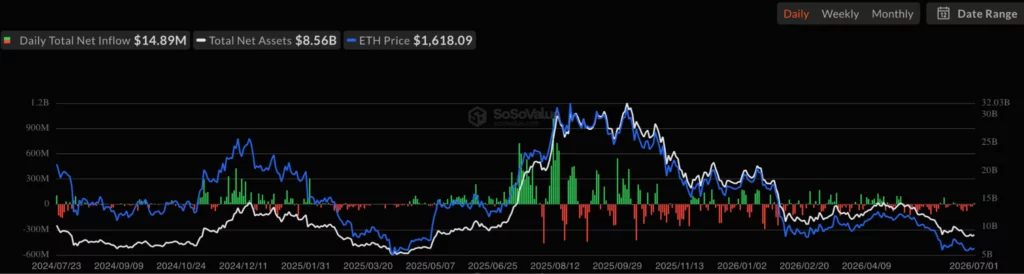
Ethereum price holds near lower range
Ethereum’s short-term setup remains cautious. The recent price trend has been mostly sideways near the lower range, with ETH holding around $1,580 to $1,650. The market still needs a move above the $1,700 to $1,800 area to show stronger recovery momentum.
Recently, Ethereum had remained pinned near the $1,500 support zone after quarter-end selling, whale distribution, and weak institutional flows. That report said analysts were watching $1,700 as a key recovery level, while a loss of $1,500 could open another move lower.
The technical picture shows early improvement, but not a full trend reversal. The MACD histogram is positive near 7.60, while the MACD line is around minus 66.92 and above the signal line near minus 74.52. That points to a bullish crossover and weaker bearish momentum, but both lines remain below zero.
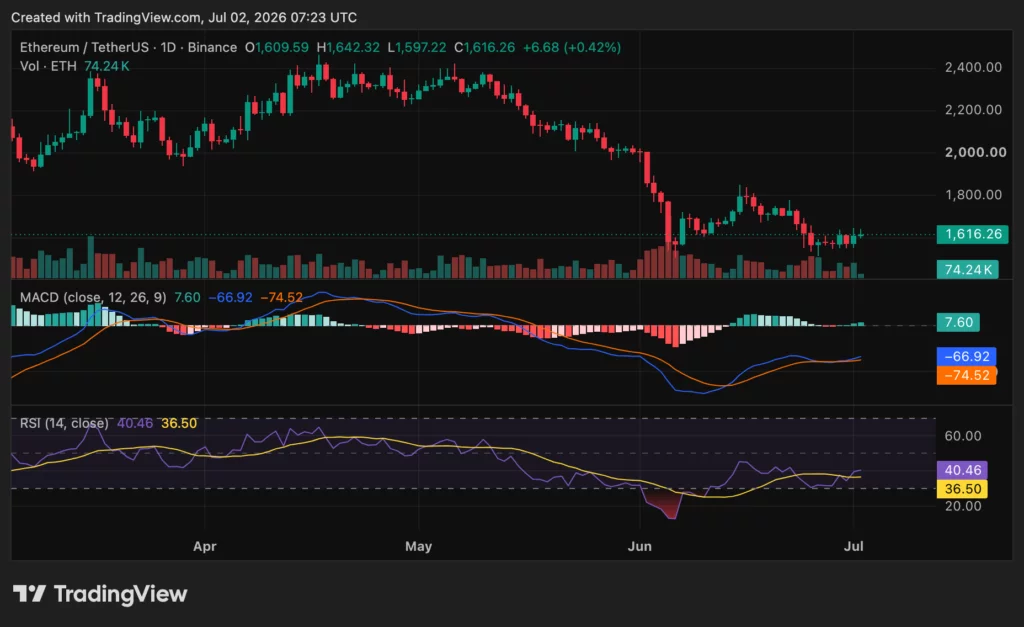
The RSI is near 40.46 and above its moving average around 36.50. This shows some recovery in momentum, but the reading remains below 50. Buyers need a stronger RSI move and a price reclaim of $1,700 to $1,800 before the setup turns more constructive.
ETF inflows return after weeks of pressure
ETF flows remain central to ETH’s short-term outlook. Earlier pressure came from repeated outflows across U.S. spot Ethereum ETFs. Crypto.news previously reported that funds saw $273 million in net outflows during the week ending June 26, with BlackRock’s ETHA accounting for $236 million of withdrawals.
The latest positive daily flow gives bulls some relief, but one day of inflows does not erase the wider weakness. ETF demand matters because these products can create spot buying pressure when flows are positive. When flows reverse, fund managers may need to redeem underlying ETH, adding supply to the market.
Ethereum has underperformed during this period because its ETF market is smaller than Bitcoin’s. Ethereum ETF outflows have been more painful in relative terms because the ETH ETF complex is much smaller than the Bitcoin ETF market.
That makes the July 1 inflow important for sentiment. A steady run of inflows would support the case for ETH to retest $1,700. If inflows fade again, traders may keep treating rallies as weak rebounds inside a broader downtrend.
Staking rate reaches record level
On-chain data adds a different signal. CryptoQuant analyst EgyHash said Ethereum’s staking rate has crossed 33% for the first time, reaching about 33.06%. The analyst described the trend as a sign that long-term holders continue locking ETH despite price weakness.
EgyHash noted that the staking rate has climbed steadily since the Merge, while ETH price has moved through several bull and bear phases. The analyst said this shows many holders prefer to keep ETH staked rather than sell during weak market periods.
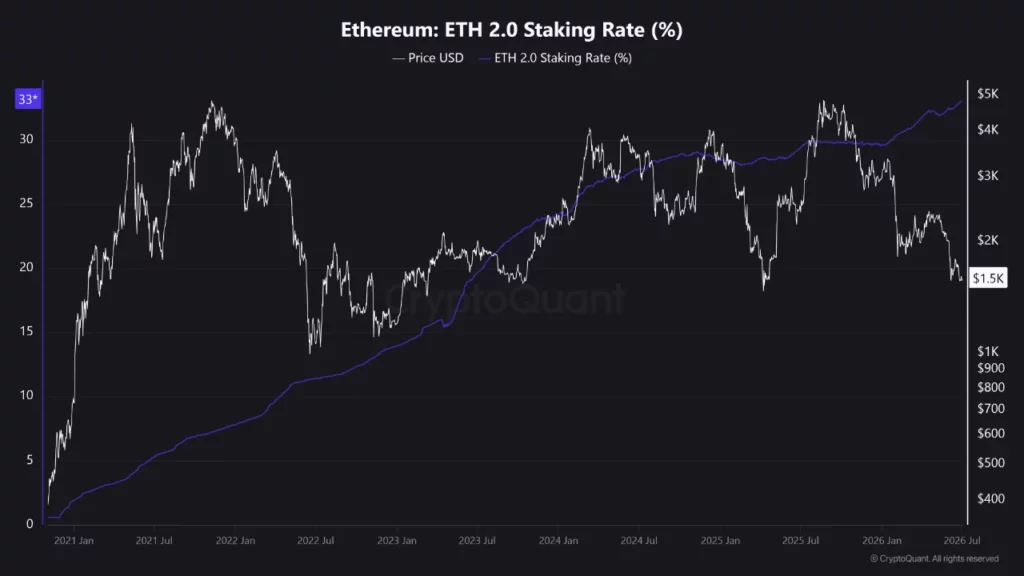
A higher staking rate can reduce liquid supply available on exchanges. That may support price if demand returns, because fewer coins are immediately available for sale. Still, the analyst warned that “staking growth alone does not guarantee an immediate price recovery.”
This makes staking a medium-term support factor rather than a short-term trigger. It can help tighten supply, but ETH still needs demand from ETFs, spot buyers, treasury firms, and onchain users to produce a stronger recovery.
Corporate buyers keep accumulating ETH
Corporate treasury demand remains active despite weak price action. As previously reported, SharpLink bought another 10,000 ETH for $16.1 million, lifting its holdings to 886,725 ETH. The purchase came as Ethereum headed toward a rare third straight quarterly loss.
BitMine has also expanded its Ethereum treasury. Moreover, BitMine added 27,084 ETH in one week, raising its holdings to more than 5.7 million ETH, or about 4.7% of circulating supply.
The institutional push is also expanding beyond treasury buys. Earlier today, crypto.news reported that Ethereum Institutional launched with backing from BitMine, SharpLink and Joe Lubin to support adoption by banks, asset managers, custodians, and other financial firms.
The corporate buying has not yet changed the short-term trend. Whale selling, ETF weakness, and broader risk-off trading have kept ETH below the $1,700 to $1,800 recovery band. Still, these purchases show some institutions continue to add ETH at lower prices.
Ali Charts said ETH is approaching a long-term support area near $1,100, a level he described as the lower boundary of a multi-year channel. He pointed to $3,000 as a mid-range target and $5,000 as a macro ceiling if the lower channel holds.
Disclosure: This article does not represent investment advice. The content and materials featured on this page are for educational purposes only.


Be the first to comment