


A wealth-focused digital asset market analyst has warned that holders are living through “one of the most frustrating things in all of investing”: a stream of bullish on-chain and institutional data alongside a price that keeps breaking support and drifting lower.
In a recent YouTube episode, Dr. Kamilah Stevenson lays out why strong ETF inflows, shrinking exchange balances and record wallet counts can coexist with a falling market — and why that pattern may resemble the late stages of a downtrend rather than a broken thesis.
ETF Inflows Up & Exchange Balances Down: Yet XRP Drifts Lower
According to Kamilah Stevenson, recent XRP-linked ETF inflows have reached “some of the strongest levels we’ve seen all year.”
Sponsored

Crypto Prediction Markets
18+ · Gambling involves risk. Play responsibly.
At the same time, the amount of XRP coins held on centralized exchanges is said to be declining, typically interpreted as investors moving coins into long‑term storage rather than preparing to sell. The number of wallets holding XRP is described as being at record highs.
Each of those data points would normally be read as bullish. Yet Dr. Kamilah Stevenson notes that XRP has broken through “key support” and “just kept sliding down,” leaving the token “a little suppressed at this point.”
She frames the current range as an “accumulation zone for those who have conviction,” warning that weaker holders could be “washed out” if there is another leg lower.
Near-Term XRP Price vs. Long‑Term Value: The ‘Two Clocks’ Issue
The core argument is that investors are confusing short‑term price mechanics with long‑term value creation. In the near term, price is driven by whichever side is “more aggressive on a given day — the buyers or the sellers,” regardless of positive headlines.
Large early holders taking profit, leveraged traders being forced out of positions, or a broad “fear day” across crypto can outweigh steady ETF demand.
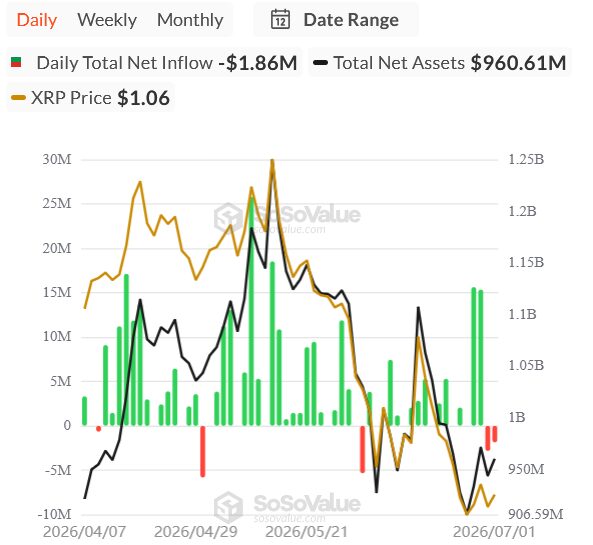
ETF inflows are just “one pipe filling the pool” while other, sometimes larger, pipes are draining it via profit‑taking and liquidations. That can leave retail investors puzzled by strong ETF numbers that fail to translate into immediate price appreciation.
Exhausted Sellers & The Quiet Phase Before Cycles Turn
Where the video departs from simple reassurance is in its description of what happens when “good news stops moving the price.” Rather than seeing that as evidence fundamentals no longer matter, the analyst characterizes it as a typical late‑downtrend pattern: most of those inclined to sell have already exited, and remaining holders “are not going anywhere.”
Historically, she argues, bottoms often form not with capitulation headlines but with a “slow, boring stop,” as selling pressure — which she calls “finite” — burns out while accumulation continues in the background. Coins leaving exchanges, rising holder counts and consistent ETF inflows, if sustained, could set up a sharper move once that selling is exhausted.
Stevenson repeatedly avoids price targets or timing calls, focusing instead on “positioning over price.”
She stresses that many investors still lack the asset base and emotional discipline to navigate a full cycle, urging viewers to use the current “suppressed stage” to increase knowledge of macro drivers, risk management and tax‑efficient structures such as Roth IRAs for crypto exposure in certain jurisdictions.
For crypto investors, the video underlines a familiar but uncomfortable point: structurally bullish flows do not prevent deep or prolonged drawdowns, especially in a leveraged market.
It also suggests that the divergence between XRP’s on‑chain/ETF data and its spot price deserves close monitoring, not as a guarantee of an imminent reversal, but as a potential sign that the market’s seller base is thinning out.
Dive into DailyCoin’s popular crypto news right now:
Donald Trump’s Crypto Business Tops $1B in Office
TradFi Perps Hit $1.3T as Traders Abandon Spot Markets
People Also Ask:
Kamilah Stevenson states that the ETF demand is only one source of buying; larger selling from early holders, traders and broader market fear can still push prices down.
Good news failing to push prices lower, declining exchange balances, record holder counts and evidence that selling pressure is slowing are highlighted as signs of a late‑stage downtrend.
DailyCoin’s Vibe Check: Which way are you leaning towards after reading this article?




Be the first to comment