



Peter Brandt, one of the most followed chartists in the industry, said he is considering selling part of his Bitcoin for gold, reigniting the year’s defining store-of-value debate.
Key Takeaways
- Brandt cites the XAU/BTC ratio breaking upward.
- Bitcoin trades 50% below its October 2025 peak.
- Gold holds near $4,174 after a 25% retrace.
- Saylor and on-chain data push the other way.
In a post on X, the 50-year trading veteran, known for traditional chart methods, extensive futures-market experience, and widely followed Bitcoin commentary, wrote he is “contemplating” selling some of his Bitcoin for gold, sharing a monthly XAU/BTC chart.
“Looks to me that Gold is going to gain substantially on Bitcoin,” Brandt added. His chart shows the gold-to-Bitcoin ratio at 0.067, curling up from the multi-year base it built after a decade of decline, with a projected path suggesting the ratio breaks out of its long falling channel.
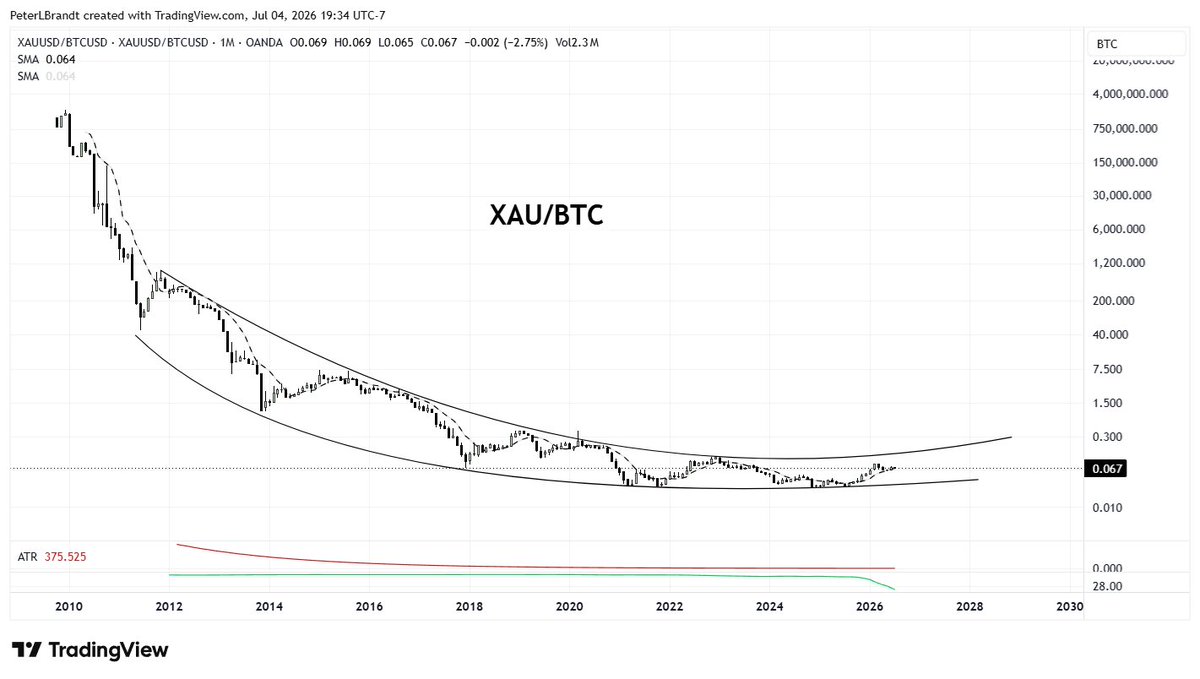
The ratio math explains the timing. Since Bitcoin’s October 2025 peak at $126,000, BTC has fallen roughly 50% to around $63,000 at the time of writing, while gold rallied to a record above $5,500 in late January before retracing about 25% to $4,174. Even after gold’s pullback, the pair has moved decisively in the metal’s favor over the cycle, exactly the kind of relative-strength shift Brandt’s channel analysis is built to catch.
Brandt has been consistently cautious on Bitcoin this year, previously mapping an investable low in the $40,000–$60,000 zone before hitting $250,000.
The Case Against the Rotation Read
Not everyone accepts the premise that capital is moving from Bitcoin to gold. Analysis by Shanaka Perera argues the rotation story is simply wrong: while headlines focused on ETF outflows, long-term holders added roughly 125,000 BTC, buying the supply that short-term fund investors panic-sold. The same report cites analyst Charlie Bilello’s finding that gold and Bitcoin have both traded below their long-term trend levels simultaneously, suggesting parallel weakness across hard assets rather than money flowing from one to the other, a reading consistent with gold’s own 25% drawdown from its January record.
Strategy’s Michael Saylor offered a third explanation entirely. Speaking on the New Era Finance podcast this week, he argued that massive capital raises by AI companies have diverted tens of billions of dollars away from crypto in the short term, while maintaining that 2026 is the year Bitcoin achieved consensus status as global digital capital. In his framing, Bitcoin’s underperformance is a liquidity diversion, not a verdict, and the competitor draining capital is AI infrastructure, not bullion.
The Longer Argument Behind the Trade
Brandt’s post lands on well-tilled ground. Ray Dalio argued in March that “there is only one gold,” telling the All-In Podcast that central banks will never hold an asset whose every transaction is publicly traceable, while Saylor has long targeted Bitcoin overtaking gold’s market cap within a decade. What makes Brandt’s version different is that it is not ideological. It is a chart trade with a ratio, a channel, and by implication an exit, which is also why it can reverse faster than the philosophical positions on either side.
Gold has clearly won the cycle since October on a relative basis, which validates Brandt’s ratio. But gold is itself 25% off its high, long-term Bitcoin holders are absorbing supply rather than distributing it, and the freshest weekly data shows crypto outperforming both gold and equities as ETF flows turned positive. A rotation confirmed at the cycle’s turning point might look exactly like this ambiguity. The XAU/BTC ratio Brandt flagged is now the single cleanest scoreboard for the debate: a sustained breakout validates the gold case, while a rejection at the channel top could mark the moment the fastest-horse trade started running the other way.
This article is for informational purposes only and does not constitute financial or investment advice. Cryptocurrency markets are highly volatile. Always conduct your own research before making investment decisions.

Kosta has reported on cryptocurrency markets and blockchain infrastructure since 2020, bringing over six years of hands-on experience in the crypto industry built through daily tracking of markets, trends, and emerging blockchain developments. Specializing in Bitcoin on-chain analysis, institutional ETF flows, and digital asset price action, his work at Coindoo has been cited by other news agencies and consistently covers market developments with a focus on data-driven reporting across Bitcoin, Ethereum, Solana, and XRP.
Over the years, Kosta has contributed to multiple crypto media outlets in different regions, authoring over 6,000 articles across the sector. His reporting spans cryptocurrency markets and the broader fintech industry, tracking not only price action but also the technological and regulatory forces shaping the ecosystem.
To support his analysis, Kosta actively leverages on-chain data and metrics from leading platforms such as Santiment, Glassnode, and CryptoQuant, enabling deeper, evidence-based market insights. He believes in the power of transparency and the data that underpins the blockchain ecosystem.
His academic background in Marketing Management from Denmark further complements his analytical approach, adding a strong understanding of communication strategy and content positioning to his work.



Be the first to comment