

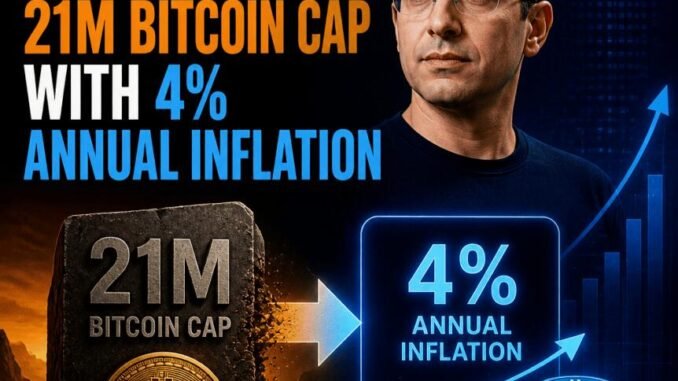

StarkWare CEO Eli Ben-Sasson has reignited a long-running Bitcoin debate by arguing that the network’s fixed 21 million coin cap “doesn’t make sense” and should be replaced with a steady 4% annual issuance model. His position challenges a foundational pillar of Bitcoin’s monetary narrative: that a hard supply limit protects the asset from monetary debasement and preserves purchasing power over time.
In a post on X Tuesday, Ben-Sasson said the cap becomes less meaningful as time passes because private keys are lost, eventually leaving holders unable to access their coins. He linked that concern to the idea that, as the timeline approaches infinity, the usable supply trends toward zero—an argument that directly contrasts with the traditional “digital gold” framing of Bitcoin’s capped issuance. Source: Eli Ben-Sasson on X
Key takeaways
- Ben-Sasson argues Bitcoin’s 21 million cap is undermined over long time horizons by lost private keys.
- He suggested replacing the fixed cap with an issuance rate of about 4% per year, while still maintaining a form of long-term scarcity.
- Ledger has previously estimated that millions of Bitcoin may already be permanently lost, feeding into the “lost keys” argument.
- Critics on X say Bitcoin’s divisibility and fixed supply mechanics still address “not enough to go around,” and that changing the cap would make Bitcoin more like other cryptocurrencies.
- A potential workaround discussed in the Zcash ecosystem—burning with periodic reissuance—highlights how miner economics could be addressed without removing a hard cap, but it would still require broad Bitcoin consensus.
Why Ben-Sasson thinks the cap will fail over time
Ben-Sasson’s core claim is not simply that Bitcoin supply will be inadequate, but that the economic effect of a cap is eroded if a growing share of coins become inaccessible. He pointed to the long-run reality that private keys can be lost, making coins effectively unrecoverable.
To anchor that idea in publicly available estimates, the proposal also echoes figures cited by Ledger. In November, Ledger estimated that up to 4 million Bitcoin have been burned or permanently lost. Ledger estimate (via Ledger Academy)

Ben-Sasson said he still supports a hard upper bound on supply. But rather than relying on a one-time fixed limit, he argued that a consistent 4% annual issuance rate better matches real-world population growth—an analogy meant to address whether Bitcoin’s supply schedule remains economically aligned as adoption expands.
Bitcoin maximalists push back: scarcity, divisibility, and “lost keys”
Ben-Sasson’s proposal met quick and pointed criticism from the Bitcoin community on X. One user challenged the premise that Bitcoin would run out “to go around,” citing Bitcoin’s divisibility into 2.1 quadrillion satoshis (the smallest base unit). Source: X user response
Ben-Sasson replied that satoshis are not a permanent solution if private keys continue to be lost. In his view, even though Bitcoin is divisible, the accessible balance still trends toward zero over time as keys go missing. Source: Ben-Sasson follow-up on X
Other opponents framed the debate around identity: lifting the fixed cap, they argued, would move Bitcoin toward the behavior of other cryptocurrencies that issue supply through inflation. Ben-Sasson countered that Bitcoin would retain scarcity as long as the inflation rate stayed fixed. Source: X user response
The clash reflects a deeper asymmetry in how people interpret Bitcoin’s supply mechanics. For many Bitcoiners, lost keys can be viewed as a feature rather than a flaw: if coins are permanently inaccessible, they effectively reduce circulating supply and reinforce supply-demand dynamics. A prominent example is Michael Saylor, who has said he plans to burn his Bitcoin private keys after his death as a “pro-rata contribution” to other holders—an act intended to make other coins scarcer by reducing the amount of reachable supply.
Looking for a middle path: Zcash’s approach to cap sustainability
As the debate intensified, Zcash founder Bryce “Zooko” Wilcox suggested Bitcoin developers look at a proposal being discussed in the Zcash ecosystem. Zcash also has a fixed supply cap set at 21 million ZEC, and Wilcox argued that Bitcoin could study how Zcash addresses miner incentives without removing its hard limit. Source: Zooko on X
The proposal Wilcox referenced is the “Network Sustainability Mechanism.” Its design aims to keep ZEC’s 21 million cap intact by allowing users to burn tokens, which are then reissued gradually as block rewards over a four-year period. The intent is to relieve pressure on miner incentives without changing the hard supply cap.
While the concept is attractive in theory—seeking to balance network security incentives with a capped supply—Bitcoin would face a different practical environment. Implementing a protocol-level mechanism would require agreement across Bitcoin’s decentralized ecosystem, including developers, miners, and node operators. That coordination challenge is a major reason Bitcoin’s core monetary rules have historically been difficult to change even when a proposal is technically feasible.
What this debate means for Bitcoin’s future trajectory
Ben-Sasson’s argument is likely to keep circulating precisely because it targets a common point of tension: the difference between theoretical supply and economically usable supply over very long time horizons. The discussion also highlights that “hard cap” supporters and critics may not be speaking about the same problem. One side focuses on monetary predictability and the protection against debasement; the other side emphasizes that lost keys reduce the practical share of supply and may eventually distort the cap’s economic assumptions.
For investors and builders, the more immediate takeaway may not be whether a cap change happens, but what kinds of proposals gain traction around the margins of Bitcoin’s monetary design. A cap-preserving mechanism inspired by other networks would still require broad consent, yet it signals a potential direction for future debate: adjusting incentives and usability while trying to preserve the properties Bitcoin is known for.
As this topic continues to trend, watch for whether any proposal gains concrete supporters beyond social commentary—especially ideas that address miner and security incentives without directly abandoning the cap narrative that underpins Bitcoin’s cultural and market identity.



Be the first to comment