


Standard Chartered head of digital assets research Geoff Kendrick predicted in a recent research note that assets in DeFi could reach $2.7 trillion by 2030.
He said that, currently, only 3% of stablecoins and 10% of tokenized real-world assets (RWAs) are used in DeFi. However, he predicts this will rise to 30% by 2030.
That would be a 37-fold increase from where they are now, but the growing tempo of tokenization gives Kendrick reason for an optimistic outlook.
The market for tokenized real-world assets — which includes stocks, bonds, real estate, gold, and carbon credits — hit $32.22 billion in distributed on-chain value by the end of June. That’s almost three times the roughly $11.8 billion RWA market from a year earlier. Add stablecoins, which are just tokenized real world fiat, into the mix, and the broader tokenized market sits north of $328.8 billion.

Total RWA asset holders have grown to 937,928, up 13% last month alone, according to data from RWA.xyz.
Here’s a closer look at exactly what is driving growth across different RWA verticals.
US Treasuries
US Treasury bills, notes, and bonds are the largest tokenized asset category by on-chain value at $15 billion. They’re familiar for investors, low-risk, liquid and generate yield — something that stablecoins can’t do yet.
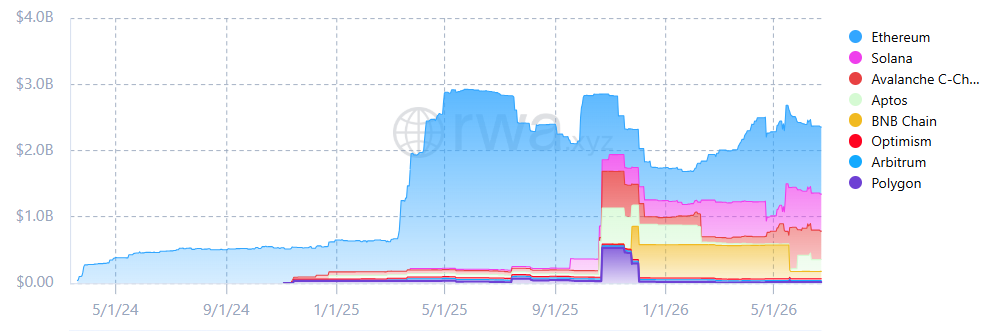
Launched in March 2024, Blackrock’s BUIDL fund reached over $2.9 billion in total asset value by June 2025. It’s currently at $2.23 billion as some funds declined due to capital reallocation and competition between platforms. It has distributed more than $100 million dividends and operates on Ethereum, Solana, Polygon, Avalanche, Arbitrum, Optimism, Aptos, and BNB Chain.
Source: RWA.xyz
In February 2026, Uniswap Labs and Securitize announced that BUIDL shares were available for trade on UniswapX. This put a major, regulated, institutional tokenized fund on a decentralized exchange (albeit with restrictions on who can buy and sell it).
“This is the unlock we’ve been working toward: bringing the trust and regulatory standards of traditional finance to the speed and openness for which DeFi is known,” said Carlos Domingo, CEO of Securitize.
Related: Philippine SEC signals readiness for RWA tokenization
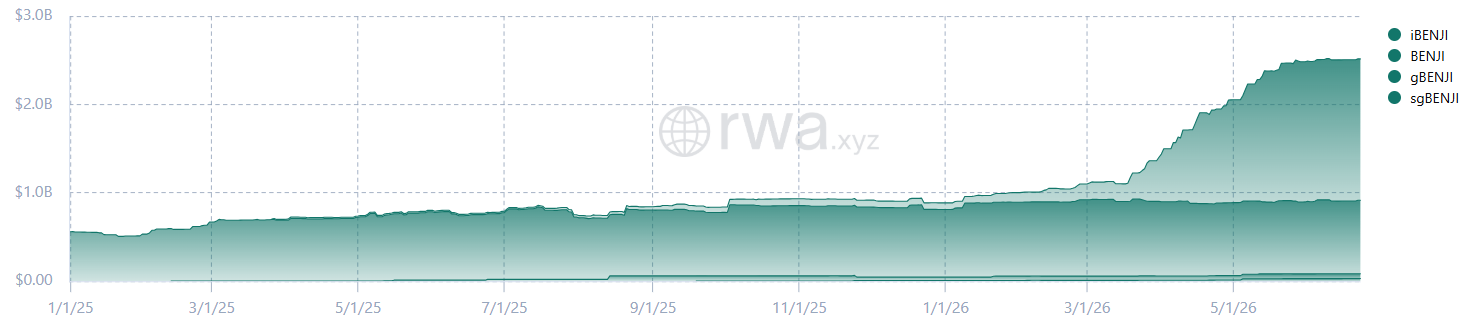
A similar product is Franklin Templeton’s OnChain US Government Money Fund, which is represented in the form of the BENJI token. It has reached $2.44 billion and runs on Avalanche, Arbitrum, Aptos, Base, and BNB Chain, Stellar, Ethereum, Solana, Polygon.
Source: RWA.xyz
Other significant Treasury products include Circle’s USYC ($3.1 billion), Ondo’s suite ($3.7 billion) and WisdomTree’s WTGXX ($764 million).
Private Credit
Private credit — loans that are issued, negotiated and held by non-bank institutions — is another fast growing category within RWAs.
The appeal is similar to that of Treasuries, but private credit provides higher yields than government debt. Furthermore, tokenization helps add liquidity to the private credit sector, which is known for years-long capital lockups.
A corporate treasurer or asset manager can now hold private credit positions that are transferable on-chain, usable as collateral, and redeemable.
The largest platforms for issuing tokenized private credit are Maple Finance and Stokr. Each has about 22% market share, according to RWA.xyz. The total value of tokenized private credit is about $6.2 billion.
Stocks and ETFs
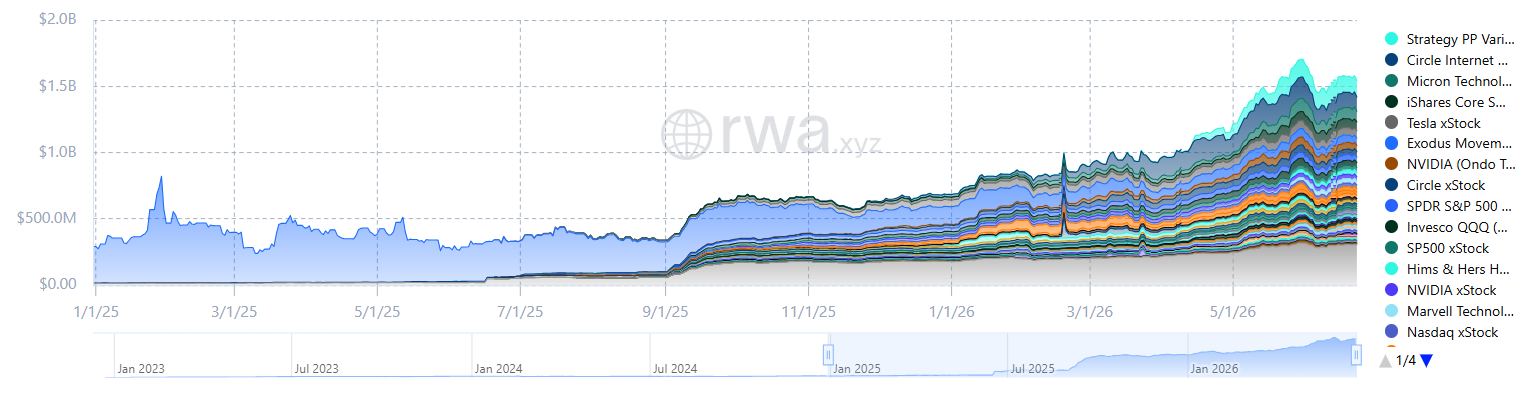
Currently, stocks represent a modest proportion of overall tokenized assets with just $2.19 billion, according to RWA.xyz. That’s up by almost 50% in just the past thirty days, so it is growing very quickly, and is set for a further major boost soon.
In May, the Depository Trust & Clearing Corporation (DTCC) announced plans to pilot tokenized securities trading. DTCC clears and settles almost all US stock trades and custodies over $114 trillion in securities.
The pilots are slated to begin this month, with a full commercial launch possible by October.
The assets in the pilot include Russell 1000 equities, major index ETFs, and US Treasuries. More than 50 financial firms are participating, including BlackRock, Goldman Sachs, JPMorgan, Citigroup, Bank of America, Morgan Stanley, Circle, Ondo Finance, and Ripple Prime.
Ondo Finance now holds roughly 60% of the tokenized equity market through its Global Markets platform. In March 2026 it entered a partnership with Franklin Templeton to tokenize five ETFs.
In April, it formed another partnership with Broadridge Financial Solutions to let holders of tokenized stocks and ETFs to submit voting preferences for underlying shares.
Source: RWA.xyz
Gold and commodities
Tokenized gold, the largest sub-category within tokenized commodities, has been around for years, but 2026 gave it an unexpected stress test.
When US–Iran tensions escalated in early 2026, traditional markets were closed. Tokenized oil and gold markets were not.
After the US and Israel attacked Iran early this year, Wall Street trading desks increasingly found themselves using on-chain perpetual futures platforms as the only available venue for pricing gold, oil, and other risk-off assets during off-hours.
Weekend volumes on on-chain commodity perpetuals have increased ninefold since the beginning of 2026. Onchain perpetual futures for commodities now make up more than 67% of builder-deployed contracts on DEXs.
The takeaway is that tokenized commodities, which trade on markets that never close, can provide a real advantage amid geopolitical turmoil, which doesn’t happen based on market hours.
Tokenized commodities hit $5.8 billion in March 2026 and have pulled back to $4.7 billion currently, with gold making up a substantial majority of that.
Tokenized gold volumes have increasingly begun to move in concert with traditional gold markets. This correlation was historically weak but crossed the 0.70 threshold in Q1 2026, suggesting the onchain market is maturing.
Real estate
Real estate tokenization has been more of a promise to date than a reality at scale.
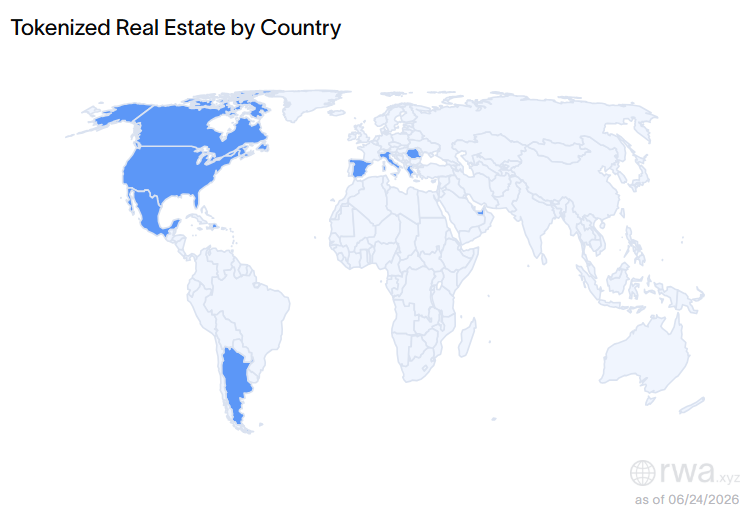
As a slice of the RWA pie, real estate represents just $202.7 million in assets at present, but that’s only going to grow with its entry into a couple of major, regulated markets this year.
Dubai’s Land Department began the second phase of its real estate tokenization project in February 2026, opening tokenized property units for resale. Hong Kong’s Securities and Futures Commission also approved real estate tokenization products from Derlin Holdings in the same quarter.
Real estate tokenization offers fractional ownership to investors who cannot afford the high cost of entry for real estate investment. The token represents a share of the building, which can offer proportional rents and the ability to trade their position without waiting for a property sale.
Source: RWA.xyz
RWAs are still relatively small
Tokenized real-world assets are growing, but still have a long way to go. Tokenized Treasury products are the largest and most mature category of RWAs, representing almost $15 billion. This is still dwarfed by the traditional US Treasury market of some $30 trillion.
Tokenized stocks are a rounding error compared to the DTCC’s $114 trillion worth of assets under custody.
Liquidity is also still pretty thin, with many RWAs seeing low secondary trading and long holding periods.
But regulators are beginning to get on board. In March, the SEC approved a Nasdaq proposal to allow certain stocks to be traded and settled via tokens. Analysts and observers are expecting a more broad approval of stock token trading in the near future, with SEC Chair Paul Atkins likely to give RWAs the go-ahead through an “innovation exemption.”
The now appears to no longer be whether real-world assets will be tokenized, but how quickly.



Be the first to comment