



WRITTEN BY
Crypto investor and blockchain researcher


Monad price prediction attracts attention because traders search for projects with high upside and strong infrastructure. MON recently entered the spotlight after extreme price volatility. The token trades near $0.023 today. The monthly low sits around $0.018 on June 30. The monthly high reached $0.026 on July 7. This range shows aggressive market behavior and speculative interest.
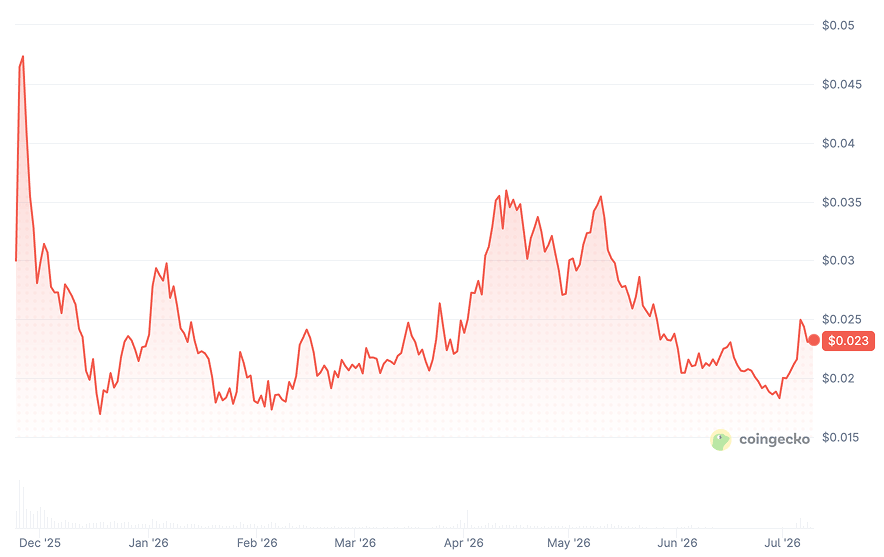
CoinGecko, July 9, 2026
Such price swings often appear in early-stage blockchain ecosystems. They reflect both hype and uncertainty. Investors now ask whether Monad can stabilize and grow. Others question if the rally already peaked. These debates shape current sentiment around MON.
This article examines Monad from multiple angles. We review the project’s structure and purpose. We analyze historical price action. We explore long-term forecasts through 2050. We also study expert opinions and technical signals. In addition, we explain what factors move the MON price.
The goal is not prediction certainty. Crypto markets remain unpredictable. However, structured analysis improves decision-making. Understanding context matters more than chasing hype. MON may represent opportunity, risk, or both depending on timing.
| Current MON Price | MON Price Prediction 2026 | MON Price Prediction 2030 |
| $0.023 | $0.03 | $0.06 |

Monad (MON) Overview
Monad is a high-performance Layer 1 blockchain launched on November 24, 2025. The network targets Ethereum’s biggest limits, which include slow throughput and expensive gas fees. Monad remains 100% EVM compatible, so developers can migrate Ethereum applications without rewriting code. This compatibility removes friction and accelerates ecosystem growth.
Performance defines Monad’s identity. The chain targets 10,000 transactions per second. Block finality reaches about 0.8 seconds. Average gas fees stay near $0.001 per transaction. By comparison, Ethereum transactions often cost between $0.50 and several dollars. This efficiency opens doors for payments, gaming, and high-frequency decentralized finance.
MON Price Statistics
| Current Price | $0.023 |
| Market Cap | $275,456,601 |
| Volume (24h) | $46,831,116 |
| Market Rank | #106 |
| Circulating Supply | 11,825,165,000 MON |
| Total Supply | 100,682,925,000 MON |
| 1 Month High / Low | $0.026 / $0.018 |
| All-Time High | $0.04876 Nov 26, 2025 |
Monad Labs formed in April 2022. Three former Jump Trading engineers founded the company. Keone Hon serves as CEO and previously led high-frequency trading systems at Jump. James Hansaker acts as CTO and built ultra-low-latency trading infrastructure. Eunice Giarta brings experience from BofA Merrill Lynch and Broadway Technology. The broader team includes over twenty engineers from Jump Crypto and other elite research firms. The group spent more than two years refining the protocol before launch.
The project follows a mission built on three pillars. First, it delivers a smooth developer experience through Ethereum compatibility. Second, it expands into global markets, especially regions with limited banking access. Third, it pursues cutting-edge performance without sacrificing decentralization. The long-term vision centers on powering a global, online-first economy through accessible financial infrastructure.
Monad achieves its speed through several architectural innovations. Parallel execution analyzes transaction dependencies and processes many at once. Superscalar pipelining divides work into stages and runs them simultaneously. Asynchronous input and output prevents data bottlenecks. MonadBFT consensus optimizes HotStuff to deliver fast finality with over 200 validators. MonadDB stores most state data on SSD rather than RAM, which lowers hardware costs and supports decentralization. RaptorCast and a local mempool improve block propagation and bandwidth efficiency.
The project raised roughly $432 million in funding. Investors include Paradigm, Dragonfly Capital, Electric Capital, Greenoaks, Coinbase Ventures, and Galaxy. This capital supports ecosystem growth and long-term research.
Monad Price Prediction: 2026, 2027, 2030-2050
| Year | Minimum Price | Maximum Price | Average Price | Price Change |
| 2026 | $0.016 | $0.0448 | $0.03 | +30% |
| 2027 | $0.0184 | $0.0546 | $0.035 | +50% |
| 2030 | $0.03 | $0.09 | $0.06 | +160% |
| 2040 | $0.072 | $0.1234 | $0.1 | +335% |
| 2050 | $0.1 | $0.3366 | $0.2 | +770% |
Monad Price Prediction 2026
DigitalCoinPrice analysts estimate that in 2026, Monad may trade between $0.0239 (+5%) at the lower end and $0.0448 (+95%) at peak valuation. Their outlook assumes gradual ecosystem traction and recovery from earlier volatility.
According to Coincodex, MON is expected to stay in a tighter range. Their models forecast a minimum price of $0.01603 (-30%), with a potential high of $0.02336 (+1%).
LBank presents a more conservative scenario. Their 2026 estimate places Monad around $0.02 (-15%), reflecting a slow accumulation phase rather than a breakout year.
Monad Price Prediction 2027
DigitalCoinPrice expects Monad to extend its climb in 2027, projecting a range between $0.0356 (+55%) and $0.0546 (+135%), supported by rising market confidence.
Coincodex aligns with the bullish direction. Their forecast suggests a floor of $0.01835 (-20%) and a ceiling of $0.06414 (+180%), pointing to accelerating adoption.
LBank remains cautious. Their 2027 model targets roughly $0.03 (+30%), implying gradual structural growth.
Monad Price Prediction 2030
By 2030, DigitalCoinPrice analysts believe MON could trade between $0.0463 (+100%) and $0.0566 (+145%), driven by expanding network activity.
Coincodex sees much stronger momentum. Their projections indicate a minimum of $0.03 (+30%) and a maximum of $0.09(+290%), assuming Monad evolves into a major infrastructure asset.
LBank’s long-term estimate suggests a modest level near $0.03 (+30%), reflecting a conservative adoption curve.
Monad Price Prediction 2040
Coincodex’s ultra-bullish 2040 scenario places Monad is between $0.089 (+285%) and $0.1234 (+435%), reflecting expectations of massive long-term ecosystem expansion.
DigitalCoinPrice offers a much more conservative view. Their 2040 forecast is between $0.0721 (+215%) and $0.0767 (+235%), suggesting gradual growth rather than explosive dominance.
Monad Price Prediction 2050
Looking further ahead, Coincodex estimates that MON could trade between $0.2364 (+930%) and $0.3366 (+1,365%) by 2050 if adoption compounds over decades.
DigitalCoinPrice’s long-term model suggests a smaller but still notable range between $0.1 (+335%) and $0.11 (+380%), reflecting a cautious outlook shaped by market cycles.
MON Price Prediction: What Do Experts Say?
Expert opinion around Monad remains sharply divided after the mainnet launch. Institutional participation created strong visibility, yet analysts disagree on whether that momentum can convert into sustainable price growth. Most projections for 2026 cluster between cautious optimism and structural skepticism. Targets range widely from modest recovery scenarios to aggressive breakout expectations.
Blockchainreporter outlines a constructive base case that places MON between $0.12 and $0.18 in 2026. Their thesis assumes steady developer migration, expanding DeFi activity, and rising transaction volume. In their framework, a 5–6× increase from the $0.025 public sale price represents a realistic outcome for a Layer 1 network that achieves traction during its first operational year. They emphasize adoption rather than speculation as the primary driver.
Bitget’s research desk supports a similar direction. Their team highlights Monad’s technical efficiency and EVM compatibility as long-term advantages. They place medium-term targets around $0.13–$0.15, contingent on institutional participation and ecosystem maturity. Many analysts now treat the $0.1 level as a psychological checkpoint. A sustained break above that threshold would signal a transition from experimental asset to functional infrastructure.
Crypto researcher Alex Becker presents conditional optimism. He argues that Monad’s scalability could enable 2× gains in 2026, but he rejects the idea of automatic dominance. His position reflects a broader expert consensus: technological superiority alone does not guarantee price appreciation. Real adoption, active users, and fee generation determine long-term value. Without those factors, scalability remains theoretical.
The strongest criticism comes from Arthur Hayes, co-founder of BitMEX. He warns that Monad’s tokenomics create structural sell pressure. Hayes describes MON as a high fully diluted valuation asset with limited circulating float. He highlights that over 30% of supply unlocks during 2026, which could flood the market. In his view, artificial scarcity inflated early pricing. He later exited his position and publicly predicted severe downside risk. His stance rejects the narrative of Monad as an Ethereum successor.
Analyst Manya echoes skepticism from a capital efficiency perspective. She questions whether massive venture funding guarantees token success. Her argument centers on execution risk. Large budgets do not automatically create organic demand.
MON USDT Price Technical Analysis
Monad is trading around $0.023 and continues to demonstrate a steady bullish trend. Over the past 30 days, the token has gained approximately 11%. The price is currently slightly above former resistance zones.
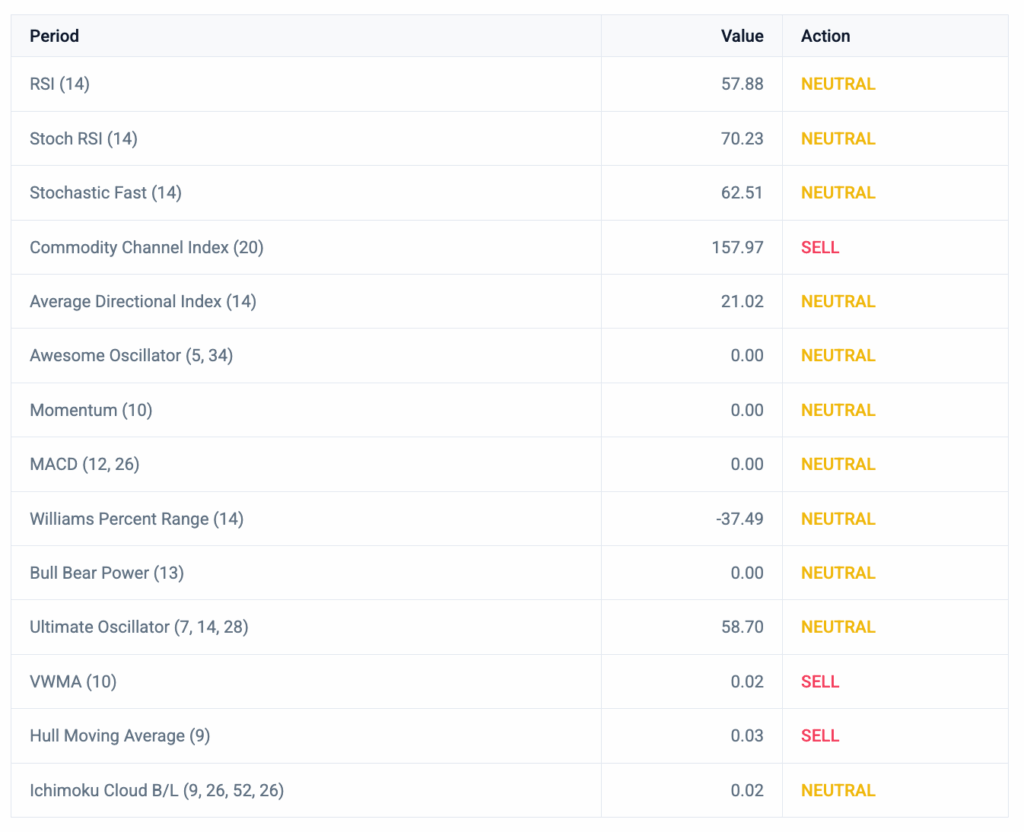
CoinCodex, July 9, 2026
Indicator data confirms the bullish trend. Around 80% of technical signals are neutral.
Volatility remains elevated above 7%, which reflects unstable post-launch conditions. The relative strength index reads near 58. This value sits in neutral territory. The Fear and Greed Index registers extreme fear (22), which historically aligns with fragile sentiment and low conviction buying.
The overall picture for the month indicates gradual stabilization and growth. The price is moving toward historical highs. A sustained hold above $0.025 could form a base. A failure would open up new opportunities for decline. The future structure depends largely on the dynamics of the token supply and the actual activity of the ecosystem.
What Does the MON Price Depend On?
The price of MON does not move randomly. Several structural forces shape its direction. Some factors relate to market psychology. Others come from network mechanics and token supply. Understanding these drivers helps explain why price swings can appear extreme in early-stage blockchains.
The first major factor is token supply dynamics. Monad launched with a large fixed supply and a staged unlock schedule. When new tokens enter circulation, selling pressure increases. Early investors and airdrop recipients often realize profits quickly. That behavior can suppress price even when fundamentals improve. Markets react not only to technology, but to liquidity.
Adoption represents the second pillar. A blockchain gains value when people use it. Transactions, decentralized applications, and active wallets create organic demand. If developers build tools that attract real users, MON benefits from network effects. If activity stagnates, speculative interest fades. Price follows usage over time.
Investor confidence also plays a decisive role. Crypto markets run on narrative as much as metrics. Positive headlines can trigger aggressive rallies. Negative commentary can accelerate selloffs. Large holders influence short-term direction because their orders shift liquidity quickly. Early ecosystems often show exaggerated reactions to news.
Macroeconomic conditions amplify all of these elements. When the broader crypto market enters a bullish phase, capital rotates into emerging Layer 1 projects. In bearish cycles, investors prefer stability and reduce exposure to risk. MON trades inside this wider environment rather than in isolation.
Key drivers include:
- Token unlock schedules and circulating supply expansion.
- Developer adoption and application growth.
- Exchange liquidity and trading volume.
- Institutional participation and venture backing.
- Overall crypto market sentiment.
Technology remains important, but markets price expectations. Fast infrastructure alone does not guarantee appreciation. Sustainable value emerges when performance converts into real economic activity. The MON price ultimately reflects the balance between supply pressure and adoption growth. When demand outpaces emissions, price stabilizes. When supply dominates, volatility returns.
MON Coin Features
Monad positions itself as a performance-first Layer 1 while preserving Ethereum compatibility. Its design focuses on speed, scalability, and decentralization without fragmenting the developer experience. Instead of building a rollup or sidechain, the team redesigned the stack from the ground up. The result combines high throughput with familiar tooling.
At the consensus level, Monad introduces architectural changes that allow fast block production without sacrificing security. The protocol optimizes message flow and validator coordination to reduce bottlenecks.
Key consensus and performance features include:
- MonadBFT consensus, a pipelined Byzantine Fault Tolerant system with linear communication scaling.
- 10,000+ transactions per second throughput.
- 400ms block time for rapid settlement.
- 800ms full finality with speculative confirmation at 400ms.
- Sub-second confirmation suitable for trading and real-time applications.
Execution architecture represents another core innovation. Traditional chains process transactions sequentially. Monad breaks that limitation by running operations in parallel while preserving deterministic results. This model increases efficiency without compromising correctness.
Execution features include:
- Optimistic parallel execution of transactions.
- Asynchronous execution is decoupled from consensus.
- Deferred execution engine that separates ordering from processing.
- Superscalar pipelining across consensus, execution, and storage.
- Just-In-Time compilation for faster smart contract execution.
State management also plays a major role in scalability. Many blockchains demand expensive hardware to operate nodes. Monad reduces this burden through optimized storage design. Lower hardware barriers encourage validator participation and strengthen decentralization.
State and networking capabilities include:
- MonadDB, a custom database optimized for disk and memory efficiency.
- Merkle Patricia Trie architecture for secure state tracking.
- StateSync, which lets new nodes download snapshots instead of replaying full history.
- RaptorCast protocol for fast block propagation.
- linear communication scaling supporting large validator sets.
Developer compatibility remains a defining advantage. Monad maintains full Ethereum Virtual Machine support. Existing smart contracts migrate without modification. This eliminates friction for teams already building on Ethereum.
Developer-focused features include:
- 1:1 EVM bytecode compatibility.
- Support for MetaMask, Foundry, Hardhat, and standard Ethereum tools.
- Cancun fork opcode support including TSTORE and MCOPY.
- Identical opcode-to-gas mapping as Ethereum.
- Geth-compatible RPC interface.
Hardware accessibility reinforces decentralization. Consumer-grade machines can run full nodes effectively. The entire codebase remains open source and built in C++ and Rust, allowing public auditing and community contributions.
Together, these features position Monad as a high-speed infrastructure layer designed for real-world applications rather than experimental scaling. The architecture aims to deliver performance without fragmenting the Ethereum ecosystem.
MON Coin Price Prediction: Questions and Answers
Will Monad Be a Good Investment?
Monad carries both opportunity and risk. The project offers advanced infrastructure and strong funding, which supports long-term development. However, the token still trades in a highly speculative environment. Price depends on adoption, unlock schedules, and overall market cycles. Investors should treat MON as a high-volatility asset. Potential upside exists, but downside risk remains significant in early ecosystem stages.
How Much Is 1 Monad (MON)?
At the time of writing, 1 MON trades around $0.023. The price fluctuates within a narrow consolidation range after the post-launch correction. Short-term movements remain sensitive to liquidity and sentiment. Traders should expect rapid swings even during sideways periods. Real-time exchange data always provides the most accurate valuation.
What Is the Total Supply of Monad?
Monad has a fixed total supply of 100 billion MON. No additional tokens can be minted beyond that amount. Circulating supply expands gradually through unlock schedules. This structure means emission timing matters more than inflation. Supply pressure enters the market in phases rather than continuously.
How High Will Monad Crypto Go?
No model can predict an exact ceiling. Bullish projections assume strong developer adoption and network usage. Conservative scenarios expect slower ecosystem growth. Long-term targets vary widely among analysts. Some forecasts remain modest, while others assume exponential expansion. Price ultimately follows real demand, not theoretical capability.
Will Monad Reach $0.1?
A move to $0.1 requires roughly a 5× increase from current levels. Analysts view this as possible if adoption accelerates and liquidity improves. That level also represents a psychological milestone. Breaking it would signal structural recovery. However, it depends on sustained buying pressure and ecosystem traction.
Will Monad Reach $1?
A $1 valuation implies a massive market cap expansion. This scenario demands global adoption and sustained capital inflow. It cannot occur through speculation alone. Infrastructure success and real application usage would need to justify the valuation. Most analysts treat $1 as a long-term possibility rather than a near-term expectation.
Will Monad Reach $10?
A $10 target represents extreme optimism. It would require exponential ecosystem dominance and multi-cycle growth. Only a handful of Layer 1 assets achieved comparable scaling. Analysts consider this outcome highly speculative. It remains a theoretical ceiling rather than a practical forecast.
What Is the Price Prediction for Monad in 2026?
Forecasts for 2026 range from conservative stabilization to moderate recovery. Some analysts expect prices near $0.02–$0.03. Others project stronger rebounds above $0.04 under bullish conditions. Most scenarios assume gradual rebuilding after early volatility. Adoption metrics will determine which path unfolds.
What Is the Monad Price Prediction for 2030?
Long-term projections diverge sharply. Conservative models expect incremental growth. Aggressive forecasts assume Monad becomes major infrastructure. These scenarios produce wide price ranges. Analysts agree that 2030 valuation depends almost entirely on developer ecosystem strength and user activity.
Why Is Monad Crashing?
Price declines follow supply pressure and early profit taking. Airdrop distribution and unlock schedules increase circulating tokens. Markets often overreact during launch phases. Weak sentiment amplifies selling. The crash reflects liquidity dynamics rather than technical failure. Network fundamentals can improve while price still falls.
Is Monad on Ethereum?
Monad is not built on Ethereum, but it is fully compatible with Ethereum. It operates as an independent Layer 1 blockchain with its own consensus and infrastructure. However, developers can deploy Ethereum smart contracts without modification. This compatibility allows Monad to inherit Ethereum’s tooling and ecosystem while maintaining its own performance architecture.
Is Monad Better than Solana?
Monad and Solana pursue similar performance goals but use different designs. Monad emphasizes EVM compatibility and lower hardware requirements. Solana prioritizes raw throughput with a distinct execution model. “Better” depends on developer needs and adoption. Performance alone does not determine success. Ecosystem growth, stability, and real usage decide long-term leadership.
Where to Buy Monad Coin?
StealthEX is here to help you buy Monad if you’re looking for a way to invest in this cryptocurrency. You can buy MON safely and without the need to sign up for the service. StealthEX crypto collection has more than 2,000 different coins and you can do wallet-to-wallet transfers instantly and problem-free.
How to Buy Monad? Quick-Step Guide
Just go to StealthEX and follow these easy steps:
- Choose the pair and the amount you want to exchange — for instance, ETH to MON.
- Press the “Start exchange” button.
- Provide the recipient address to transfer your crypto to.
- Process the transaction.
- Receive your crypto coins.
Follow us on Medium, X, Telegram, YouTube, and Publish0x to stay updated about the latest news on StealthEX and the rest of the crypto world.
Don’t forget to do your own research before buying any crypto. The views and opinions expressed in this article are solely those of the author.
crypto price prediction MON Monad price analysis price prediction



Be the first to comment