


Bitcoin climbed 1.5% to $63,800 on 10th of July in a market stuck in a strange place: down roughly 50% from its high, its aggressive buyers quiet for five weeks, and the usual capitulation sellers still missing.
Key Takeaways
- BTC gained 1.5% in 24 hours to $63,800, holding its June range.
- The 90-day Spot Taker CVD turned neutral in early June after a buy-dominant May.
- The current ~50% drawdown compares with 78% in 2022 and 84% in 2018.
- Memory-chip ETFs took in ~$12B since April as spot BTC ETFs lost $4B.
What the Spot Tape Actually Shows
Spot Taker CVD measures the balance between aggressive buyers and aggressive sellers, the traders willing to pay the market price to get filled immediately rather than waiting with a passive order. When the indicator runs green, real spot demand is pushing price. When it runs red, sellers are hitting bids. CryptoQuant’s 90-day view shows Bitcoin’s tape was solidly green from late April through May, the stretch when price pushed above $80,000. Since early June, it has been neutral, and it has stayed neutral into July.
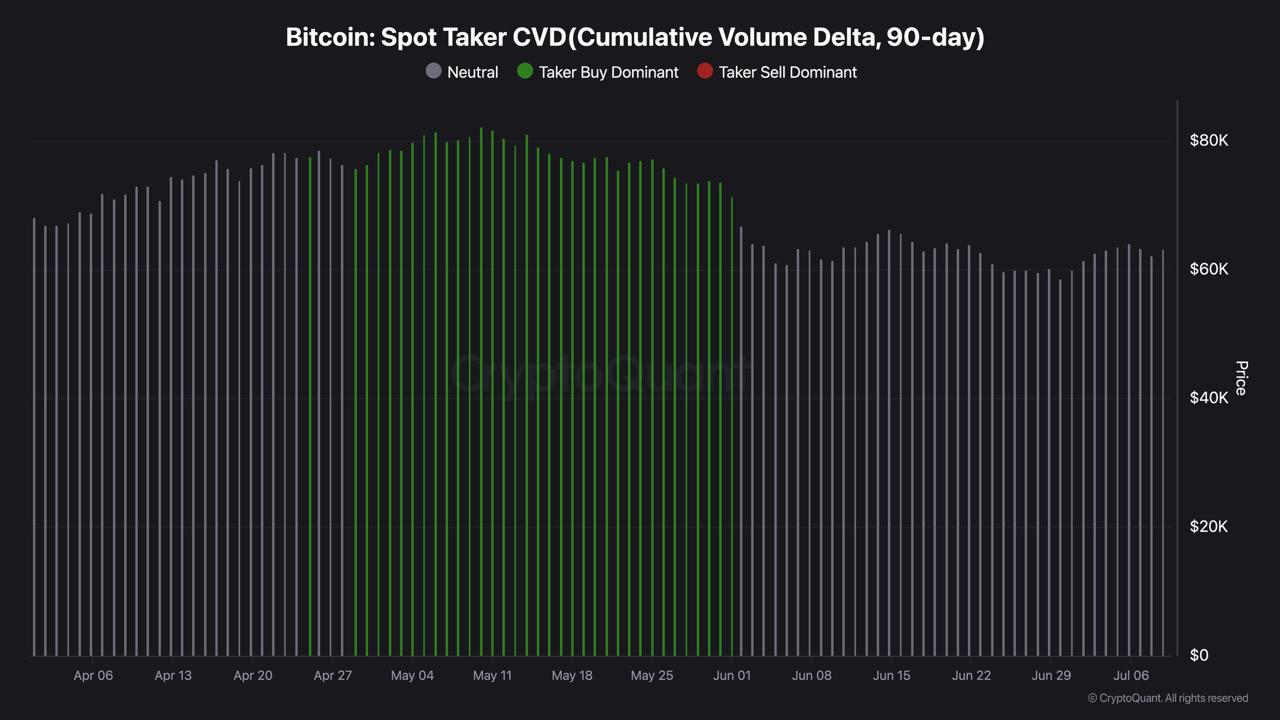
The detail that matters is what the chart does not show: a single sell-dominant day. The rally’s fuel ran out, but no aggressive distribution replaced it. Price fell from the May highs to the high-$50,000s on fading demand rather than active selling, and it has spent five weeks ranging while the spot market declines to vote. That is hesitation, not breakdown, and it makes today’s 1.5% bounce easy to classify: a move inside a neutral tape, not yet a change in one.
Why Bitwise Says This Bear Is Different
The neutral tape has a structural explanation, and it is the core of Bitwise’s argument. Senior investment strategist Juan Leon says the firm’s clients now split into two groups: existing Bitcoin allocators using the decline to rebalance and dollar-cost average, and larger capital pools waiting for clearer US rules before entering. Where 2022’s clients asked whether crypto would survive, he says, 2026’s ask about entry points and position sizing. Neither group panic-sells, and neither group chases. The result is exactly what the CVD shows: a market that grinds sideways instead of capitulating.
The numbers support the framing. The current drawdown is around 50%, against 78% in 2022 and 84% in 2018, making this Bitcoin’s mildest structural bear market on Bitwise’s reading. Leon’s explanation is that ownership has migrated from retail speculation toward professional allocation, and in his words, “the floor is rising every cycle, and that’s not an accident.”
The missing demand has a specific destination. Since April, memory-chip ETFs riding the AI trade have absorbed roughly $12 billion while spot Bitcoin ETFs bled more than $4 billion, a rotation Bitwise attributes to sticky inflation, higher-rate expectations, and geopolitical uncertainty rather than anything Bitcoin-specific. The firm expects that flow to reverse on the logic that allocators eventually hunt for the asset trading 50% off its high with improving fundamentals, and it points to the CLARITY Act as the unlock: not a headline trade, but a change in the permission structure for institutional capital that currently cannot touch the asset class. Leon does not expect passage before the August recess.
Bitwise is not alone in reading the cycle as intact rather than broken. Binance founder Changpeng Zhao made a similar case, calling the downturn a normal four-year cycle with a floor that rises each time, and pointing out that this cycle’s low near $60,000 sits far above the $16,000 bottom of the FTX era. Notably, Zhao’s biggest worry is not crypto regulation but AI regulation, a sign that even crypto’s most prominent builders now treat the two sectors as competing for the same capital and policy attention.
What May Confirm a Turn, and What Could Break It
The counter-argument keeps the celebration on hold. Past Bitcoin bear markets ran roughly 12 to 13 months; this one is about eight months old, which by historical rhythm leaves room for another leg down. The bottoming signals Bitwise flags, oversold momentum, roughly half of holders underwater, renewed long-term-holder accumulation, and record spot ETF outflows in June, are consistent with a base forming, but the firm itself reads the ETF outflows as possible capitulation rather than confirmed capitulation. Neutrality in the spot tape is symmetric: the same gray bars that show no aggressive selling also show no returning demand, and a break of the June lows might resolve the standoff downward just as cleanly.
The confirmation checklist is short. A return to sustained taker-buy dominance on the CVD could show real spot demand backing the bounce, the signal durable moves are built on, rather than leverage or short-covering. Green flow plus a reclaim of the range highs turns the mildest-bear thesis into a tradable one. Red flow for the first time for months may say the professional floor is thinner than the thesis assumes.
The technical reality suggests patience over prediction. Bitcoin at $63,800 is a market where the old sellers are exhausted and the new buyers have a specific list of conditions, rate relief, regulatory passage, the AI rotation cooling, none of which resolved this week. What the data has already settled is narrower: months into a 50% drawdown, the holder base is not behaving like 2022’s. Whether that is a floor or just a pause is precisely what the gray bars on the chart have not yet answered.
The information provided in this article is for educational and informational purposes only and does not constitute financial, investment, or trading advice. Cryptocurrency markets are volatile and involve substantial risk. Readers should conduct their own research and consult with a qualified financial advisor before making any investment decisions.

Kosta has reported on cryptocurrency markets and blockchain infrastructure since 2020, bringing over six years of hands-on experience in the crypto industry built through daily tracking of markets, trends, and emerging blockchain developments. Specializing in Bitcoin on-chain analysis, institutional ETF flows, and digital asset price action, his work at Coindoo has been cited by other news agencies and consistently covers market developments with a focus on data-driven reporting across Bitcoin, Ethereum, Solana, and XRP.
Over the years, Kosta has contributed to multiple crypto media outlets in different regions, authoring over 6,000 articles across the sector. His reporting spans cryptocurrency markets and the broader fintech industry, tracking not only price action but also the technological and regulatory forces shaping the ecosystem.
To support his analysis, Kosta actively leverages on-chain data and metrics from leading platforms such as Santiment, Glassnode, and CryptoQuant, enabling deeper, evidence-based market insights. He believes in the power of transparency and the data that underpins the blockchain ecosystem.
His academic background in Marketing Management from Denmark further complements his analytical approach, adding a strong understanding of communication strategy and content positioning to his work.



Be the first to comment