



XRP is trading near $1.10 after losing roughly 70% from its July 2025 level, while bearish positioning on Binance has continued to build. The 30-day aggregated funding rate has reached its most negative point of 2026, leaving crowded short positions potentially vulnerable if price begins to recover.
The spot market has not confirmed that turn. XRP is leaving some exchanges while deposits are increasing on Upbit, suggesting that immediately available supply may be tightening unevenly rather than across the market. The conditions for a sharper recovery are developing, but sustained buying pressure has not appeared yet.
Key Takeaways
- Binance funding shows XRP shorts at their most crowded level of 2026 after a roughly 70% price decline.
- Binance withdrawals lead deposits by transaction count, although the metric does not reveal how much XRP was moved.
- Coinbase and Crypto.com are losing exchange-side supply while Upbit is receiving more deposits.
- A similar funding extreme near $1.25 in April 2025 preceded a 126% XRP rally, although one precedent cannot establish a repeatable outcome.
A 70% Drawdown Has Not Cleared the Short Trade
CryptoQuant analyst Darkfost reported that XRP funding rates on Binance, aggregated over 30 days to reduce daily noise, have maintained a bearish bias since the beginning of the year and are now “reaching an extreme threshold of negativity.”
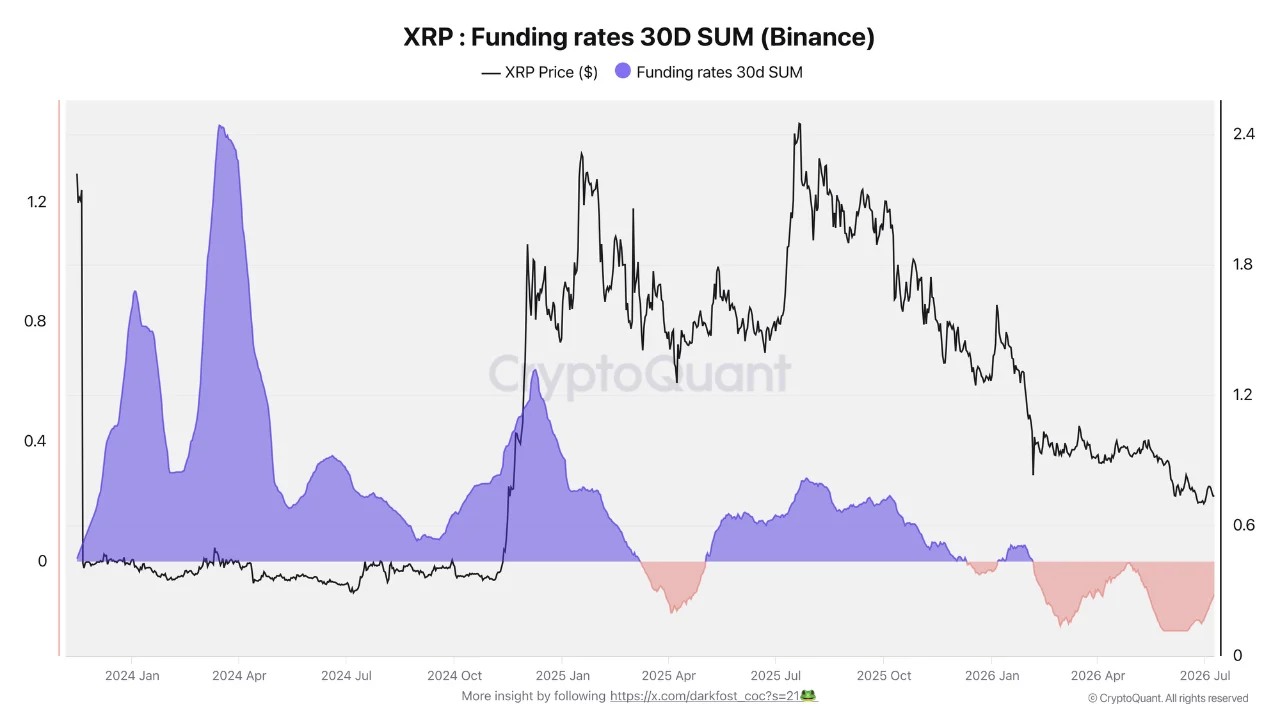
Funding rates are periodic payments exchanged between traders in perpetual futures markets to keep futures prices close to the underlying spot price. When funding is negative, traders holding short positions pay those holding long positions, usually indicating that bearish positioning has become dominant.
The current reading therefore suggests that a growing share of derivatives traders is still betting on further downside even after XRP fell from approximately $2.45 in July 2025 to around $1.10. That concentration could leave more short positions exposed if price begins moving in the opposite direction.
Darkfost cited April 2025 as the nearest comparison. XRP reached a similar funding extreme near $1.25 before advancing 126%. He described the condition as a possible sign of a medium-term reversal after a deep correction, not as confirmation that a bottom had formed.
One previous reversal cannot establish a repeatable pattern. Funding may remain negative while price continues lower, and crowded shorts would only become a source of buying if traders begin closing them.
That forced buying is what traders refer to as a short squeeze: a rapid move higher that pushes short sellers to repurchase the asset to limit losses, potentially adding further upward pressure.
How strongly such a squeeze could affect XRP may depend partly on how much supply remains available on exchanges.
Binance Withdrawals Lead by Count, Not by Volume
CryptoQuant analyst Amr Taha found that withdrawals accounted for 53.3% of Binance’s seven-day XRP transaction mix on July 10, compared with 46.6% for deposits. The 6.7-percentage-point gap placed the reading close to the highest withdrawal shares recorded in recent months:
- June 22: 53.7% of transactions were withdrawals.
- April 10: 53.4% were withdrawals.
- July 10: 53.3% were withdrawals.
A withdrawal-heavy transaction mix may indicate that users are moving XRP into self-custody or longer-term storage instead of keeping it available for immediate trading. If the transferred amounts are large, less XRP could remain on Binance to absorb fresh buying or short covering.
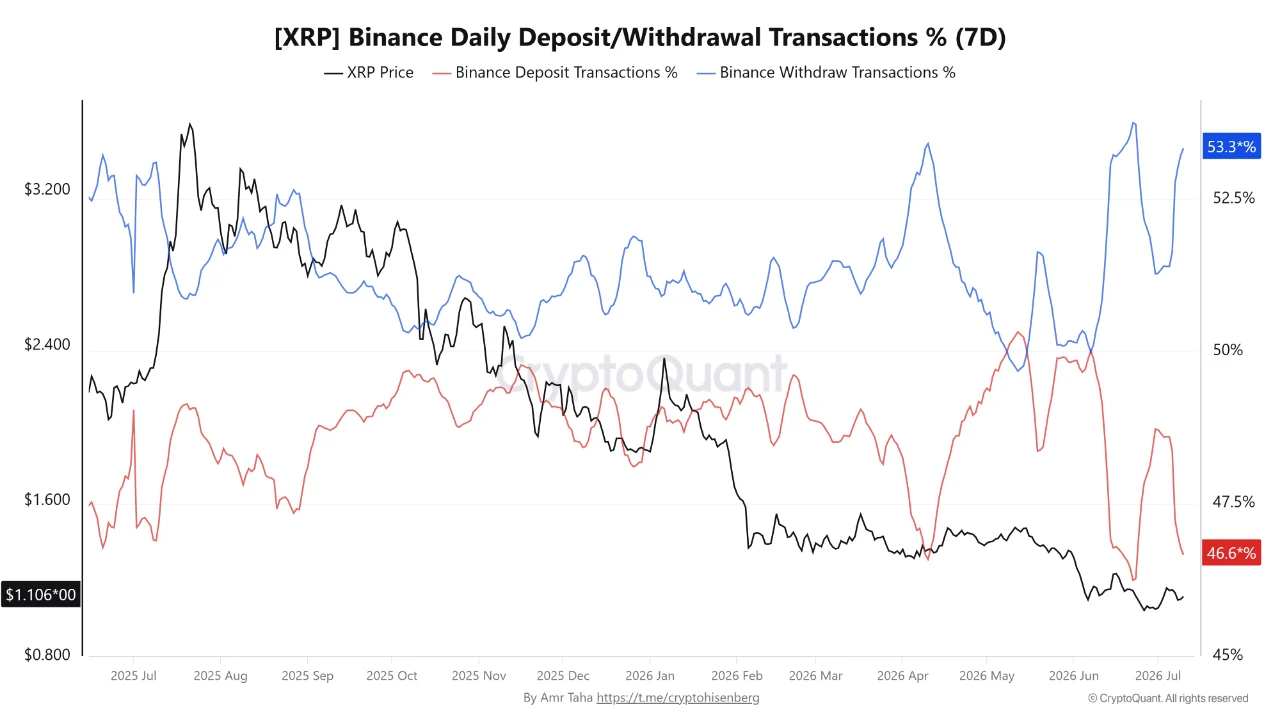
The metric cannot establish that supply reduction on its own. It measures the number of transactions, not the volume transferred. One large deposit could outweigh hundreds of small withdrawals while still producing a withdrawal-dominant count. Because whales often utilize larger, consolidated transactions while retail users generate higher volume-to-transaction ratios, this metric serves as a directional indicator rather than a precise volume audit.
So Binance may have less XRP readily available for trading, but transaction counts alone cannot show whether the reduction is large enough to affect price. Flows on other exchanges show why the Binance reading cannot be treated as a market-wide trend.
Upbit Is Receiving the XRP Coinbase Is Losing
Between June 30 and July 10, Net Wallet Flow Dominance moved in opposite directions across four major venues.
Net Wallet Flow Dominance measures how strongly deposits or withdrawals are contributing to wallet activity on an exchange. A higher deposit-side reading may indicate that more assets are being moved onto the platform for trading or potential sale, while a shift toward withdrawals may suggest that users are moving assets away from immediate exchange activity.
- Upbit rose from 21% to 29.7%, an 8.7-percentage-point shift toward deposit dominance.
- Coinbase fell from 19% to 1.8%, a 17.2-point move toward withdrawals and the largest change among the exchanges tracked.
- Crypto.com declined from 7% to 4%, also favoring withdrawals.
- Binance increased from 12% to approximately 13%, leaving its wider balance largely unchanged.
The divergence does not support a market-wide accumulation claim. Coinbase and Crypto.com users are pulling XRP away from exchanges, while Upbit users are moving a larger share of coins in the opposite direction.
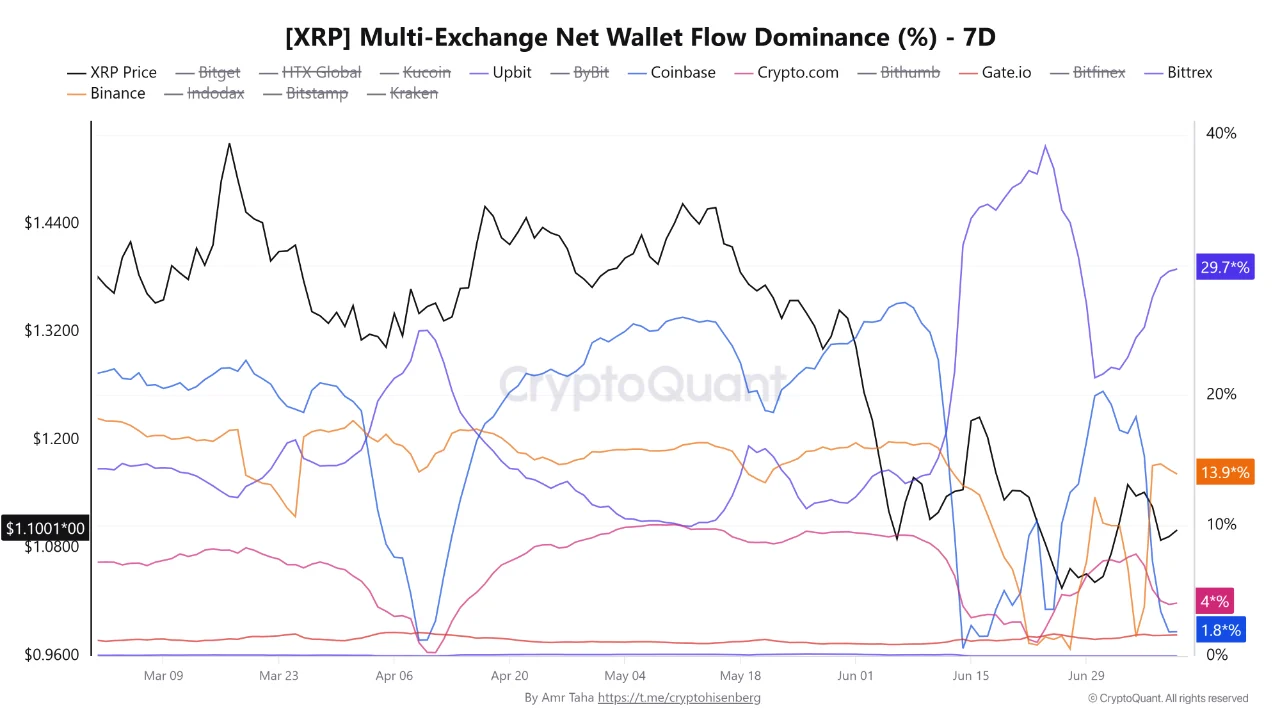
Upbit is a major venue for Korean retail trading, making its deposit increase consistent with XRP being positioned for sale or short-term activity. Coinbase’s withdrawal shift may point toward reduced exchange participation among its predominantly US user base.
Supply could therefore be becoming less accessible on some Western-facing platforms without disappearing from the market. Upbit may be building a pool of exchange-side XRP that could absorb demand if price rebounds.
XRP may be leaving Coinbase and Crypto.com, but rising Upbit deposits prevent those withdrawals from becoming a market-wide supply-tightening signal.
The Squeeze Exists in Positioning, Not in Demand
The current setup contains two conditions that could magnify an upside move: crowded shorts on Binance and signs of lower immediately available supply on several spot exchanges.
A price advance might force some short sellers to buy XRP to close their positions. That covering could have a stronger effect on venues where sellable balances have declined.
Upbit adds another constraint. Its rising deposit dominance suggests that part of the market may be preparing more XRP for exchange activity while other venues lose supply. Sellers there could absorb some of the buying generated by a short-covering move.
Neutral Funding Above $1.10 Could Shift the Balance
Four changes could make a reversal more credible:
- XRP holds above the $1.10 area while funding moves toward neutral, which may indicate that shorts are closing without forcing price lower.
- Upbit’s deposit dominance falls from 29.7%, potentially reducing the clearest visible source of exchange-side supply.
- Spot volume expands alongside price, suggesting that new buyers may be participating rather than leaving the move dependent on short covering.
- Exchange-balance data confirms a meaningful decline in available XRP, which could resolve the uncertainty created by transaction-count metrics.
The bearish reading could remain intact if funding stays deeply negative while XRP makes a lower low. Such an outcome may indicate that short sellers are being rewarded rather than trapped.
A continued rise in Upbit deposits during any rebound could also weaken the reversal case by placing more XRP on the exchange as demand improves.
Crowded shorts could make any XRP recovery sharper, but exchange flows still do not show enough broad buying to confirm that a reversal has begun.

Kosta has reported on cryptocurrency markets and blockchain infrastructure since 2020, bringing over six years of hands-on experience in the crypto industry built through daily tracking of markets, trends, and emerging blockchain developments. Specializing in Bitcoin on-chain analysis, institutional ETF flows, and digital asset price action, his work at Coindoo has been cited by other news agencies and consistently covers market developments with a focus on data-driven reporting across Bitcoin, Ethereum, Solana, and XRP.
Over the years, Kosta has contributed to multiple crypto media outlets in different regions, authoring over 6,000 articles across the sector. His reporting spans cryptocurrency markets and the broader fintech industry, tracking not only price action but also the technological and regulatory forces shaping the ecosystem.
To support his analysis, Kosta actively leverages on-chain data and metrics from leading platforms such as Santiment, Glassnode, and CryptoQuant, enabling deeper, evidence-based market insights. He believes in the power of transparency and the data that underpins the blockchain ecosystem.
His academic background in Marketing Management from Denmark further complements his analytical approach, adding a strong understanding of communication strategy and content positioning to his work.


Be the first to comment