


Disclosure: This article does not represent investment advice. The content and materials featured on this page are for educational purposes only.
Following Binance’s European changes, self-custody reportedly attracted most user withdrawals, underscoring growing demand for direct crypto asset control.

Summary
- Binance says 70% of EU user funds moved to self-custody wallets, signaling a shift away from centralized exchanges.
- European Binance users favored self-custody over rival exchanges after MiCA changes, according to Binance figures.
- Binance data suggests EU traders are increasingly choosing self-custody wallets instead of migrating to other exchanges.
Binance switched off the lights for its European users this July. Financial experts and regulators predicted that all those stranded traders would shuffle over to another regulated exchange, sign up, pass the checks, and carry on as before. That is how the story was supposed to play out according to regulators. Rules tighten, one venue closes, users file politely into the next approved CEX down the road. But that’s not what played out.
By Binance’s own count, 70% of the funds pulled off the platform did not go to another exchange at all. They went into personal wallets. Only 30% went to rival regulated venues. So when the door shut behind them, people did not look for another exchange to hold their funds, instead opting to hold their own funds.
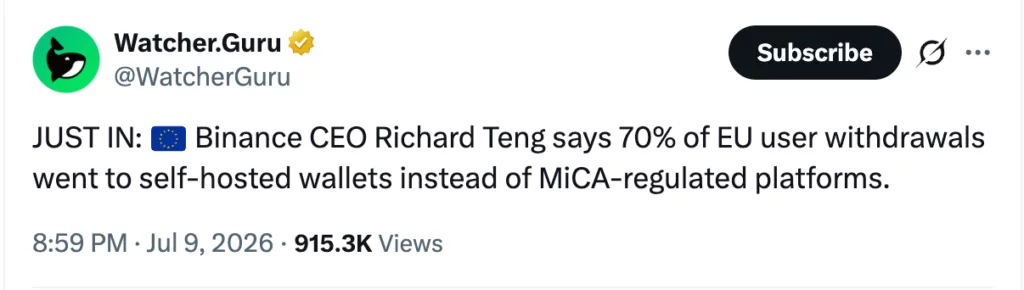
These are Binance’s own figures, which are unaudited, so it’s best to leave a bit of room for error. But even if it’s roughly true, it says something that makes every exchange a little nervous. The uncomfortable truth for the big platforms is that most people were never loyal customers, but only felt comfortable to keep their money there temporarily.
Rewinding back a few years, buying Bitcoin and later swapping it for something on another chain (like SOL or ETH) requireda centralized exchange. It held the coins, ran the trades, and handled the messy work between blockchains that required a PhD-level understanding of cryptography. Users parked their money there because there was nowhere else sensible to store it because of a serious lack of alternatives.
But users shouldn’t fret, because more alternatives have arrived since, and they don’t require expert-level knowledge to navigate. Self-custody wallets like MetaMask turned “be your own bank” from a scary slogan into a few taps on a phone. Hardware wallets made cold storage boring, which is exactly what people want it to be. And the protocol THORChain solved the swapping part everyone assumed only an exchange could do, letting users trade one chain’s native asset for others without first handing crypto to a centralized entity. They keep custody the whole time and swap only when they actually want to.
Stack those advancements together and the old deal starts to look a bit lackluster. The main reason to leave a big balance sitting on a centralized exchange was convenience, not necessity. When trading directly from a personal wallet is this easy, keeping a permanent pile of money on someone else’s platform is merely a habit, not a requirement.
None of this makes self-custody a free lunch, and it would be dishonest to pretend otherwise. Holding keys personally means more responsibility. There is no support line to call the recovery phrase is lost and there’s no reset button. The exchange took that burden off people’s hands, and for plenty of people that trade is worth making. Convenience is a real feature in this aspect of holding funds.
But the data from European users suggests the balance has shifted for a growing crowd. Given the choice between re-registering somewhere new and keeping their own coins, most people chose the latter. That is not in protest against any single rulebook, but was meant more as a quiet vote of confidence in tools that may not have existed when they first signed up.
The assumption was users needed an exchange and would always find their way to the next one. Post-July 1st, what was actually revealed is that the middleman was just a convenience all along, useful, popular, and, for a large share of people, no longer essential. The platforms were never as sticky as they looked. Their customers just had not been handed a reason to leave until someone finally opened the door.
Disclosure: This content is provided by a third party. Neither crypto.news nor the author of this article endorses any product mentioned on this page. Users should conduct their own research before taking any action related to the company.


Be the first to comment