



TL;DR:
- Brian Armstrong explained that changes in the network’s computing power do not dictate the asset’s market price.
- The Bitcoin protocol mechanically adjusts its mining difficulty every 2,016 blocks to maintain a constant issuance rate.
- The hash rate recorded a recent decline of 7.9% as the industry evaluated energy capacity redistribution.
Recently, Brian Armstrong, Executive Chairman of Coinbase, stated that the Bitcoin price does not depend directly on the hash rate or fluctuations in the network’s computing power. In his clarification, the executive explained that the blockchain’s economic architecture includes internal tools that decouple computing costs from market supply and demand.
Interesting point. The first one feels temporary.
The second one more durable. But hash power or energy going to Bitcoin mining doesn’t determine its price (the network difficulty adjusts if miners go offline to keep the same pace of block mining). Long term, Bitcoin price is…— Brian Armstrong (@brian_armstrong) July 20, 2026
The technical discussion gained relevance following the debate over the potential reallocation of electrical capacity from crypto mining toward AI data centers. Addressing this concern, Brian Armstrong argued that the temporary exit of processing capacity does not invalidate the token’s value proposition.

After each mining cycle is completed, the network software automatically adjusts the algorithmic requirement. Protocol data indicates that this mechanism recalibrates the parameter every 2,016 blocks to ensure that new block generation remains at an average of ten minutes.
In recent days, the total processing rate experienced a contraction of 7.9% due to operational reorganizations in mining farms. Despite this variation, industry analysis suggests that corrections in computing power are absorbed by the algorithm without affecting the system’s functional stability.
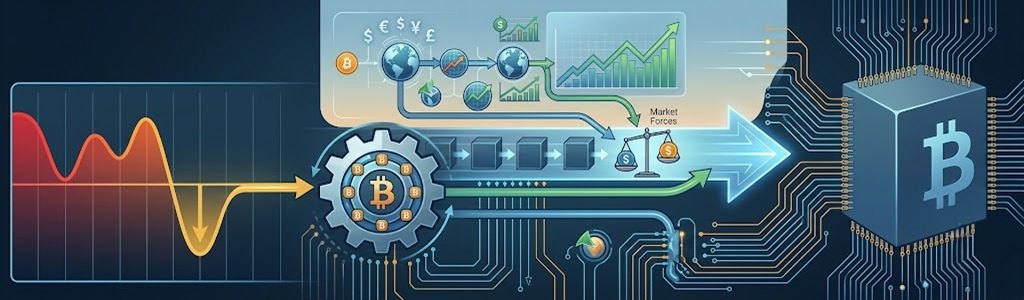
Difficulty mechanics and market dynamics
The commercial quotation of the cryptocurrency responds to a greater extent to global liquidity and investor perception. The Coinbase report reveals that long-term valuation presents itself primarily as a reflection of inflationary dynamics in fiat currencies and global fiscal deficits.
The cost of participation for mining operators changes when network competition decreases. Operational chain data shows that if hash power drops, difficulty decreases proportionally, reducing the electrical consumption required per unit produced.
On the other hand, the causal relationship between mining expenditure and exchange value remains under technical analysis. Market reports indicate that computing power tends to react to already established price movements, acting as a consequential variable rather than the cause of the fluctuation.
The network’s next technical milestone will correspond to the automatic reconfiguration of difficulty at the end of the current block cycle.



Be the first to comment