


S&P Dow Jones Indices and Pantera Capital have launched a crypto benchmark that deliberately leaves out the market’s largest asset.
Key Takeaways
- Bitcoin fails the index’s protocol-revenue screen.
- Revenue must accrue economically to tokenholders.
- Market capitalization still determines position size.
- ETF discussions have started, without filings yet.
The S&P Pantera Digital Asset Index begins with 18 tokens, but Bitcoin is not among them.
The exclusion is not based on Bitcoin’s size, liquidity or institutional acceptance. It follows from what the index is designed to measure. Instead of attempting to represent the entire crypto market, the benchmark tracks protocols that generate recurring revenue and direct economic value toward their tokenholders.
That makes the index less comparable to a broad crypto market basket and closer to a screened portfolio of economically active networks and applications. Ether, BNB, Solana, TRON and Hyperliquid are its five largest constituents at launch, according to the official S&P index brochure. Hyperliquid’s presence in that top five is no accident: the $1.2 billion fee engine we analyzed is precisely the kind of tokenholder revenue this index is built to measure.
Bitcoin Is Excluded by Design, Not Downgraded
Bitcoin does not fit the benchmark because it operates primarily as a monetary asset rather than a protocol business that captures operating revenue for BTC holders. Transaction fees are paid to miners for securing and processing the network, but Bitcoin does not use those fees for token buybacks, supply burns, staking distributions or a BTC-holder-controlled treasury.
Pantera frames Bitcoin as “a monetary asset that allocators may already have a policy around”, adding that investors can already obtain direct exposure through single-asset ETFs. The new index is therefore intended to complement existing Bitcoin allocations by covering revenue-generating protocols, not to replace BTC as a standalone institutional asset.
This distinction matters because Bitcoin’s exclusion could otherwise be interpreted as a negative judgment on its investment case. It is better understood as a category decision. A gold index would not include a profitable software company, even if that company were larger than every gold producer. In the same way, a protocol-revenue index does not automatically include a monetary asset simply because it dominates crypto market capitalization.
What “Revenue” Actually Means in This Index
The most important part of the methodology is not the market-cap threshold or the list of tokens. It is the definition of revenue supplied by Artemis Analytics, the onchain data provider used by S&P.
In crypto, fees and revenue are often treated as interchangeable metrics, even though they describe different parts of a protocol’s economics. Artemis separates them.
Protocol fees
Why It Matters: Shows demand for the service, but not necessarily value captured by the token.
Protocol revenue
What It Measures: The portion of operating fees that accrues to tokenholders through treasuries, burns, buybacks or direct distributions.
Why It Matters: Connects protocol usage with the economics of the underlying token.
Token emissions
What It Measures: New tokens created and distributed as incentives or staking rewards.
A protocol can therefore generate substantial user fees and still fail the index’s revenue test. If all fees go to liquidity providers, infrastructure operators, a private development company or another group without creating value for the native token, that activity does not automatically qualify as tokenholder revenue.
The same distinction runs through network economics more broadly. Solana’s Real Economic Value metric, which fell 43% in the second quarter even as tokenized-asset trading boomed, measures exactly this gap between activity and value captured.
Under the Artemis framework, qualifying revenue can take several forms. A protocol may use fees to repurchase tokens, burn part of the supply, distribute revenue to participating holders or place the funds in a treasury governed by tokenholders. Fee-based staking income may also count, but inflationary rewards created through new token issuance do not.
This explains why the index is more selective than a simple ranking of chains by fees or transaction volume. High activity is not enough. The economic path between the service being used and the token being held must also be visible.
The Screen Measures Revenue, Not Net Profit
Pantera compares the index’s financial viability screen with the discipline used in major equity benchmarks. The analogy is useful, but it should not be interpreted literally.
The official S&P Pantera methodology requires positive aggregate protocol revenue during the two most recently completed fiscal quarters. It does not require a protocol to report conventional net income, nor does it subtract every development cost, operating expense or other liability before determining eligibility.
By comparison, the S&P U.S. Indices methodology applies an earnings test based on positive GAAP net income for the most recent quarter and for the combined trailing four quarters.
The new crypto index therefore adapts the idea of financial viability rather than copying the S&P 500’s accounting test. Protocol revenue provides evidence that customers are paying for a service and that some value is reaching tokenholders. It does not prove that the protocol is profitable after all costs or that its token is attractively valued.
The 18 Tokens Are the Result, Not the Rule
The index currently contains 18 constituents, but the methodology does not set an 18-asset limit. The number emerged from the screening process and can change as protocols qualify or fall out during future rebalances.
The process begins with assets already eligible for the S&P Cryptocurrency Broad Digital Asset Index. The remaining candidates must have Artemis data coverage and positive revenue over the previous two completed quarters.
They must then pass several investability tests:
- A market capitalization above $500 million for new additions.
- An adjusted market capitalization above $500 million.
- A 30-day average adjusted capitalization above $500 million.
- Circulating supply exceeding 30% of total outstanding supply.
- A three-month liquidity ratio above 0.5 for new additions.
- No classification as a meme or abandoned coin.
The circulating-supply rule is particularly relevant for crypto. A token may appear large when calculated against its maximum or outstanding supply while only a small portion is actually available to investors. Requiring more than 30% of the supply to be circulating reduces the influence of projects with very low float and large future unlock schedules.
The methodology also gives existing constituents more room to remain in the index. Tokens already included only need to maintain market-cap and adjusted-market-cap levels above $250 million, compared with the $500 million entry threshold for new assets. This buffer is designed to reduce unnecessary turnover when an existing constituent briefly falls below the admission standard.
After all eligibility tests are applied, the surviving tokens are ranked by their combined revenue over the previous two quarters. Assets are selected until they account for 99% of the eligible universe’s aggregate revenue. Existing constituents receive a slightly wider 99.5% threshold.
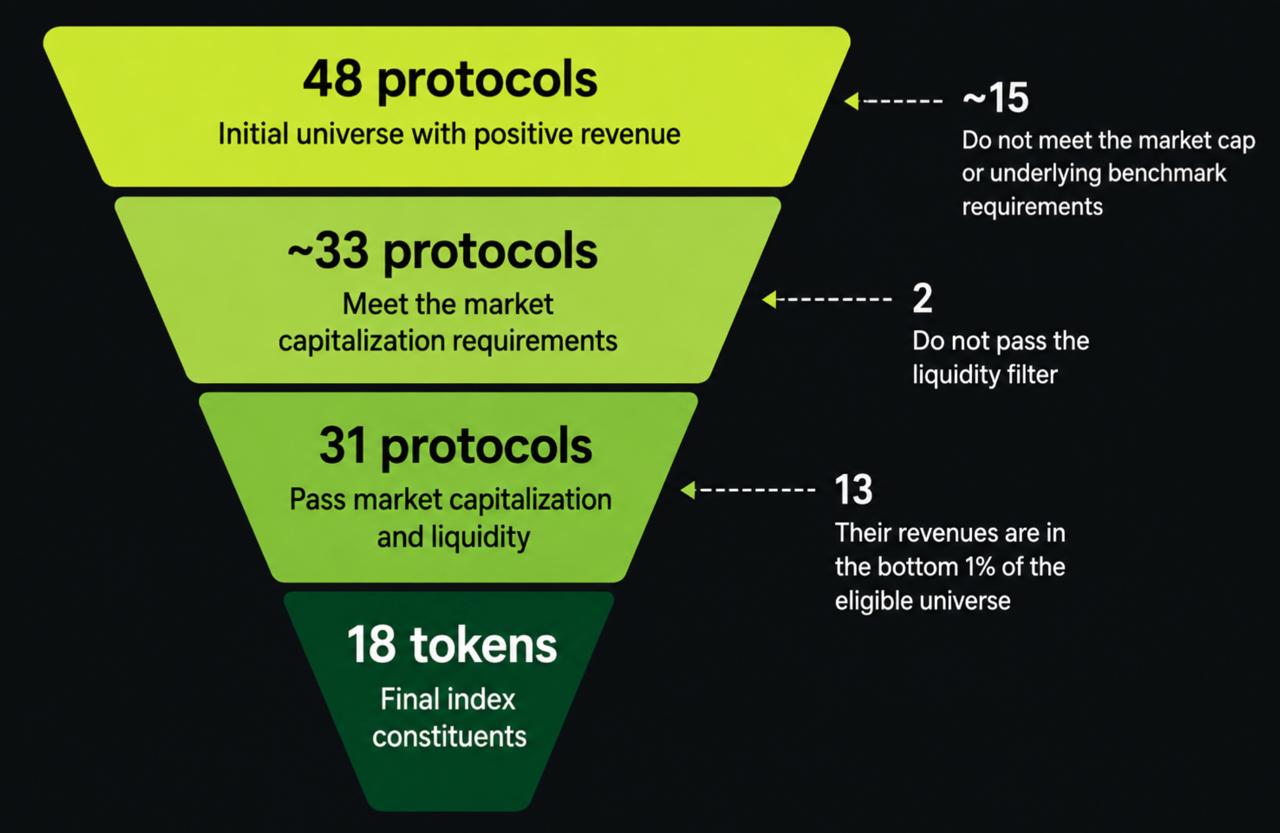
According to an S&P analysis of the index construction, the initial revenue pool contained 48 protocols. Market-cap and underlying benchmark requirements removed around 15, two failed the liquidity screen and another 13 were excluded because their revenue fell within the bottom 1% of the eligible pool.
Market Capitalization Still Determines Position Size
Revenue determines which assets are eligible and helps decide which of them enter the index. It does not directly determine their final weight.
Once selected, constituents are weighted using adjusted market capitalization. The largest constituent can represent no more than 35% of the index, while remaining assets are generally capped at 20% during rebalancing.
This creates a hybrid design. The revenue screen removes economically inactive assets, but market capitalization still gives larger and more established qualifying tokens greater influence over performance.
That distinction prevents the index from becoming concentrated in a smaller protocol simply because it experienced a temporary revenue spike. It also means the benchmark is not a pure measure of protocol revenue growth. A constituent’s price, circulating supply and adjusted market value still determine how strongly it moves the index.
The launch composition reflects that structure. The five largest assets are Ether, BNB, Solana, TRON and Hyperliquid, rather than a ranking consisting exclusively of whichever applications produced the most fees during the latest quarter.
Quarterly Rebalancing Creates a Deliberate Lag
The index rebalances quarterly after the market close on the third Friday of March, June, September and December. Eligibility is determined one month earlier, using reference data captured on the third Friday of February, May, August and November.
Lukka supplies the pricing and market data used for capitalization and liquidity calculations, while Artemis provides revenue and token-supply data. The official price capture time is 4:00 p.m. Eastern Time.
This schedule means a token cannot enter the index immediately after one strong week of fees, a token launch or a sudden increase in trading activity. It must first establish two completed quarters of positive revenue, pass the size and liquidity requirements and wait for the next scheduled review.
The resulting delay is intentional. A benchmark intended for institutional use needs stable and repeatable rules, not a composition that changes whenever a new protocol briefly becomes popular.
Institutional Governance Goes Beyond the Formula
The methodology is rules-based, but it is not entirely automatic. An S&P Dow Jones Indices committee maintains the benchmark and can make exceptions when required to prevent excessive turnover or market disruption.
The committee may also remove or suspend an asset because of legal, regulatory or practical concerns. The methodology specifically identifies potential securities issues, allegations of market manipulation, sanctions exposure, privacy features that create anti-money-laundering concerns and major hacking incidents.
This discretion adds another layer that is absent from many automated crypto rankings. A token can satisfy the numerical tests and still face exclusion if S&P determines that it presents risks incompatible with an institutional benchmark.
This Is a Benchmark, Not an ETF
The index is live, but investors cannot purchase an index directly. It can instead be licensed as the reference benchmark for funds, structured products or actively managed strategies.
In its official launch letter, Pantera said the 18 constituents generated more than $3 billion in combined annualized revenue based on the trailing two quarters. The firm also said it had started discussions with asset managers about potential ETFs and other index-linked products.
Those discussions do not mean an ETF has been launched, filed or approved. Any investable product would require a separate structure, issuer, regulatory process and fee schedule.
The index itself launched on July 20, 2026, and revealed on July 21. Historical figures dating back to June 2021 are hypothetical back-tested results, not the performance of a live fund or a portfolio that investors could have purchased during that period.
A New Incentive for Token Economics
The index introduces a different definition of what deserves to represent the crypto market. Size and popularity remain relevant, but they are no longer sufficient. A protocol must show that users repeatedly pay for its product and that part of the resulting value reaches the token economy.
That standard could influence how projects design their tokens. Protocol teams seeking future inclusion now have a reason to make revenue flows more transparent, reduce dependence on inflationary incentives and establish clearer mechanisms connecting usage with tokenholder value.
The benchmark still does not answer every investment question. Revenue alone cannot measure operating costs, governance quality, token valuation, regulatory exposure or the durability of user demand. A protocol can pass the screen and remain expensive, risky or heavily concentrated.
What the S&P Pantera Digital Asset Index provides is a narrower and more measurable starting point. Instead of asking which tokens are largest or attracting the most attention, it asks which protocols are being paid for a service and where that money ultimately goes. Bitcoin is absent because it answers a different economic question.
This article is provided for informational purposes only and does not constitute financial, investment or legal advice.

Kosta has reported on cryptocurrency markets and blockchain infrastructure since 2020, bringing over six years of hands-on experience in the crypto industry built through daily tracking of markets, trends, and emerging blockchain developments. Specializing in Bitcoin on-chain analysis, institutional ETF flows, and digital asset price action, his work at Coindoo has been cited by other news agencies and consistently covers market developments with a focus on data-driven reporting across Bitcoin, Ethereum, Solana, and XRP.
Over the years, Kosta has contributed to multiple crypto media outlets in different regions, authoring over 6,000 articles across the sector. His reporting spans cryptocurrency markets and the broader fintech industry, tracking not only price action but also the technological and regulatory forces shaping the ecosystem.
To support his analysis, Kosta actively leverages on-chain data and metrics from leading platforms such as Santiment, Glassnode, and CryptoQuant, enabling deeper, evidence-based market insights. He believes in the power of transparency and the data that underpins the blockchain ecosystem.
His academic background in Marketing Management from Denmark further complements his analytical approach, adding a strong understanding of communication strategy and content positioning to his work.



Be the first to comment