


The negotiation over the CLARITY Act’s ethics provision has hit a little hiccup as the White House and Senate Democrats differ on two key areas.
Why is the ethics deal stalled?
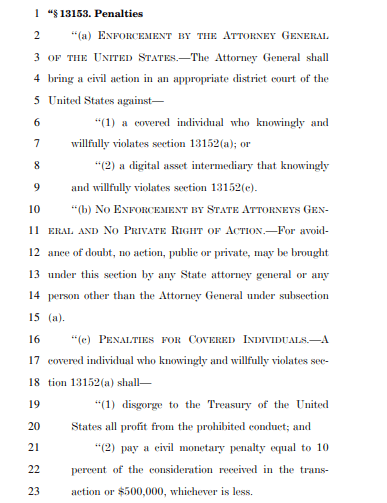
First, Democrats want state Attorneys General [AG] to have a role in enforcing the ethics provisions.
In fact, the recently released White House-backed ethics deal proposes that the Department of Justice (DoJ) should have the absolute enforcement power in ethics-related cases.
Secondly, Senate Democrats sought to hold the U.S. President Donald Trump accountable for his prior crypto activity. Trump reportedly made over $1.4B in crypto profits in 2025 while holders of his memecoins and tokens made losses.
Unsurprisingly, this emboldened Democrats to intensify calls for strong ethics provisions.
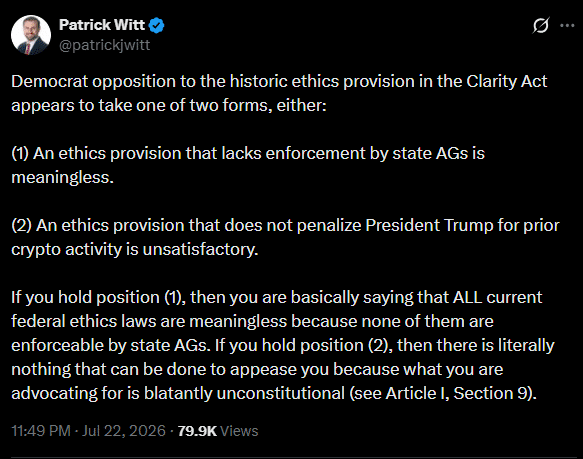
However, President Trump has outright rejected the proposals. In a statement, the White House Chief Crypto Advisor Patrick Witt called the second suggestion “blatantly unconstitutional.”

If you hold position (2), then there is literally nothing that can be done to appease you because what you are advocating for is blatantly unconstitutional.
CLARITY Act: Democrats’ opposition goes beyond ethics
For her part, former SEC Chief of Staff and pro-Democrat Amanda Fischer said the ethics deal was “laughable.”
She noted that the deal allows the president to have a one-year window to put his crypto ventures in a blind trust and doesn’t bar them from earning interest income.
Additionally, even if charged for ethics violations, the max penalty is capped at $500K. Fischer added,
Doesn’t change much at all about Trump’s existing crypto grift. No divestment required. Maybe stops new crypto grifts, but it’s up to his personal attorney Todd Blanche to enforce. Amnesty kicks in as soon as the new POTUS is inaugurated.
Besides, the ethics proposal only bars the president, his administration officials and members of Congress. But it excludes their kids.
That said, the Senate Democrats, including Angela Alsobrooks, Ruben Gallego and five others, opposed the current ethics language and other key aspects of the CLARITY Act bill.
The Republican-proposed text of the CLARITY Act as it currently stands falls short. Key provisions, including those addressing ethics for elected officials, consumer protection, illicit finance, conflicts of interest and market integrity must be strengthened.
Worth pointing out that Alsobrooks and Gallego were the only Democrats who supported the bill during the committee markup.
Since the Republicans will need about 7-10 Democrats to hit the 60-vote threshold for the bill to be passed in the final floor vote, their holdout is as crucial as their support.
Amid the ethics deal hiccup, Bitcoin [BTC] price eased to $65.7K after rallying to nearly $67K earlier in the week, underscoring how crucial the bill’s progress is in driving its short-term market sentiment.
It remains to be seen whether a win-win compromise on the ethics language will be achievable in the coming days.
Final Summary
- Democrats opposed the White House-backed ethics deal and other key CLARITY Act provisions
- White House seems reluctant to fold to Democrats’ ethics demands





Be the first to comment