




TLDR
- Brent crude rose 4% to $97.87, its highest level since early June
- Iran declared the Strait of Hormuz “completely closed” after a tanker explosion
- Houthi militants struck two Saudi oil tankers in the Red Sea’s Bab el-Mandeb strait
- The U.S. military completed its 12th consecutive night of strikes on Iran
- Goldman Sachs expects oil prices to hold most gains through July and August
Oil prices climbed for a fifth straight day on Thursday, with Brent crude rising 4% to $97.87 a barrel, its highest level since June 3. U.S. West Texas Intermediate rose 3.2% to $89.63 a barrel.
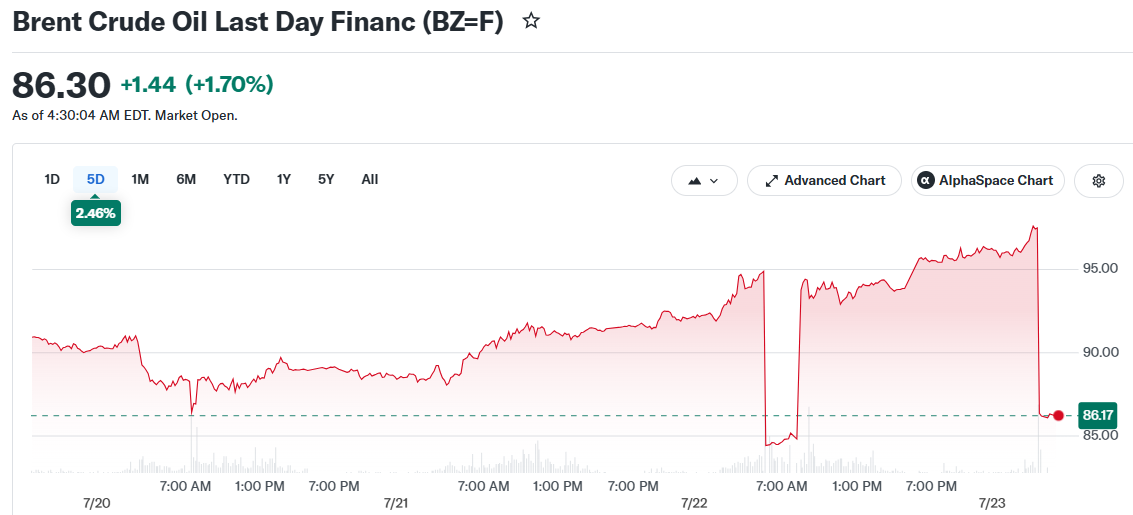
The rally was driven by fresh fears over supply disruptions at two of the world’s most critical oil shipping routes.
Iran’s Revolutionary Guards said one oil tanker caught fire after an explosion along a mined route south of the Strait of Hormuz, near the coast of Oman. Two other tankers turned back. Iran then declared the strait “completely closed,” warning no tanker would be allowed through without prior coordination with Iranian authorities.
BREAKING: President Trump says the US will bomb and destroy one bridge or power plant for every time Iran shoots at a ship in the Strait of Hormuz “from this point forward.”
Trump says this includes bridges and power plants next to or in Tehran. pic.twitter.com/qj65ptcnIS
— The Kobeissi Letter (@KobeissiLetter) July 22, 2026
Houthis Escalate Red Sea Blockade
On the same day, Iran-aligned Houthi militants said they struck two Saudi oil tankers — named ENCELA and LAYLIA — in the Red Sea. The group accused the vessels of violating a maritime blockade it recently announced targeting Saudi-linked shipping.
Saudi authorities have not confirmed any damage. But the attacks marked another step up in a conflict that is now threatening both the Strait of Hormuz and the Bab el-Mandeb strait simultaneously.
Together, these two waterways handle a large share of the world’s seaborne crude shipments. The Bab el-Mandeb connects the Red Sea to the Gulf of Aden. Goldman Sachs said oil flows through that strait have averaged nearly 9 million barrels per day over the past month, including around 4 million barrels per day that would be hard to reroute if both chokepoints were blocked at once.

Several Saudi crude tankers bound for India and China had already altered course earlier in the week following Houthi warnings.
U.S. Strikes Iran for 12th Consecutive Night
The U.S. military said it completed a 12th straight night of strikes on Iran. President Donald Trump had vowed to destroy an Iranian bridge or power plant every time Iran fires on a ship in the Strait of Hormuz.
Pepperstone research strategist Ahmad Assiri said markets were now pricing in “a worrying probability of supply interruptions in a second chokepoint,” keeping the near-term outlook for crude prices supportive.
Goldman Sachs said it expects oil to retain most of its recent gains through July and August. The bank pointed to declining global inventories, lower Middle East production, seasonal summer travel demand, and a slowdown in releases from strategic petroleum reserves.
There was one offsetting data point. U.S. Energy Information Administration data showed a surprise build in commercial crude inventories of 2 million barrels for the week ended July 17, bringing total stocks to 411.7 million barrels. Gasoline and distillate inventories also rose.
Despite the inventory build, traders remained focused on the transportation risks, rising insurance costs, and the threat of further attacks on tankers or energy infrastructure.
Stop guessing and start investing with confidence. KnockoutStocks gives you the AI insights, market intelligence, and stock research you need to spot opportunities, cut through the noise, and make smarter investment decisions — all in one powerful platform.
Sign up today and get 50% OFF full access to our premium stock picks.
Simply use coupon code SPECIAL50 at checkout to claim your exclusive discount.


Be the first to comment