




TLDR
- The Nasdaq fell more than 2.5% on Thursday, dragged down by Alphabet and Tesla
- Alphabet posted its first-ever quarterly free cash flow burn, spending $44.9 billion on capex in Q2
- Tesla shares fell 13.5% after weak margins and $5.8 billion in quarterly capex spending
- Big Tech stocks including Amazon, Meta, and Microsoft also fell sharply
- Analysts warn capex across five major tech firms could outpace free cash flow by 2027
Alphabet and Tesla reported quarterly results that rattled Wall Street on Thursday. Both companies posted heavy capital expenditure figures that more than wiped out their free cash flow, raising questions about whether AI spending will ever pay off at the pace investors need.
The Nasdaq Composite fell 2.8% to close near 24,975. The S&P 500 dropped 1.5% and the Dow Jones Industrial Average shed 1.2%.
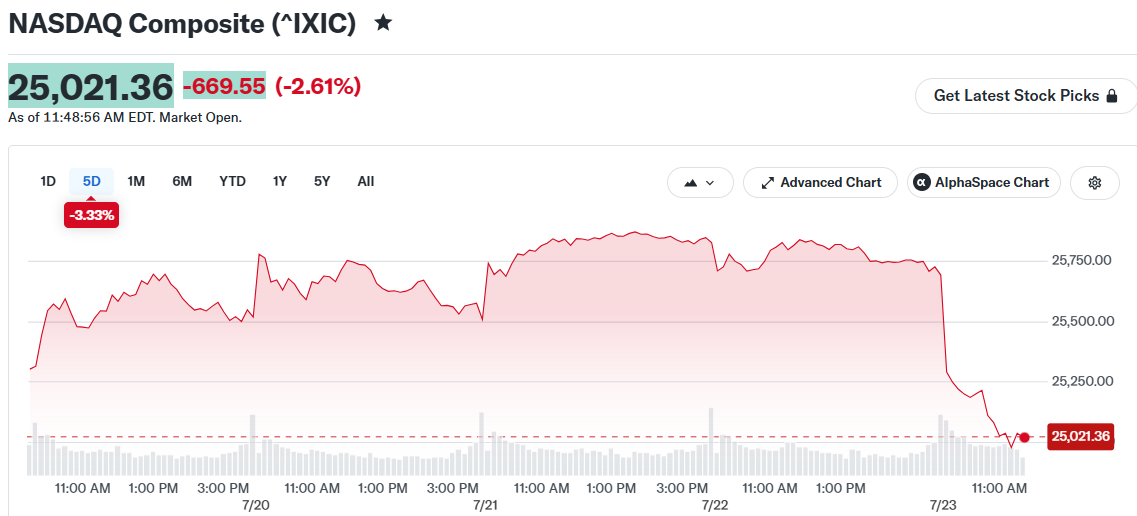
The Numbers Behind the Selloff
Alphabet’s Q2 revenue came in at $119.8 billion, beating the $116.9 billion consensus. Google Cloud jumped to $24.8 billion, up 82% year over year.
But the number that rattled investors was capex: $44.9 billion in a single quarter, double the year-ago figure. That spending wiped out operating cash flow of $39.1 billion and left the company with negative free cash flow for the first time on record.
Alphabet raised its full-year capex guidance to $195–205 billion, up from $180–190 billion, and said spending would rise further in 2027.
Chief Executive Sundar Pichai said AI investments are “redefining what’s possible across every part of our business.” The market disagreed. Alphabet shares fell more than 7% on Thursday.
Tesla’s quarter told a similar story. Vehicle deliveries of 480,126 beat forecasts, but automotive gross margin came in at 16.3%, well below the 18.04% that analysts expected.

Capex surged 142% to $5.8 billion as Tesla accelerates its robotaxi and AI programs. Elon Musk told analysts the company is confident its investments will yield returns. Shares fell 13.5%.
A Sector-Wide Problem
The selloff spread across Big Tech. Amazon fell nearly 5%, Meta dropped close to 4%, and Microsoft slid more than 2%. The Philadelphia Semiconductor Index had already fallen more than 20% from its late-June peak before these results landed.
A Reuters analysis found that Microsoft, Alphabet, Amazon, Meta, and Oracle are collectively on track to spend more on capex than they generate in free cash flow by 2027. For every $1 of additional operating cash flow those companies expect to generate between 2025 and 2027, they plan to spend $1.57 on capex.
That math worked when these companies ran on software margins and minimal infrastructure. AI is changing that model.
Keith Lerner, chief investment officer at Truist, said the selloff looks more like a rotation than a full market exit, with Industrials, Energy, and Healthcare showing relative strength.
“The bull market still deserves the benefit of the doubt, but this reinforces our view from the past month that markets were entering a bumpier period,” Lerner said.
Investors are now watching Meta and Microsoft, both reporting on July 29, and Amazon on July 31. Those results will show whether this week’s losses were an isolated reaction or the start of a broader reset for AI-driven valuations.
Stop guessing and start investing with confidence. KnockoutStocks gives you the AI insights, market intelligence, and stock research you need to spot opportunities, cut through the noise, and make smarter investment decisions — all in one powerful platform.
Sign up today and get 50% OFF full access to our premium stock picks.
Simply use coupon code SPECIAL50 at checkout to claim your exclusive discount.


Be the first to comment