


On July 24, 2026, Pi Network announced that its Launchpad had completed the distribution of SLICE, its second Testnet token.
Key Takeaways
- SLICE attracted more than 242,000 Testnet participants.
- Commitments reached 15.92 million Test-Pi during distribution.
- Launch proceeds seed liquidity, not project treasuries.
- Testnet activity does not create Mainnet demand.
- PI is testing support around $0.08.
More than 242,000 users committed 15.92 million Test-Pi to acquire 10 million SLICE tokens between June 11 and June 28.
The participant count demonstrates the reach Pi can bring to a new application, but the experiment goes further than token distribution. Pi is testing whether the assets committed during a launch can become permanent liquidity for the token, rather than being transferred to the project as fundraising proceeds.
That design could give new applications an immediate market while reducing the risk that a project withdraws the liquidity supporting its token. It does not yet show that users will continue using those applications after the launch campaign ends.
SLICE uses Test-Pi and will never migrate to Mainnet. The test can refine infrastructure for future ecosystem tokens, but has no bearing on PI’s decline toward $0.08.
More Users Participated, but Average Commitments Fell
SLICE followed Pi’s first Launchpad experiment with IRRA. During that earlier test, more than 198,000 users committed 14.72 million Test-Pi, of which 11.71 million Test-Pi ultimately applied toward acquiring 10 million IRRA tokens.
Compared with IRRA, the SLICE launch attracted roughly 22% more participants while total commitments increased by only about 8%. Average commitments consequently fell from approximately 74 Test-Pi per participant to around 66 Test-Pi, a decline of nearly 12%.
The figures suggest that participation became broader without becoming proportionally larger in capital terms. That may be closer to Pi’s goal of distributing access among many users instead of allowing the largest commitments to dominate an allocation.
It cannot be attributed entirely to greater interest in SLICE. Pi changed the participation process after the IRRA test showed that some users struggled with separate staking and commitment steps. More than 478,000 users had staked Test-Pi during that first launch, but fewer than half proceeded to make a commitment.
For SLICE, the Launchpad automatically calculated the required fair-access hold after a participant selected a commitment amount. Pi also presented application engagement as a percentage bonus on the tokens received, rather than as a discount on their acquisition price.
According to Pi Network’s explanation of the revised flow, larger commitments require proportionally larger holds. The temporary hold remains the participant’s Pi and is returned after the relevant period.
The simpler process may have reduced the drop-off seen during the first experiment. Because both the interface and the application changed, however, the published results cannot establish whether the additional participants arrived because of SLICE’s utility, easier onboarding or general curiosity around a second launch.
Launch Commitments Become Permanent Liquidity
Pi’s proposed ecosystem token model differs from a conventional token sale in one central way. The issuing project does not receive the Pi committed by participants. Those assets are paired with tokens supplied by the project and placed into a liquidity pool.
The project then permanently disables its ability to withdraw the initial liquidity contribution, according to the official Pi ecosystem token design. Users remain able to swap between Pi and the new token or add more liquidity to the pool.
This structure addresses a genuine weakness faced by small application tokens. Distribution alone does not create a usable market. Without sufficient liquidity, even modest transactions can produce substantial price changes, while holders may be unable to sell without accepting severe slippage.
Directing launch commitments into the pool gives the token a trading foundation from the moment its market opens. Preventing the project from removing that initial liquidity also reduces the risk that users are left holding a token whose principal market has suddenly disappeared.
Permanent liquidity should not be confused with permanent value. A pool can continue operating while the token falls sharply if holders repeatedly sell and new demand fails to replace them. The mechanism guarantees that reserves remain available under the stated design; it does not guarantee a particular price, trading depth or level of application usage.
There is also a cost for developers. Projects gain distribution and access to Pi’s user base, but they do not receive the committed Pi as operating capital. That may discourage teams primarily interested in raising money, which is consistent with Pi’s product-first objective. It could also be restrictive for legitimate applications that need funding to hire developers, market a finished product or expand infrastructure.
The New Chart Tracks Pool Balances, Not Fair Value
The SLICE pool uses a constant-product automated market maker. When a participant swaps Test-Pi for SLICE, Test-Pi enters the pool and SLICE leaves it. The remaining SLICE becomes more expensive relative to Test-Pi because the relationship between the two reserves has changed.
Selling SLICE produces the opposite result. SLICE returns to the pool, Test-Pi leaves it and the displayed token price may fall.
Pi has added a chart showing how these swaps affect the SLICE price. This gives users a practical way to observe automated pricing without having to calculate the changing reserve balance themselves.
The chart does not establish an independent market valuation for SLICE. Its price is produced by activity within a controlled Testnet pool, and the token will never move to Mainnet. A rising price would confirm that purchases are removing SLICE from the pool, but it would not show whether buyers value the game, expect future utility or are simply experimenting with Test-Pi that has no real monetary cost. Activity involving Test-Pi does not require users to purchase traded PI, remove it from exchanges or spend it inside a Mainnet application.
A Working Game Makes SLICE a Better Test
Unlike IRRA, which was connected to a demonstration application, SLICE is linked to Slice of Pi, an operating third-party game. Pi can therefore examine how interaction with a real product affects token participation and allocation.
The Launchpad may award users a percentage bonus based on their engagement with the application. The intention is to favour participants who have explored the product rather than distributing tokens solely according to the amount they can commit.
That is a more useful test than attaching a token to an empty interface, but launch-period engagement is not the same as lasting adoption. Users may interact with an application to improve their allocation and then stop once distribution is complete.
Pi disclosed how many users participated and how much Test-Pi they committed. The announcement did not provide repeat-user retention, post-distribution game activity, allocation concentration, liquidity depth or swap volume.
Those figures would show whether the Launchpad is creating users or only attracting participants. A successful Mainnet model would need people to return because the application remains useful after the token has already been distributed.
PI Returns to the $0.08 Support Zone
The Launchpad update arrives while PI remains under heavy market pressure. A similar gap between technical development and token demand appeared around Pi Network’s Protocol v25 upgrade, which improved the network’s infrastructure while PI traded approximately 97% below its February 2025 peak.
At the July 25 chart timestamp, PI traded at $0.08136 on Kraken, down approximately 1.8% on the daily candle. Price had briefly moved below the $0.0807 to $0.0821 shelf that has held on repeated tests since the middle of July before returning to the edge of that area. The zone is being tested, but it had not been cleanly lost while the daily candle remained open.
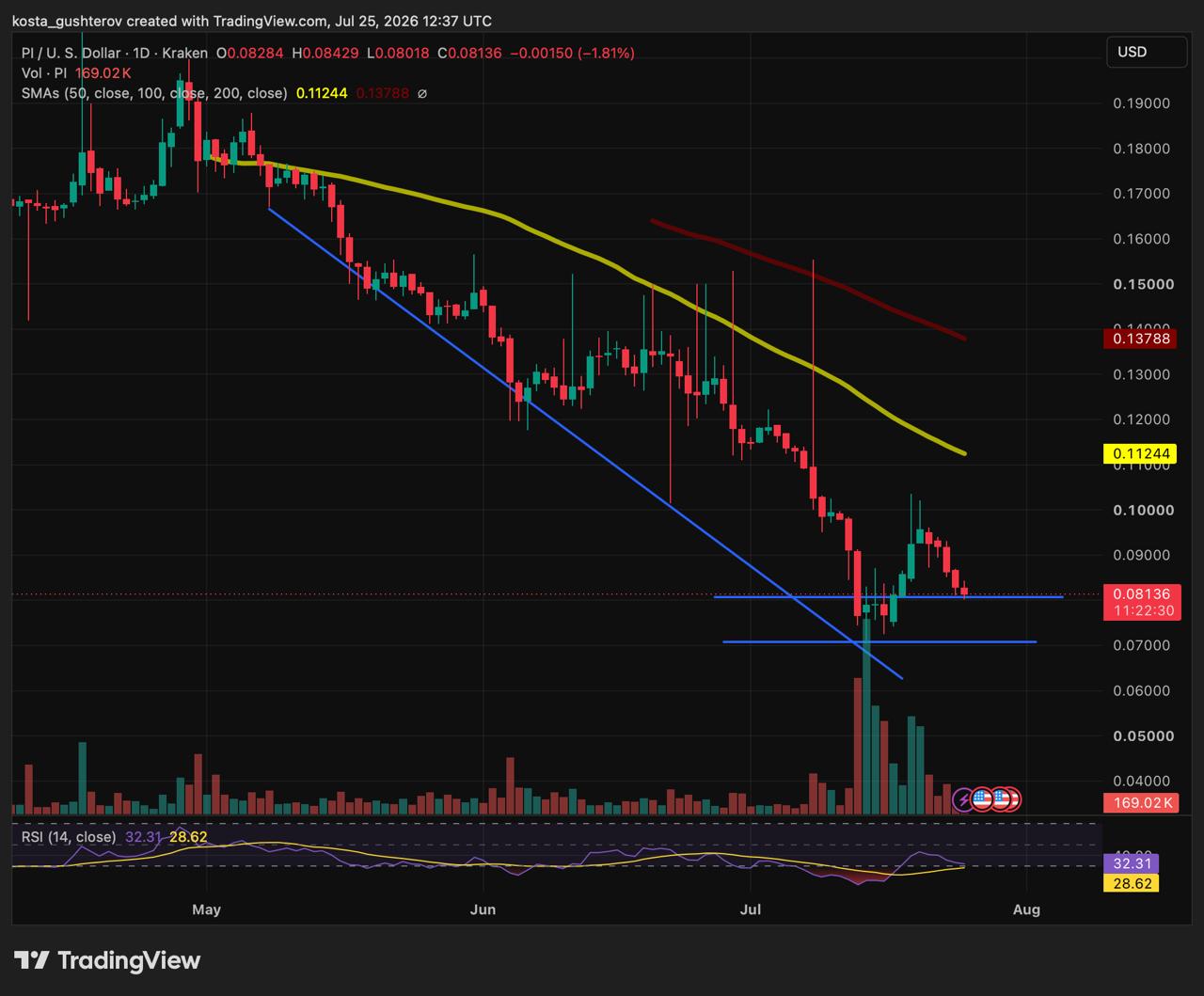
Holding around $0.08 would preserve the recent range and could support another move toward $0.086. The more consequential resistance sits near $0.10, where the rebound following July’s capitulation low previously stalled, followed by the 50-day simple moving average near $0.11244 and the 100-day near $0.138, both sloping downward and untouched during PI’s current basing attempt.
The Relative Strength Index stood at 32.31. That is low enough to reflect weak momentum but remains above the July capitulation extreme, leaving room for a relief move without confirming that a durable bottom has formed.
A daily close below $0.08 would weaken the range and expose the July low around $0.07. That level represents the lowest price shown on the chart and has not been retested since the high-volume reversal. Losing it would place PI at fresh multi-month lows without a visible prior support level beneath it.
The Longer Downtrend Still Controls the Market
PI has already broken above the steep descending trendline that guided the decline from May into July. The break occurred during the capitulation reversal, when volume reached its highest level on the displayed chart, which removes the former trendline as the most relevant resistance. Attention now belongs on the moving averages above price instead.
Defending $0.08 keeps the current basing attempt alive, while recovering $0.10 and then the 50-day average would provide stronger evidence that demand is improving.
Pi’s Launchpad test cannot resolve that technical structure on its own. SLICE shows that the network can direct hundreds of thousands of users toward a token experiment and form a working liquidity pool around it. The missing evidence is whether the same mechanism can produce repeat Mainnet activity that requires real PI.
That will depend less on the number of people who enter a launch and more on what they do afterwards. Persistent application use, recurring swaps, deeper liquidity and demand that survives beyond token distribution would begin connecting Pi’s product development with PI’s market economics. Until those signals appear, the Launchpad represents a potentially useful infrastructure test while the traded token continues defending one of its weakest price levels.
- Disclaimer: This article is for informational purposes only and should not be treated as financial or investment advice. SLICE and Test-Pi are Testnet assets with no real monetary value and are not evidence of Mainnet demand for PI. Markets are volatile, and past chart behavior doesn’t guarantee future results. Make your own decisions and consult a professional before trading.
- Methodology: Technical levels are sourced from the daily PI/USD Kraken chart via TradingView (July 25, 2026). Launchpad and SLICE distribution data is from Pi Network’s official blog and GitHub documentation.

Kosta has reported on cryptocurrency markets and blockchain infrastructure since 2020, bringing over six years of hands-on experience in the crypto industry built through daily tracking of markets, trends, and emerging blockchain developments. Specializing in Bitcoin on-chain analysis, institutional ETF flows, and digital asset price action, his work at Coindoo has been cited by other news agencies and consistently covers market developments with a focus on data-driven reporting across Bitcoin, Ethereum, Solana, and XRP.
Over the years, Kosta has contributed to multiple crypto media outlets in different regions, authoring over 6,000 articles across the sector. His reporting spans cryptocurrency markets and the broader fintech industry, tracking not only price action but also the technological and regulatory forces shaping the ecosystem.
To support his analysis, Kosta actively leverages on-chain data and metrics from leading platforms such as Santiment, Glassnode, and CryptoQuant, enabling deeper, evidence-based market insights. He believes in the power of transparency and the data that underpins the blockchain ecosystem.
His academic background in Marketing Management from Denmark further complements his analytical approach, adding a strong understanding of communication strategy and content positioning to his work.



Be the first to comment