



Quantum computing has officially moved out of laboratories and into real-world business. While telecommunications giant AT&T is deploying next-generation commercial processors, Bitcoin has fallen toward the $63,000 mark.
This contrast has prompted the market to discuss a shorter timeline to “Q-Day” — the moment when legacy blockchain encryption could be critically compromised.
Seconds instead of hours: AT&T and D-Wave breakthrough
The discussion was triggered by an expanded contract between AT&T and D-Wave Quantum Inc., under which the operator integrated quantum annealing technology into its network optimization algorithms.
As a result, a complex network task that previously took one hour can now be completed in just 15 seconds. Against this backdrop, QBTS shares rose above $18.10 in premarket trading.
At the same time, Bitcoin slipped toward the $63,000 mark, triggering $100 million in forced liquidations of traders’ positions. The current decline has been driven by external factors, including a drop in South Korea’s KOSPI index, a sell-off in the semiconductor sector, and expectations surrounding the upcoming U.S. Federal Reserve meeting.
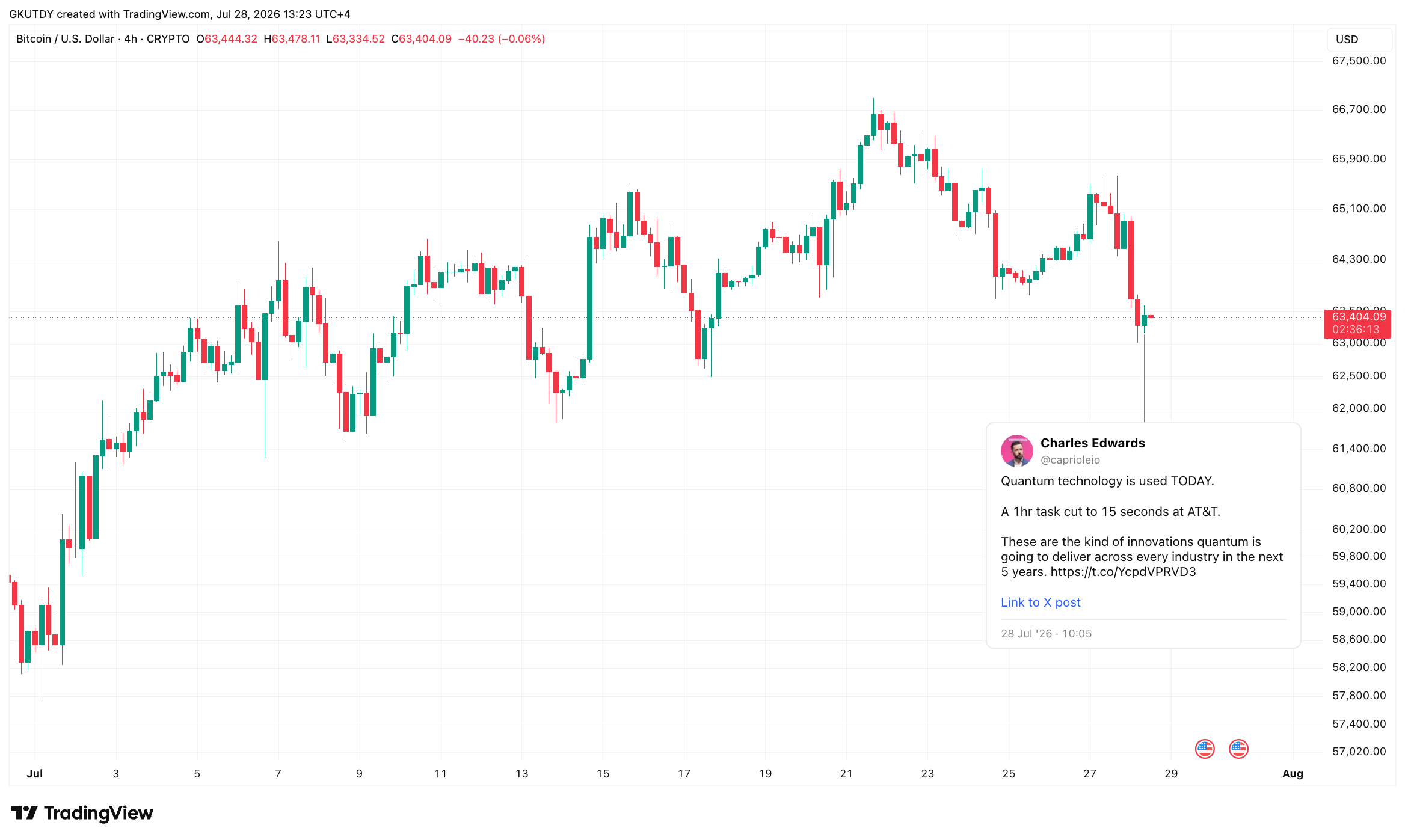
However, the downturn has also brought security risks back into focus. Experts such as Quantum Xchange CEO Eddy Zervigon have directly described cryptocurrencies as a “canary in the coal mine” in the face of the quantum threat. They predict that blockchain protocols could become the first targets because of their decentralized nature.
You Might Also Like

Meanwhile, the “Q-Day” clock is ticking faster:
- Google researchers have reduced their estimate of the computing power required to break Bitcoin by 20 times. They now believe fewer than 500,000 physical qubits would be needed.
- The U.S. Department of Energy expects a powerful quantum computer to be built within the next three years.
- Corporations including IBM and Microsoft are preparing the market for the arrival of cryptographically relevant systems by 2029.
AT&T’s success has demonstrated that the quantum era is already a real business process. Bitcoin’s main challenge now lies elsewhere: whether its community can agree on an encryption upgrade before it is too late.


Be the first to comment