



TL;DR
- South Korean police dismantled an $8.5 million XRP staking scam, recovering evidence of 3.4 million stolen tokens and arresting three of four suspects
- Shiba Inu’s failed 40% pump exposed extreme wallet concentration, with Etherscan data showing 0.04% of addresses holding 94.56% of supply
- BlackRock’s IBIT fund pumped $89.83 million into Bitcoin, single-handedly ending a four-day outflow streak across U.S. spot ETFs
- Bitcoin stays stuck between $63,000 and $66,000 as the Fed’s hawkish split and 5.23% Treasury yields pressure the market ahead of a historically weak August
Crypto scam on YouTube: South Korea busts $8.5 million fake XRP staking scheme
Seoul police have completely dismantled a criminal group that defrauded investors of 3.4 million XRP tokens. The total losses amounted to 12.3 billion won, or approximately $8.55 million, with 71 people falling victim to the scam, according to Yonhap News Agency.
YouTube became the organizers’ main tool for attracting investors, with videos actively promoting promises of easy profits.

The criminal scheme began in October last year, when the scammers created a fake investment platform called Fxrpntwork.com. Through YouTube videos, posts on popular blogs and articles in online media, they promised investors full protection of their capital and fixed monthly returns of between 1.5% and 1.8%.
Trusting users followed strict instructions: they purchased XRP tokens on South Korean cryptocurrency exchanges, transferred them through an overseas platform to designated wallets, after which the website immediately shut down and the organizers disappeared.

However, the criminals failed to cash out or hide the stolen funds due to the rapid response of South Korean investigators. Authorities were already monitoring the market amid a rise in cryptocurrency-related crime and reacted immediately. Cyber analysts traced the chain of blockchain transactions and completely froze the scammers’ wallets just three days after the first complaint was filed.
After realizing that access to the millions had been blocked, the accomplices attempted to escape in different directions. Investigators arrested the ringleader at a hideout in South Korea shortly after he returned from abroad. Two of his accomplices were detained while attempting to flee deeper into the country, and one of them has already been referred to prosecutors.
The fourth member of the group remains abroad, but an Interpol Red Notice has already been issued for his international arrest.
Seoul police concluded by announcing a zero-tolerance policy toward cryptocurrency fraud and officially urged investors to avoid any platforms offering “guaranteed” returns.
You Might Also Like

Aftermath of SHIB’s failed pump: On-chain scanner shows who really profited from retail investors
The aftermath of Shiba Inu’s recent 40% surge continues to weigh on the market. The local hype has faded, the price has pulled back, and fresh data from blockchain scanner Etherscan has exposed the hard numbers: whales quietly disappeared from the radar with their profits, while retail traders were left holding the bag during the decline.
What on-chain data is showing right now:
- SHIB has an impressive base of 1.67 million holders, but this creates an illusion of decentralization. A fresh network snapshot shows that, excluding the dead burn address 0xdea…069, which holds 41%, a microscopic group of whales representing only 0.04% of all addresses currently controls 94.56% of the entire circulating supply.
- SHIB’s Gini coefficient stands at a critical 0.9957, where 1 represents absolute monopoly. Small wallets in the Crab and Shrimp categories account for 96% of all holders but control only tiny fractions of a percent of the total capital.
- Nearly all real liquidity is locked in the balances of several giants. Robinhood holds 3.92%, Binance addresses collectively control more than 4.4%, while Crypto.com holds approximately 3.33%.
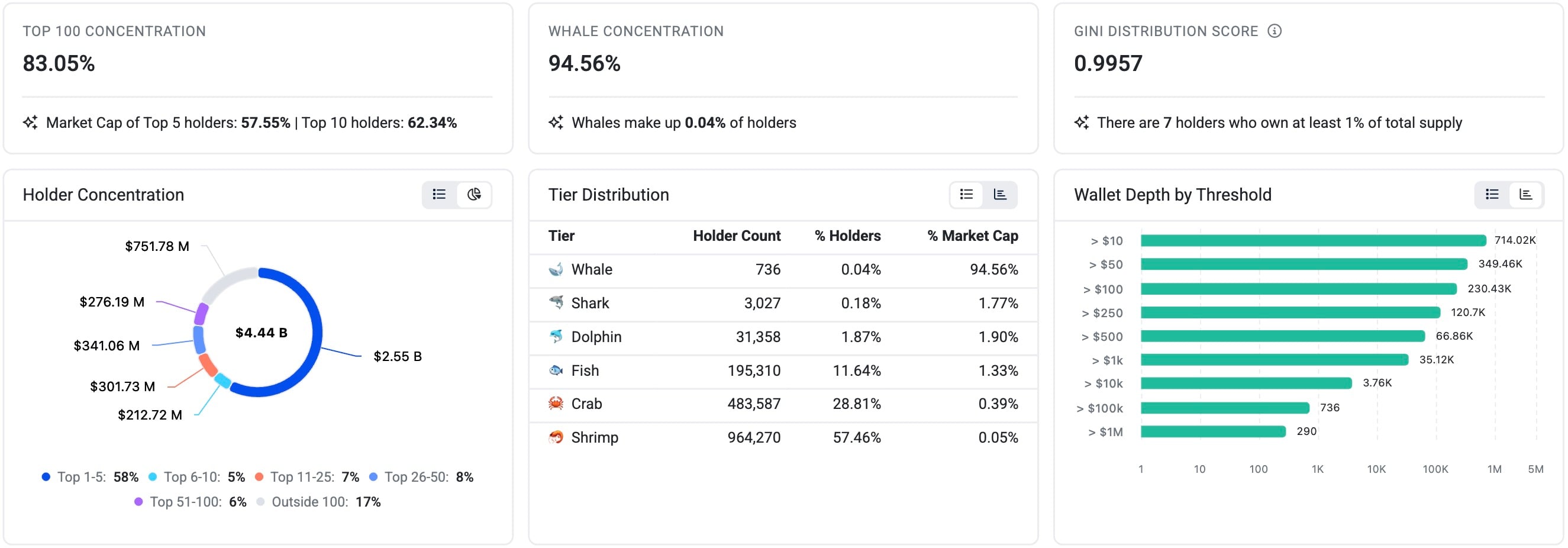
Santiment’s report this week, which recorded 52 large transactions worth at least $100,000 per day, was only a symptom. Fresh scanner data shows that SHIB’s underlying structure turns every pump into a conveyor belt for unloading large positions.
As soon as retail traders gave in to FOMO and began pushing the price higher, they immediately ran into a wall of liquidity from exchange market makers and major holders. Whales once again used the inflow of fresh capital as the perfect opportunity to cash out and quietly disappeared, leaving millions of small wallets to finance the failed rally.
BlackRock carries Bitcoin alone: $90 million reversal saves crypto ETFs from collapse
U.S. spot Bitcoin ETFs have finally pulled out of a steep decline, ending a four-day losing streak. Over the past day, the market attracted a modest but symbolic $32.11 million in net inflows, according to the SoSoValue platform.
The main driver of the comeback was BlackRock’s IBIT fund. While its peers continued recording losses, the Wall Street giant made a sharp U-turn and single-handedly brought $89.83 million into Bitcoin.
The spot ETF desk currently looks as follows:
- BlackRock’s IBIT: +$89.83 million over the past day, making it the clear driving force of the session.
- Fidelity’s FBTC: -$43.08 million as investors continue to exit.
- Ark Invest’s ARKB: -$14.62 million.
- Overall balance: Selling pressure exceeded $57 million, but BlackRock’s powerful buying activity fully offset the losses and pushed the total figure back into positive territory.
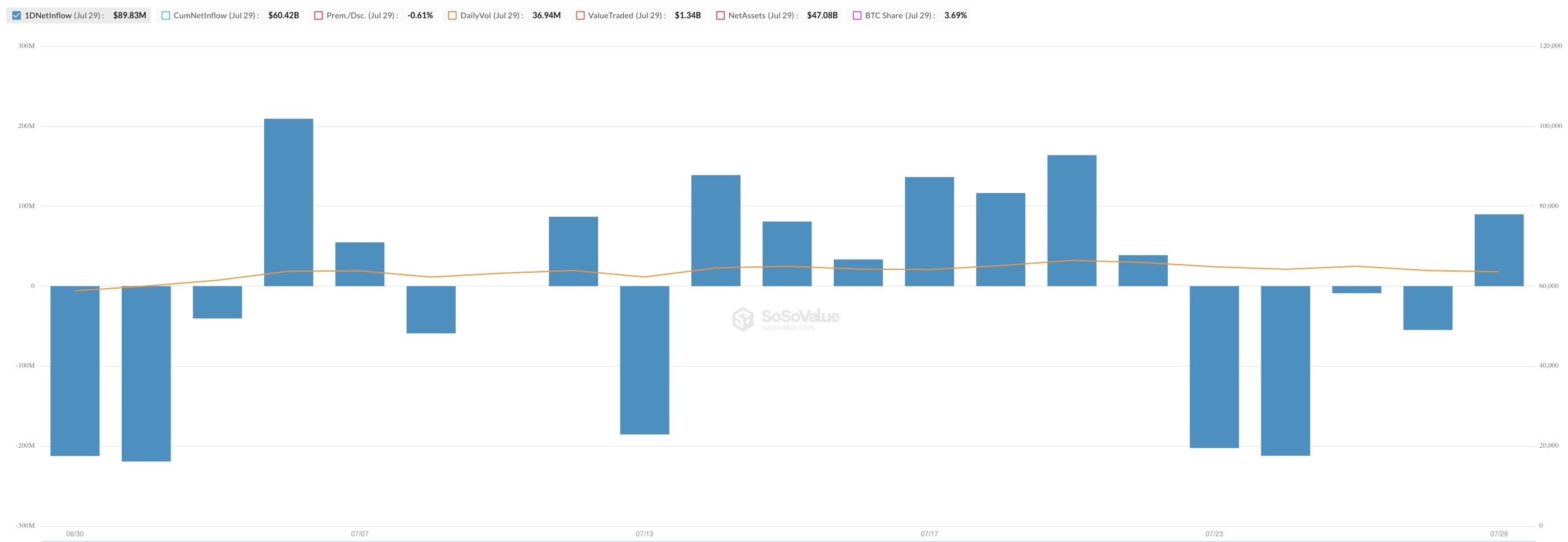
Bitcoin ETFs currently hold $77.46 billion in assets under management, representing 6.08% of the total market capitalization of the leading cryptocurrency.
There has also been activity in the Ethereum ETF segment. The recently launched Morgan Stanley Ethereum Trust, MSSE, reported a daily inflow of $14.30 million, making it the strongest-performing fund focused on the second-largest cryptocurrency.
Crypto market outlook: Federal Reserve split pushes Bitcoin into a summer deadlock
Bitcoin remains trapped in a tight range between $63,000 and $66,000, showing signs of local consolidation. The Federal Reserve’s hawkish position and internal disagreements among policymakers are preventing further growth, pressing the chart against key support levels and creating an extended summer sideways market.
Key checkpoints:
- Bitcoin caught in a technical squeeze: The Bitcoin price is currently in a phase of local accumulation. A break below the $63,000 support level would open the door to a prolonged correction, while consolidation above the $66,000 resistance level would return control to the bulls.
- The Fed’s hawkish deadlock: The decision to keep interest rates unchanged at 3.50%–3.75% was accompanied by a split, with three votes calling for an immediate increase. Monetary policy easing has been completely removed from the agenda.
- Extreme Treasury yields: The yield on 30-year U.S. government bonds climbed to 5.23%, reaching its highest level since 2008. High risk-free returns are pulling liquidity away from the cryptocurrency market.
- Negative August seasonality: Analysts are highlighting downside risks ahead of August. Current price action closely resembles previous U.S. midterm election cycles, including 2022, when the end of summer was accompanied by a market decline.
- ETH/BTC capitulation: Ethereum celebrates the 11th anniversary of its mainnet on July 30 as the ETH/BTC pair falls to a 10-month low of 0.02835. Bitcoin dominance continues to suppress the leading altcoin as the market waits for the full launch of testnets for the upcoming Glamsterdam upgrade.
- DeFi risk cleanup: Major lending protocol Aave is winding down operations across Sonic, Scroll, zkSync, Metis, Soneium and Aptos. The freezing of pools containing $98.1 million signals the industry’s shift toward quality and real liquidity instead of chasing hype.
You Might Also Like



Be the first to comment