



What to know:
- Meta stock sank as investors focused on rising AI costs and pressure on future margins.
- Quarterly revenue reached $60.8 billion, but earnings missed key Wall Street forecasts.
- Capital spending may reach $145 billion as Meta expands its AI infrastructure capacity.
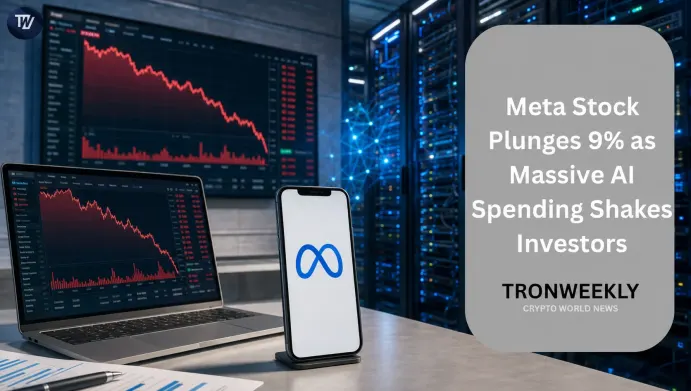
Meta stock fell about 9% in Wednesday’s after-hours trading after investors focused on the company’s rising artificial intelligence costs. Strong revenue failed to offset weaker earnings. Higher planned spending also intensified concerns about future margins.
Meta Platforms reported second-quarter revenue of about $60.8 billion, slightly above Wall Street estimates for the quarter. Its core digital advertising business continued to expand. However, earnings of $6.18 per share missed analyst forecasts ranging from roughly $7.14 to $7.19.
Also Read: Robinhood Revenue Hits Record $1.31 Billion Despite Crypto Trading Decline

What Drove the Meta Stock Sell-Off After Earnings
However, in a post on X, The Kobeissi Letter highlighted that Meta stock dropped more than 9% due to underwhelming results. During the earnings call, the selloff intensified as the executives pointed out that the company would spend more on AI.
Executives signaled that elevated spending could continue much longer than many investors had expected. The company is funding data centers, AI chips, computing capacity, and technical talent. Those commitments raised fresh questions about margins and free cash flow.
Meta increased its projected 2026 capital expenditures to between $125 billion and $145 billion. Its earlier guidance ranged from $115 billion to $135 billion. Management cited higher equipment prices and additional data center capacity needed for future AI products.
The forecast of spending added more downward pressure on Meta stock even with strong demand for advertising. AI recommendations are useful in providing users of Facebook and Instagram with more relevant content. Advanced targeting systems also contribute to improved performance of engagement and advertising.
How Meta Plans to Generate Returns From Its AI Investments
Meta has a different return system compared to Microsoft, Amazon, and Alphabet. Its competitors run cloud operations, which generate income from selling AI computing power to external corporate clients. Meta does not have an equivalent product that can offset the cost of infrastructure.
Its return system relies on improvements in advertising and potential future consumer or business products. They may be generated by Meta AI, business agents, and smart glasses. These products could take years to start generating revenues that match the scale of today’s spending.
That timing gap is still the major concern of the market. Investors got very little confidence around when and how AI projects will start to make a difference in terms of profits. The Meta stock sell-off showed that revenue growth alone could not overcome uncertainty about rising costs.
Meta’s rising AI spending requires investors to accept another long investment cycle under CEO Mark Zuckerberg. The strategy may recall the company’s prolonged metaverse push. Reality Labs generated limited revenue while reducing operating profit by $17.73 billion in 2024 and $19.19 billion in 2025.
Why the Fed Decision Added Pressure on Meta Stock
The earnings release shortly followed the Federal Reserve’s decision to hold interest rates at 3.50% to 3.75%. Three policymakers supported a quarter-point rate increase. Their votes added concern that borrowing costs could stay high or rise if inflation remains elevated.
Increased interest rates have an impact on expensive growth stocks, as they decrease the current value of future earnings. Meta stock is under pressure due to monetary policy and its budget. The market reaction reflected concerns about both factors.
The firm needs to prove that record AI investments will yield sustainable profits, not merely higher infrastructure costs. Proving that monetization is possible could restore confidence in Meta stock. Without this, even sustained advertising success may not be enough to stop share price volatility.
Also Read: SpaceX Contract Worth $1.6 Billion Secures 18 Space Force Falcon 9 Launches



Be the first to comment