

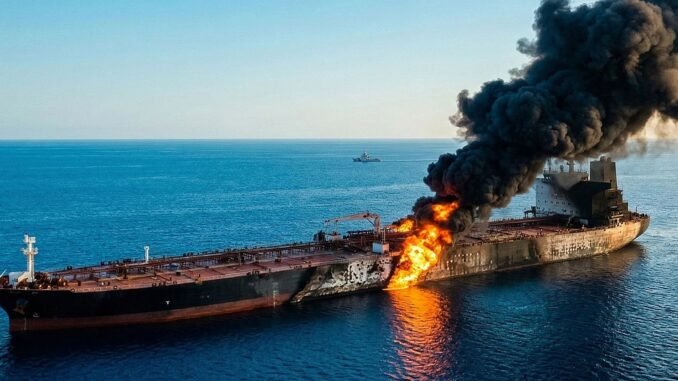


One ship paid $2 million just to pass through the Strait of Hormuz. That single data point tells you everything about the state of the world’s most critical oil corridor right now.
Ships Sit Idle As Clock Runs Out
US President Donald Trump issued a 48-hour ultimatum Saturday, threatening to destroy Iranian power plants if free passage through the Strait of Hormuz is not restored by Monday night.

The warning — posted on Truth Social — came as maritime data showed tanker transits through the strait have collapsed by more than 90%. Hundreds of vessels sit idle on both sides of the waterway, pushing Brent crude above $100 per barrel for the first time since 2022.
Iran declared the Strait of Hormuz closed on March 4, three days after the US and Israel launched joint air strikes on Iranian military targets on February 28.
Since then, Iranian forces have attacked at least 10 ships attempting to transit the corridor, killing five crew members aboard two vessels.
Tehran has made clear it is not backing down. Iranian officials warn they will target regional energy facilities if their own oil infrastructure comes under direct attack.
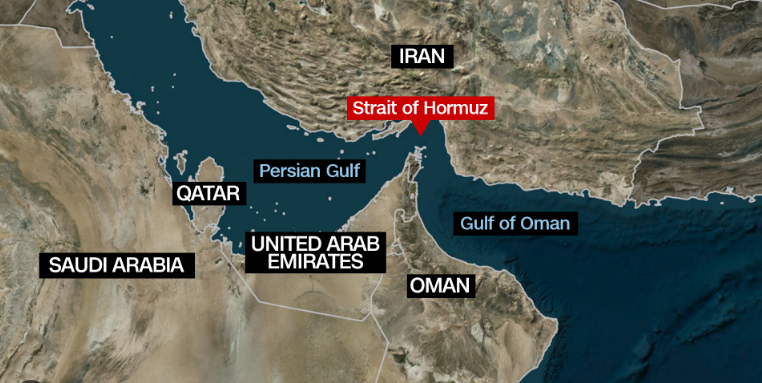
The Strait of Hormuz. Image: CNN
The US military has tried to punch holes in Iran’s ability to threaten shipping. Admiral Brad Cooper, head of US Central Command, said American fighter jets bombed an underground Iranian coastal facility storing anti-ship cruise missiles earlier this week, claiming it had “degraded” Iran’s attack capacity. Iran’s response to Trump’s latest ultimatum: threats of broader retaliation.
Energy Shock Ripples Across Global Markets
The scale of this disruption has no modern equivalent. The International Energy Agency called it “the greatest global energy and food security challenge in history.”
Brent crude hit $126 per barrel at its peak — the closure has been described as the largest energy supply disruption since the 1970s oil crisis.
The economic pain extends well beyond the pump. Moody’s supply chain lead Andrei Quinn-Barabanov warned that for many commodities moving through the strait, inventories typically cover only a few weeks, meaning shortages could surface quickly if disruptions drag on.
Roughly 85% of Middle East polyethylene exports move through the Strait of Hormuz, meaning packaging, auto parts, and consumer goods are all facing higher costs. Aluminum, fertilizer, and helium prices have also climbed.
Bitcoin Holds Ground As Crypto Watches Oil
Digital asset markets are not sitting this one out. US strikes on Iran and the blockade of the Strait of Hormuz have hit the global oil market, pushing volatility to its highest levels since 2020 and forcing markets to revise expectations on the timing of interest rate cuts — a shift that directly affects crypto valuations.
Yet Bitcoin has shown a degree of staying power that surprised some traders. Even as oil prices swung violently and Goldman Sachs warned of potential $150 per barrel prices, Bitcoin consolidated between $67,000 and $71,000, with falling open interest suggesting a cooling of speculative leverage.
Featured image from Navy Lookout, chart from TradingView
Editorial Process for bitcoinist is centered on delivering thoroughly researched, accurate, and unbiased content. We uphold strict sourcing standards, and each page undergoes diligent review by our team of top technology experts and seasoned editors. This process ensures the integrity, relevance, and value of our content for our readers.



Be the first to comment