


The Bank of Japan held its policy rate at 1.0% on July 31, six weeks after raising borrowing costs in June.
Key Takeaways
- The BOJ held at 1.0% in an 8-1 vote, with Hajime Takata dissenting for an immediate rise to 1.25%.
- Markets read the single dissent as dovish, and the yen resumed sliding past 160 against the dollar.
- Suspected intervention a day earlier pushed USD/JPY from 163.5 to 158.2, with part of the move holding.
- Bitcoin touched $65,340 before returning to $64,400, with support holding at $63,400–$63,600.
The decision matched the base case in our analysis of how Japan’s rate path affects Bitcoin, where a hold was expected to contain the immediate carry-trade risk while a surprise hike would have forced markets to reprice yen funding.
What followed was not the cautious reaction a hold usually produces. The yen resumed weakening within hours, giving back part of a sharp rally that had come the day before.
One Dissent Read as Dovish
The Policy Board approved the hold 8-1. Hajime Takata dissented, arguing for an immediate 25-basis-point rise to 1.25% on the grounds that upside price risks had increased enough to justify a pre-emptive move.
Traders drew the opposite conclusion from that vote. Analysts at FOREX.com noted that previous BOJ tightening episodes were generally preceded by meetings where several members broke ranks, so a single dissenter suggests a board still short of consensus, pushing the next move toward October or December. USD/JPY climbed back above 160 in Asian trading after the announcement.
Not every read agrees. MUFG’s research team forecasts the BOJ moving faster than markets price, with hikes in September and again after. Kazutaka Maeda of Meiji Yasuda Research Institute told Reuters that the slight upward revision to the economic outlook supports the rate-hike process, and that further depreciation could itself push markets to price an earlier move.
The Intervention Nobody Confirmed
USD/JPY dropped from around 163.5 to roughly 158.2 during Thursday’s New York session, then recovered to 160.31 by Friday morning, up 0.44% on the day as the yen weakened again. The pair sits about 3.2 yen below where it traded before Thursday.
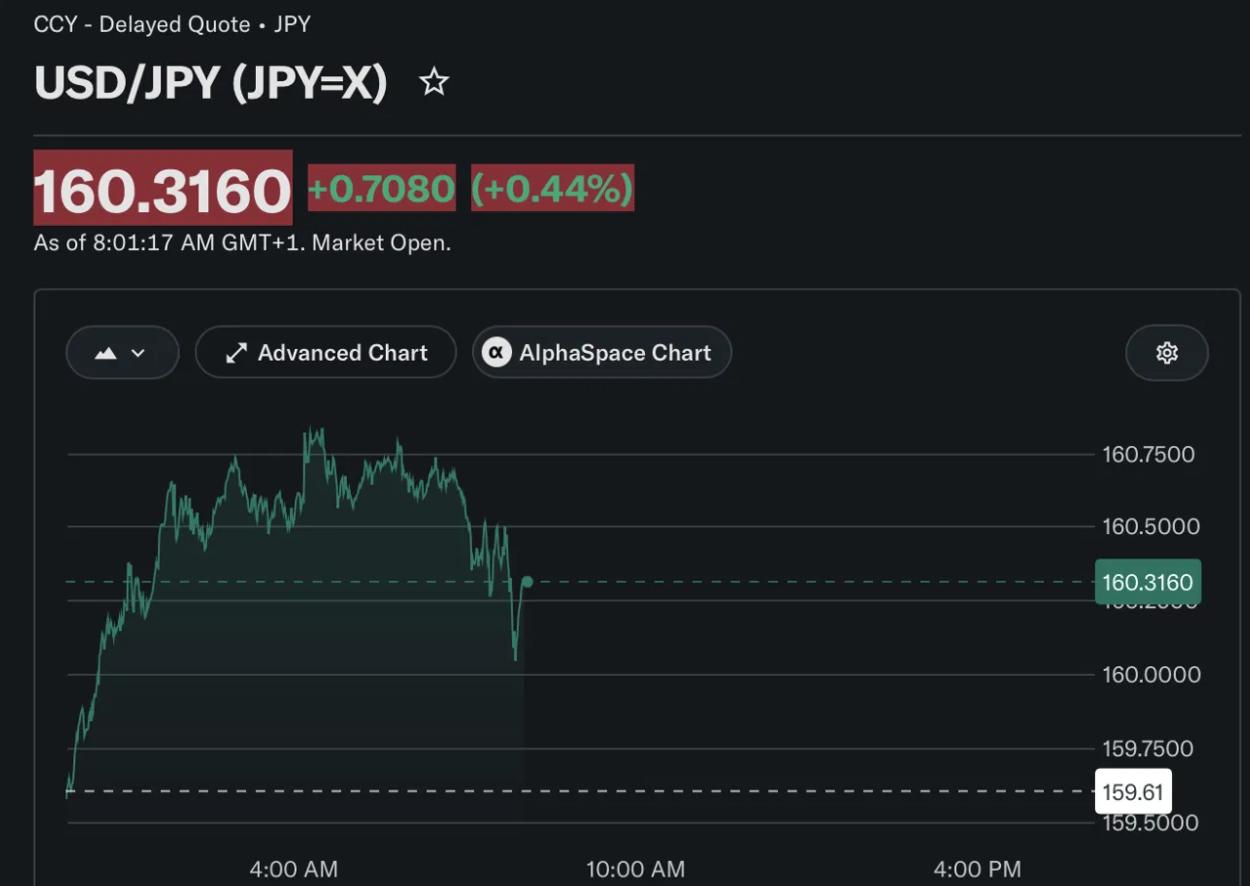
Nikkei and Bloomberg both reported that Japan intervened in the currency market, with the US conducting a rate check on the pair. Authorities confirmed nothing.
Across April and May, the Ministry of Finance deployed a record ¥11.73 trillion, roughly $73 billion, after USD/JPY breached 160. By late July the pair traded near 163.5, with a 40-year low at 163.99.
Days before Thursday, JPMorgan’s head of FX research, Junya Tanase, said the defence line markets had assumed around 162 had effectively disappeared. Thursday answered that by moving the pair five yen in a session. What it did not change was direction: the level at which Tokyo steps in has moved, and the pair has climbed every session since.
One reading is that the operation created room for a dovish outcome without triggering another wave of selling. Finance Minister Satsuki Katayama repeated that authorities stand ready to act at any moment, in coordination with the United States.
Why the Yen Matters More Than the Rate
Japan has kept borrowing costs near zero for decades, so investors around the world borrow yen cheaply and put that money into assets they expect to earn more. Stocks, bonds, currencies, crypto. The trade works as long as Japanese rates stay low and the yen stays weak, because a falling yen means the loan costs less to repay than it did when it was taken out.
Friday left both of those conditions in place. Rates did not move, the currency kept sliding, and nothing about the trade got more expensive. That is why crypto barely reacted.
The problem comes when the trade reverses. If the BOJ raises rates or the yen suddenly strengthens, those loans get more expensive fast, and investors have to sell things to repay them. They sell what is easiest to sell first, which means liquid assets that trade around the clock. Bitcoin fits that description better than almost anything else, even though not a single yen was borrowed to buy it.
Each week of depreciation brings that reversal closer. Cheaper yen means Japan pays more for imported energy and goods, which pushes inflation up and strengthens the argument for the rate rise the Bank passed on this week. The same slide that makes the trade profitable today is what eventually forces the move that ends it.
Bitcoin Rejected $65,000
BTC reached an intraday high near $65,340 on July 31 before returning to $64,400 at the time of writing, a move of roughly 1.5% across the session. Price turned back from horizontal resistance near $65,000 that the market has tested across several sessions.
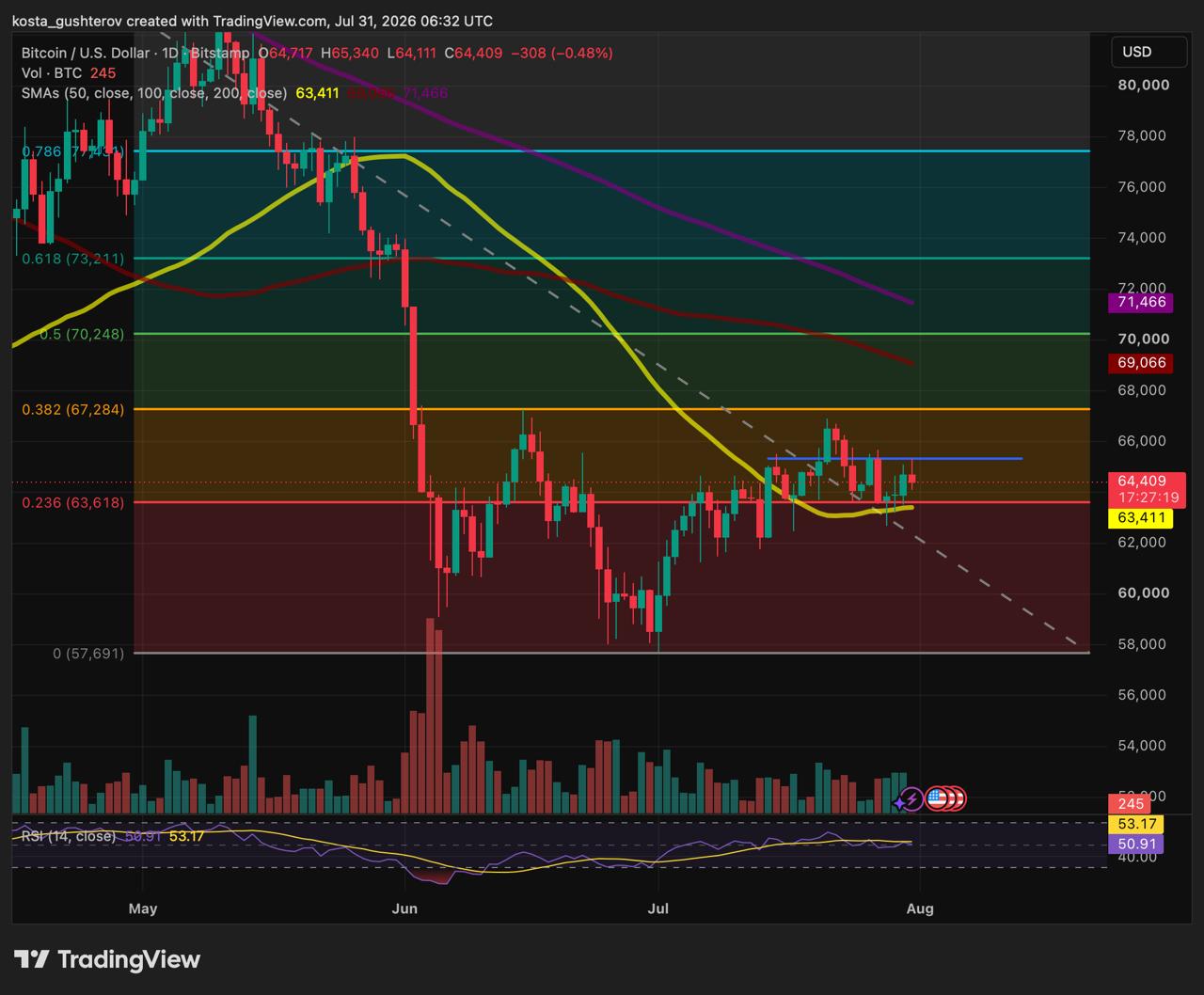
Since the Fed’s July 29 hold, Bitcoin has traded around $64,000 without establishing direction. Repeated attempts above that level show buyers active; the failure beyond $65,000 shows sellers still holding the upper end.
Support sits between the 0.236 Fibonacci retracement near $63,600 and the 50-day simple moving average near $63,400. Bitcoin has stayed above both, making the narrow $63,400–$63,600 band the floor protecting the current recovery.
The three completed sessions before July 31 formed progressively higher lows, with buyers stepping in slightly earlier on each pullback. The July 31 low near $64,100 continued that sequence, though the pattern only counts once it survives a daily close.
Clearing $65,000 and holding would open the 0.382 retracement near $67,300. Losing $63,400 would break the structure and reopen the lower range.
The Outlook Depends on a Currency the BOJ Will Not Defend
The July Outlook Report upgraded Japan’s growth forecast for fiscal 2026 to 0.8% while trimming near-term inflation projections, and expects inflation excluding fresh food to run clearly above 2% from the second half of the fiscal year.
The Bank identified several sources of upward pressure:
- Companies passing wage increases into selling prices
- The delayed effect of higher crude-oil costs
- Rising semiconductor prices tied to global AI demand
- A weaker yen lifting import costs
The last item is doing more work than the other three. Import costs feed the inflation forecast the Bank published, and the exchange rate driving them is the one variable it left untouched this week.
The Currency Sets the Timetable, Not the Calendar
The Federal Reserve meets on September 15 and 16, and the BOJ follows on September 17 and 18, leaving leveraged portfolios two days between decisions.
The Fed’s July hold carried its own hawkish split. The FOMC kept rates at 3.50%–3.75% by 9-3, with Beth Hammack, Neel Kashkari and Lorie Logan all preferring an immediate quarter-point increase.
On current pricing, a September BOJ hike is the less likely half of that pairing. The bigger threat to leveraged positioning is a currency sliding far enough to force Tokyo’s hand, and that arrives on the exchange rate’s schedule rather than the meeting calendar’s.
Friday’s relief carries that cost. A hold that leaves the funding currency falling buys leveraged books a quiet week and raises the odds of a sharper correction later, delivered either through rates or through another operation in the market.
What to Watch Before September
The BOJ publishes its Summary of Opinions from this meeting on August 10. The statement showed only the final vote; the summary indicates whether other members share Takata’s concern while still backing a pause, which is the difference between one dissent and a shifting board.
- USD/JPY: a sustained push past 164 raises the odds of another operation and pulls hike expectations forward.
- Japanese inflation: readings holding above 2% strengthen Takata’s argument.
- Wage and spending data: firm domestic demand gives the Bank room to tighten.
- US inflation and employment: stronger prints raise the odds of a September Fed hike.
- Bitcoin’s $63,400–$63,600 band: holding it preserves the higher-low structure.
Bitcoin absorbed both central-bank decisions without breaking down. What it now trades against is a currency that took an unprecedented operation to pull off 40-year lows, and has climbed every session since.
- Disclaimer: This article is for informational and analytical purposes only and does not constitute financial or investment advice. Central-bank decisions, currency intervention and global liquidity conditions can produce sudden market volatility.
- Methodology: Policy decisions and forecasts come from the BOJ’s July 31 statement and Outlook Report and the Federal Reserve’s July 29 release. Vote details and analyst comment are from Reuters, FOREX.com and MUFG Research. The suspected intervention was reported by Nikkei and Bloomberg and has not been officially confirmed by Japanese authorities. Currency levels are as of Friday morning and Bitcoin levels come from the BTC/USD daily chart dated July 31, 2026.

Kosta has reported on cryptocurrency markets and blockchain infrastructure since 2020, bringing over six years of hands-on experience in the crypto industry built through daily tracking of markets, trends, and emerging blockchain developments. Specializing in Bitcoin on-chain analysis, institutional ETF flows, and digital asset price action, his work at Coindoo has been cited by other news agencies and consistently covers market developments with a focus on data-driven reporting across Bitcoin, Ethereum, Solana, and XRP.
Over the years, Kosta has contributed to multiple crypto media outlets in different regions, authoring over 6,000 articles across the sector. His reporting spans cryptocurrency markets and the broader fintech industry, tracking not only price action but also the technological and regulatory forces shaping the ecosystem.
To support his analysis, Kosta actively leverages on-chain data and metrics from leading platforms such as Santiment, Glassnode, and CryptoQuant, enabling deeper, evidence-based market insights. He believes in the power of transparency and the data that underpins the blockchain ecosystem.
His academic background in Marketing Management from Denmark further complements his analytical approach, adding a strong understanding of communication strategy and content positioning to his work.



Be the first to comment