



Key Takeaways
- Elon Musk rejected the Tesla China sale report as entirely false.
- The Wall Street Journal reported executives explored separating Tesla’s China business.
- The dispute highlights scrutiny of Tesla’s China operations and strategy.
Musk Rejects Report on Tesla’s China Business
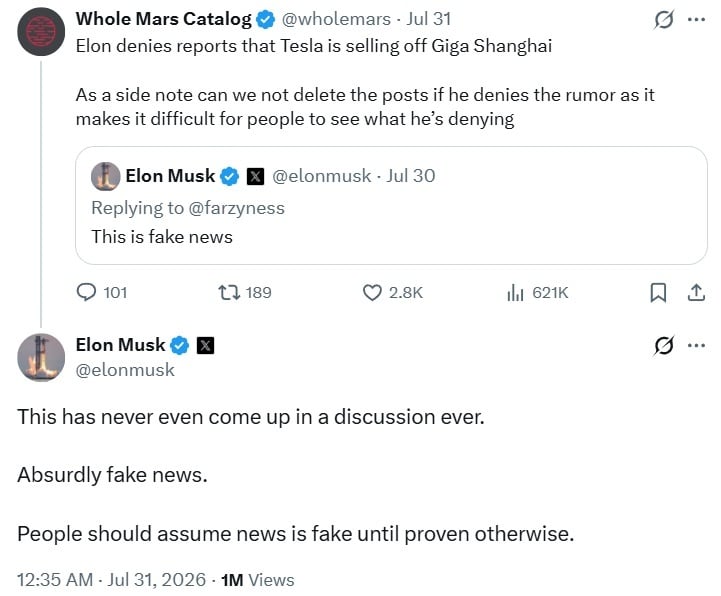
Elon Musk rejected a report that Tesla Inc. (Nasdaq: TSLA) had explored selling or separating its China business as part of preparations for a potential merger with SpaceX, framing the story as entirely inaccurate while drawing broad investor attention.
Musk characterized the report as fabricated, maintained that selling or separating Tesla’s China operations had never entered internal discussions, and urged readers to treat unverified news claims skeptically.
The Wall Street Journal’s report on a potential sale or spinoff of Tesla’s China business, citing people familiar with the matter, said Musk had instructed executives to structure the company’s U.S. and China operations so they could be separated amid geopolitical tensions. The newspaper said the move could also facilitate any future combination with SpaceX, while characterizing the planning as precautionary rather than a finalized transaction.
Tesla’s China Operations Remain Central to Its Business
Tesla’s latest quarterly filing identifies China as one of the company’s largest markets and a major manufacturing hub through Gigafactory Shanghai, which supplies vehicles to domestic buyers and export markets while remaining an important contributor to production and revenue.
The automaker reported second-quarter production of more than 450,000 vehicles and deliveries exceeding 480,000 vehicles, underscoring the operational scale surrounding any discussion involving its China business and explaining why reports about the facility quickly attracted market attention.
Discussion about a potential Tesla-SpaceX merger has gained momentum in recent months. The speculation followed Musk’s projection that SpaceX could generate about $1 trillion in annual revenue by 2030, compared with Morgan Stanley’s $330 billion estimate, after its June 12 Nasdaq debut raised about $75 billion at a $1.75 trillion valuation.
Prominent investor Steve Eisman treated a combination as plausible during a June 8 interview, although he viewed acquiring Tesla as unfavorable for SpaceX shareholders. Eisman linked his skepticism to Tesla’s weakening earnings, the capital-intensive electric vehicle market, and lower-cost Chinese competition, while reported SpaceX share demand reached $250 billion against the company’s planned $75 billion offering.
Crypto Holdings Add Another Dimension
Both companies also hold significant bitcoin reserves, giving any discussion involving their ownership structures added relevance for digital asset markets and institutional investors following corporate treasury strategies.
Recent disclosures indicate SpaceX holds 18,712 BTC and Tesla holds 11,509 BTC, representing a combined treasury of 30,221 bitcoin if the companies were ever brought under a single corporate structure.
Separate market volatility has also affected both businesses, with SpaceX’s valuation and Tesla’s share price remaining key drivers of Elon Musk’s net worth after reports of a sharp one-day decline in his fortune during recent trading.



Be the first to comment