



A security flaw affecting Coldcard hardware wallets has sent shockwaves through the cryptocurrency community, prompting urgent calls for users to move their funds and abandon old recovery phrases.
Following the discovery, Coldcard maker Coinkite issued a public advisory urging customers to upgrade affected devices, generate a completely new seed phrase, and carefully transfer their bitcoin to a newly secured wallet. The warning quickly spread across social media as prominent crypto figures amplified the message.

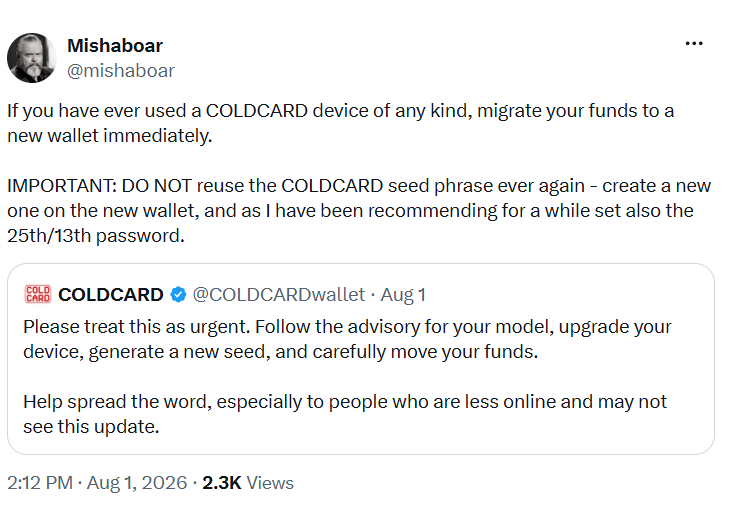
Meanwhile, Dogecoin community member Mishaboar urged users who had previously used a Coldcard device to migrate their funds immediately and avoid reusing any existing Coldcard seed phrase. He also recommended adding an additional passphrase layer for extra protection.
The concern stems from a vulnerability linked to a firmware release dating back to March 2021. According to reports, the flaw involved weak software-based randomness during key generation, potentially allowing attackers to recreate private keys and systematically drain wallets.
Coldcard described the situation as urgent, asking users to follow model-specific instructions, upgrade their devices, create a new seed, and move funds with caution. Community members have also been warning less-active users who may not see the advisory online.

 
The incident has reignited one of crypto’s oldest debates: whether self-custody is truly safer than relying on regulated custodians.
Notably, reports circulating in the industry suggest that roughly $89 million in bitcoin may have been affected by the vulnerability. While the full scope of losses has not been independently confirmed, the figure has intensified scrutiny of hardware-wallet security practices.
Bloomberg senior ETF analyst Eric Balchunas said the incident reinforces the argument for regulated spot Bitcoin ETFs. He questioned whether a relatively small company should be responsible for securing assets worth billions of dollars and contrasted that with the far larger security, compliance, and operational infrastructure maintained by major institutional custodians.
His remarks sparked a broader discussion about the trade-offs between sovereignty and security. Supporters of self-custody note that users retain full control of their coins and avoid counterparty risk. Critics counter that technical failures, poor operational practices, or overlooked vulnerabilities can create catastrophic losses for individual holders.
However, Balchunas acknowledged that ETFs have important limitations. Investors cannot withdraw bitcoin directly at any time or use ETF shares for payments or on-chain transactions. However, he suggested that long-term investors seeking only price exposure may increasingly prefer regulated investment products after the Coldcard scare.
Nevertheless, as users rush to migrate coins, the broader market reaction has remained relatively contained. Bitcoin’s price has not shown panic selling associated with a major exchange collapse, suggesting that traders currently view the issue as a wallet-specific security event rather than a systemic threat to the Bitcoin network itself.
That said, the Coldcard vulnerability has left the crypto community on edge, serving as a stark reminder that in digital finance, control over private keys brings not only freedom but also the full weight of security responsibility.






Be the first to comment