



Subscribe to Bankless or sign in
Hyperliquid’s HIP-4 markets have had their largest success stem from the  World AIWorldcoin is an initiative creating a global, AI-resistant identity and financial network.View Profile” class=”stubHighlight”> World Cup.
I didn’t expect this. When HIP-4 launched, I argued that Hyperliquid was not really coming for Polymarket or Kalshi. That outcome markets rather looked more like an extension of its trading stack: daily crypto binaries for hedging perps, options-like exposure, and another way to keep every leg of a position inside Hyperliquid.

Breaking Down Hyperliquid’s Prediction Play on Bankless
The HIP-4 upgrade brings “outcome markets” to the much-hyped exchange, adding binary trading alongside perps.
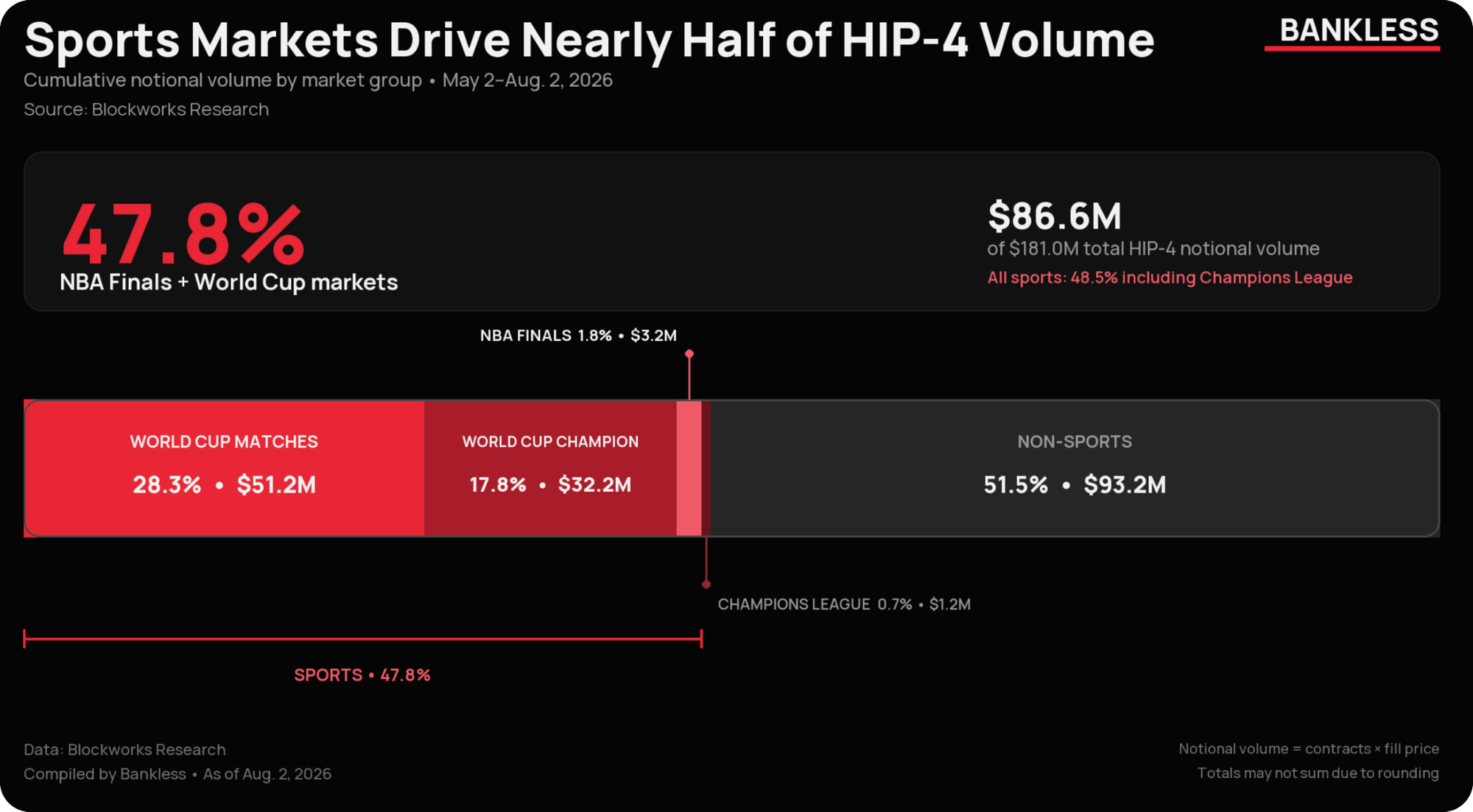
Instead,  Hyperliquid DerivativesHyperliquid is a Decentralized Exchange and L1 for perpetual futures trading.View Profile” class=”stubHighlight”> Hyperliquid launched markets for the NBA Finals, individual World Cup matches, and the tournament winner. Those three categories, though overwhelmingly the latter two, have accounted for roughly 48% of HIP-4 volume to date.
Since the height of the tournament, open interest is down more than 90%. To be clear though, HIP-4 has not failed. It’s simply run out of things to trade for the time being.
The system is still permissioned, so validators currently deploy every market. What remains is a thin book of price-related questions pulling trivial amounts of volume compared to that spurred by sports.
That constraint is what Hyperliquid is now trying to remove. On July 31st, permissionless HIP-4 deployments went live on testnet, paving the way for teams to create and operate outcome markets on their own, while showing what it will take to do so.
How Permissionless HIP-4 Works
Note that permissionless deployments will not mean unlimited deployments.
Under the preliminary mainnet design, validators first approve market templates, i.e. reusable structures that define how a market can be created and settled. A deployer then uses an approved template to launch a specific market, supplying details like the question, possible outcomes, expiration, and resolution criteria.
Take politics for example — you’ll see why in a minute — where an approved binary-event template could potentially support a market on whether a candidate wins an election. But Hyperliquid hasn’t disclosed how broad each template will be, so it is unclear whether one could cover Senate, House, and governor races, or whether different structures would be needed for party-control, seat-count, or multi-candidate questions.
Enjoying this article?
Subscribe to Bankless or sign in
What is clear is that deployers will launch markets by instantiating templates validators have already approved, rather than seeking approval for each individual market.
As in HIP-3, deployers are responsible for defining and settling markets correctly, and validators can slash their stake if they get it wrong.
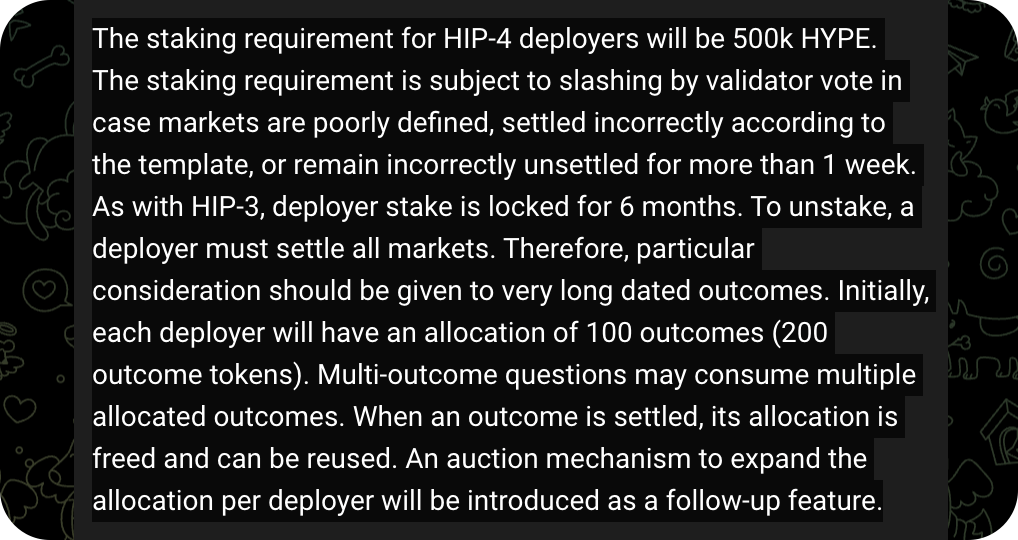
That proposed stake is 500,000 HYPE (same as HIP-3), locked for six months and withdrawable only when no outstanding markets exist. Each deployer will initially receive capacity for 100 outcomes, reusable once markets settle, with an auction for additional capacity planned later. Deployers will eventually be able to receive up to 50% of the trading fees from their markets.
What’s Next After the World Cup?
The most obvious target is the U.S. midterms.
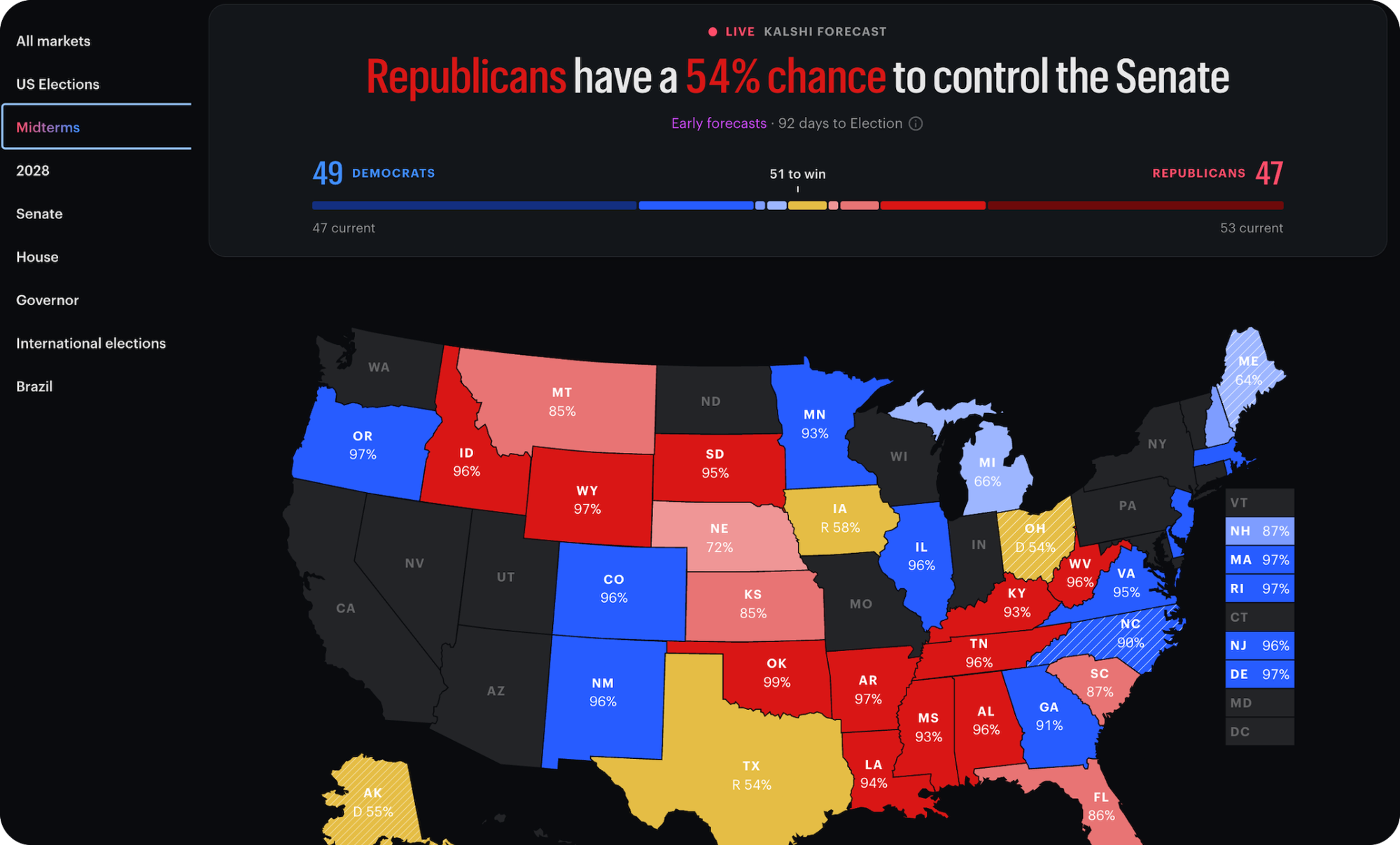
Prediction markets first broke into the mainstream through politics, and both Kalshi and Polymarket already run broad election dashboards covering congressional control, individual races, and seat totals. HIP-4 currently offers none.
Whether outside deployers can go ahead and fill that gap depends on how quickly permissionless HIP-4 moves to mainnet. HIP-3 took 164 days from its first permissionless testnet MVP to mainnet, though only 18 days from publishing its initial mainnet specification and making HIP-3 eligible for mainnet-level bug bounties.
HIP-4 sits somewhere between those points. Its preliminary mainnet structure is public and deployer actions are live on testnet, but there are no mainnet-level bug bounties. We’re in limbo for now.
If this system arrives in time, a deployer could use the midterms to build an entire election venue rather than launch isolated questions, so long as validators also approve templates supporting elections.
If permissionless deployment misses that window, validators could still list midterm markets themselves. HIP-4 could recover activity either way. What it would lose is its first major opportunity to prove that outside deployers can keep it supplied with timely markets.
The World Cup proved Hyperliquid users will trade major real-world events. It also proved that, when these events end, there’s not much else to go on. The intensity of this midterms cycle would be a strong opportunity for HIP-4 to act on, helping it simultaneously stay relevant and jumpstart permissionless deployments. Keep an eye on this in the weeks ahead.


Be the first to comment