



Could investors staking more Ethereum be tightening market liquidity?
On-chain data suggests it could. In theory, investors lock more ETH in staking, which shrinks the amount of liquid ETH available to trade.
With fewer coins circulating, market liquidity naturally becomes tighter. That means even relatively small buying or selling pressure can have a bigger impact on price.
From a staking perspective, this trend already appears to be playing out.

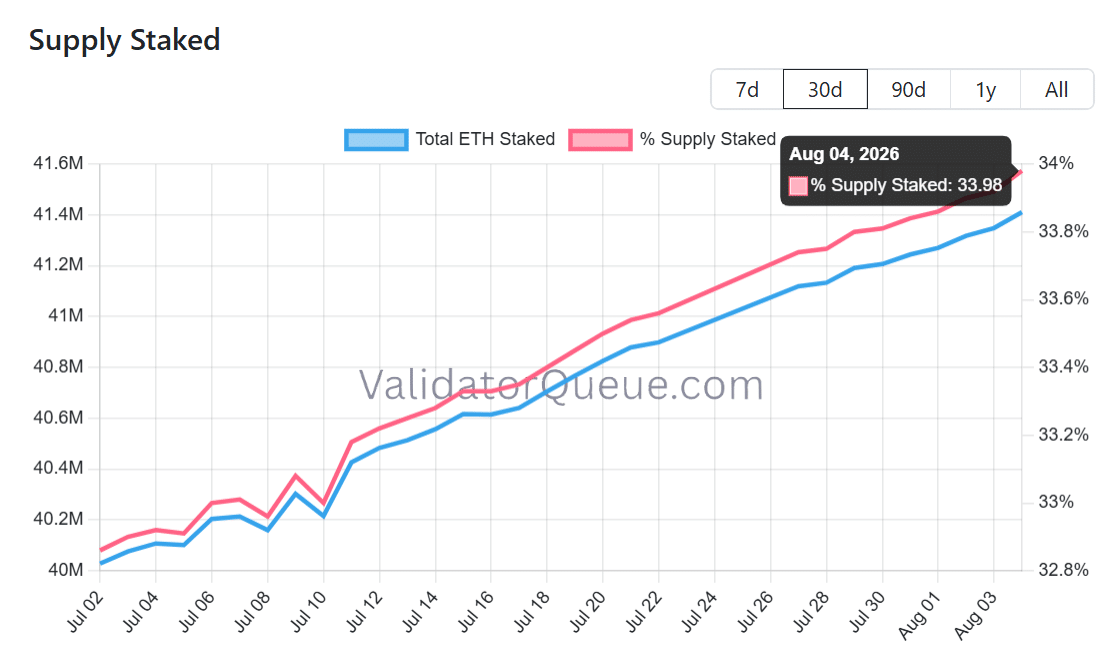
As the chart below shows, Ethereum’s total staked supply has climbed to a new all-time high of 41.4 million ETH, representing roughly 34% of the total ETH supply.
More notably, over 1.4 million ETH have moved into staking in just the past week, further reducing the amount of ETH readily available on the open market.
Recent Lookonchain data suggests this isn’t an isolated trend.
Tom Lee’s BitMine, for instance, staked another 150,120 ETH (around $278 million), bringing its total staked holdings to 5.07 million ETH worth roughly $9.38 billion, about 87.4% of its total ETH holdings.
Whales are following the same strategy. A wallet withdrew another 19,000 ETH and staked it immediately.
Over the past three weeks, the same wallet has withdrawn and staked a total of 112,000 ETH worth more than $208 million.
Taken together, the data points to the same trend: Investors are locking more ETH in staking, leaving less available to trade. While that has likely helped fuel Ethereum’s 18%+ rally so far in Q3, it also raises a bigger question for the broader market.
If Ethereum [ETH] continues moving into staking at this pace, could shrinking liquid supply start tightening liquidity across the crypto market?
Ethereum’s rising staked supply puts crypto liquidity in focus
The stablecoin market may be entering its weakest phase on record.
From a technical standpoint, STABLE.C (the total stablecoin market cap) has declined 1.6% this quarter, marking its worst quarterly performance on record. The drop coincides with more than $6 billion in liquidity exiting the crypto market.
Against this backdrop, Morgan Stanley downgraded Circle to Underweight and cut its price target from $106 to $38, citing slower USDC growth and increasing pressure on reserve income.
Notably, this technical weakness is now showing up in on-chain data.
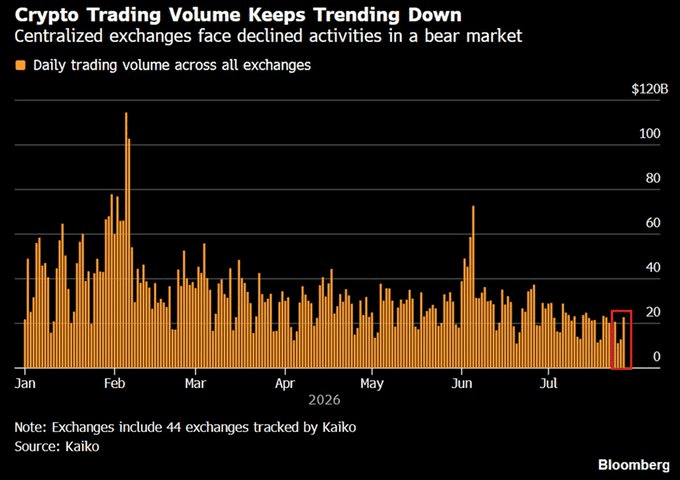
As the chart below shows, crypto trading activity continues to slow. Daily spot trading volume across the 44 exchanges fell to around $15 billion last week, its lowest level of the year and nearly 70% below January’s peak.
At the same time, average daily trading volume has dropped around 50% since December 2025 to roughly $20 billion. The message is clear: Crypto market liquidity continues to dry up.
Against this backdrop, Ethereum’s rising staking activity adds another dimension to the liquidity story.
As investors continue moving ETH into staking, they reduce the amount of ETH available for trading.
With less liquid supply, order books can become thinner, making prices more sensitive to buying and selling pressure. With crypto trading activity slowing and stablecoin liquidity continuing to shrink, liquidity across the broader market could remain under pressure.
Ethereum, however, continues to lead the market. ETH is up more than 18% this quarter, suggesting investors are concentrating capital in the asset. If that trend continues, Ethereum could become the key barometer for broader crypto market performance.
Final Summary
- Ethereum’s staked supply hit a record 41.4 million ETH, leaving fewer coins available to trade as more investors lock ETH in staking.
- With stablecoin liquidity and trading volumes falling, Ethereum could become a key signal for where the broader crypto market is heading.



Be the first to comment