



Zcash is preparing for one of its most significant governance events in recent years as coinholders will vote on the scope of the upcoming NU7 network upgrade. Scheduled to begin on Aug. 25 and run for approximately 18 days, the vote will determine several protocol-level decisions that could shape the network’s future development.
The update in a nutshell
However, the results will only be considered legitimate if at least 1,000,000 ZEC participates in the process.
The vote is being coordinated by Valar Group and Project Tachyon using a newly developed Tokenholder Voting Chain, replacing Zcash’s previous governance mechanism.

The system is designed to preserve privacy by allowing shielded wallet users to participate without revealing their identities while ensuring that funds remain secure.
The voting infrastructure relies on a distributed election authority consisting of at least 10 validators, with vote tallies recoverable only after approval from two-thirds of the validator set.
To be eligible, users must hold spendable shielded ZEC in Ironwood at the blockchain snapshot scheduled for Aug. 24 at 19:00 UTC. After the snapshot, funds can be moved freely while voting remains open until Sept. 12.
Five major update points
Coinholders will decide whether Zcash should replace traditional halvings with a smoother issuance curve under the Network Sustainability Mechanism (NSM), when transaction fee reissuance should begin, whether the legacy Sprout transaction format should finally be deprecated, whether block times should be reduced from 75 seconds to 25 seconds, and how aggressively the NU7 release schedule should proceed if certain features are not completed before the proposed deadline.
From a governance perspective, the 1 million ZEC participation threshold is particularly notable. With Zcash’s circulating supply remaining well below Bitcoin’s, securing that level of participation would represent substantial engagement from long-term holders and could provide stronger legitimacy for future protocol decisions.
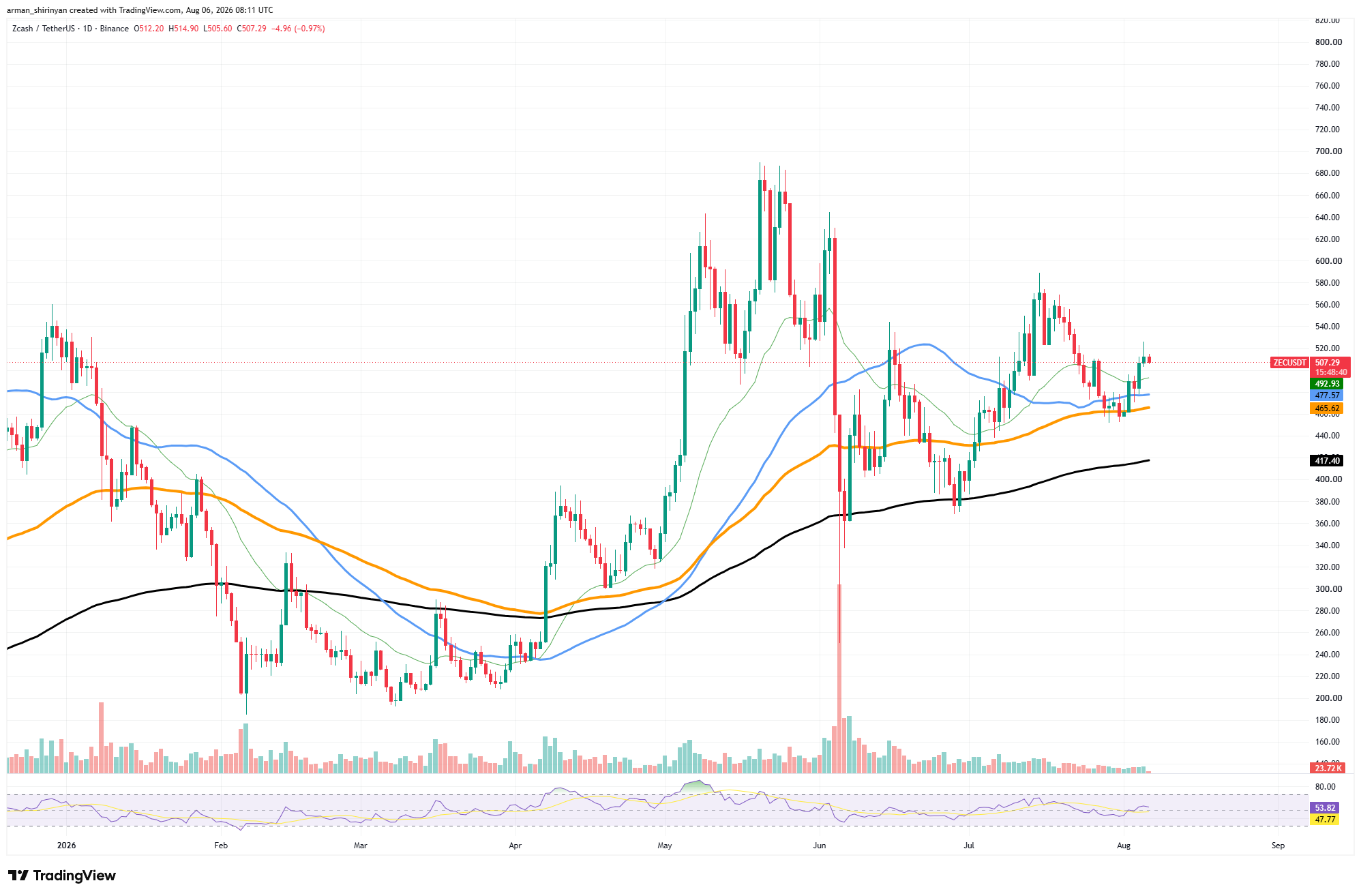
Meanwhile, ZEC’s market structure has also improved technically. The asset is trading above its 20-day, 50-day and 100-day moving averages, while the 200-day moving average continues to trend higher below current price action.
The token recently reclaimed the psychologically important $500 level and is consolidating above nearby support. The RSI has recovered to around 54, reflecting balanced momentum rather than overheated buying conditions.
If ZEC maintains support above the cluster of shorter-term moving averages, attention could shift toward another attempt at the recent swing highs established earlier this summer.


Be the first to comment