



What to know:
- XRP is stabilizing after a prolonged downtrend, with key support between $1.20–$1.35.
- A breakout above $1.50 could trigger a recovery toward $1.80 or higher.
- Ripple is expanding institutional operations in Brazil, strengthening long-term adoption signals.

XRP is showing signs of stabilization after a prolonged downtrend, with market participants closely monitoring key technical levels for a potential breakout, while broader momentum is also being shaped by Ripple’s continued expansion into regulated institutional markets such as Brazil.
XRP trading at $1.43, rising 2.93% as 24-hour trading volume surged to $3.39 billion, marking a significant 109.19% increase in activity. Despite the short-term uptick, the asset remains down 4.94% over the past week, indicating that broader bearish pressure has not fully dissipated.

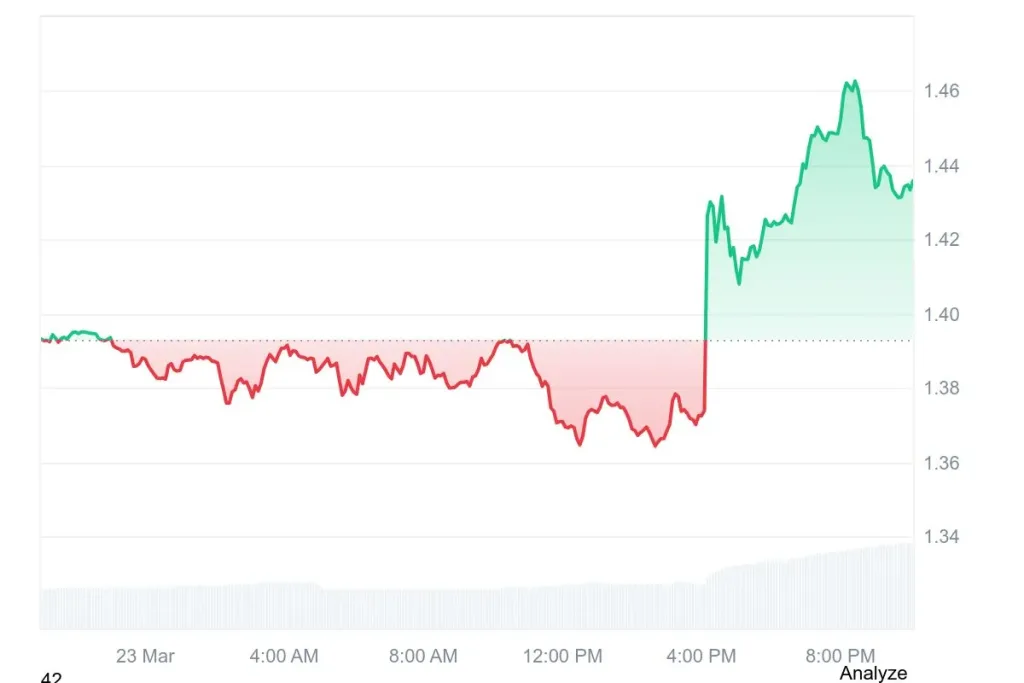
XRP Price Stabilizes in Accumulation Zone
According to crypto analyst BitGuru, XRP has been navigating a prolonged downtrend but is now showing signs of stabilization within the $1.20–$1.35 accumulation zone. This range is increasingly viewed as a region where buying interest is beginning to absorb supply, potentially setting the stage for a directional move.
From a technical perspective, a decisive breakout above the $1.50 resistance level could invalidate the prevailing bearish structure and open the door for a potential recovery toward $1.80 or higher.
Conversely, a failure to maintain support could extend consolidation and delay any meaningful reversal. XRP’s daily chart reflects a clear transition from early consolidation into a sustained downtrend characterized by lower highs and lower lows.
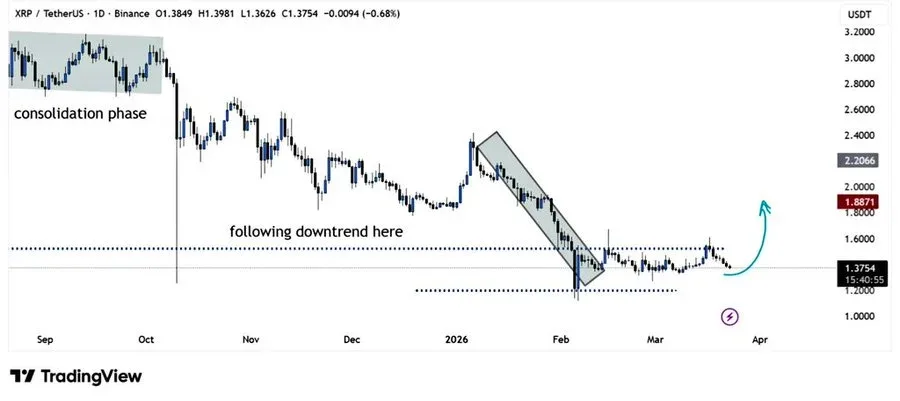
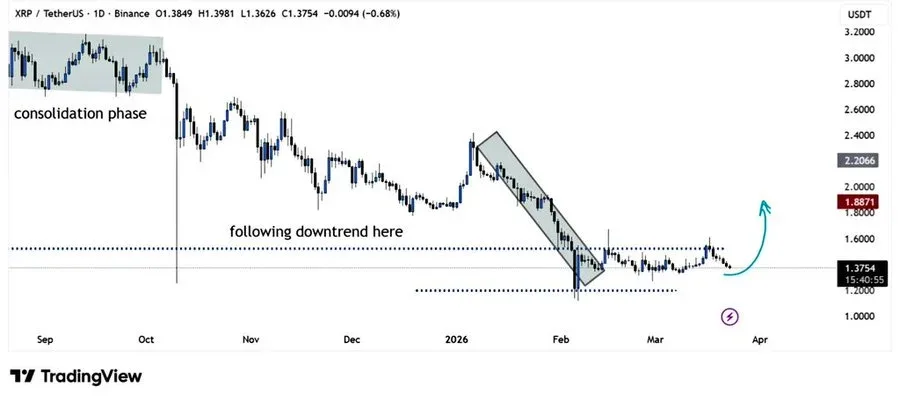
This gradual decline suggests controlled distribution rather than abrupt liquidation, with sellers maintaining consistent pressure over time. As the trend progressed, price action formed a descending channel that pushed XRP toward a key support region between $1.20 and $1.30.
Within this zone, bearish momentum has begun to weaken, as evidenced by tighter candlestick formations and repeated rejections of lower price levels. In recent sessions, XRP has entered a narrow consolidation phase just above support, a condition often associated with reduced volatility and market indecision.
Such compression typically precedes a larger move, as liquidity builds on both sides of the market. The current structure places XRP at a pivotal inflection point where market participants are weighing two primary scenarios: continuation of the downtrend or the emergence of a reversal.
Confirmation of either outcome will likely depend on whether price can break above resistance or sustain its position above support.
Also Read | XRP Forms Falling Wedge as Bulls Eye Break Above $1.46
Ripple Expands Institutional Presence in Brazil
Beyond price action, Ripple is advancing its institutional strategy with a major expansion in Brazil, one of Latin America’s most dynamic financial markets. The initiative reflects growing demand for blockchain-based financial infrastructure among regulated institutions.
The company is also preparing to apply for a Virtual Asset Service Provider (VASP) license with the Central Bank of Brazil, aligning its operations with the country’s evolving regulatory framework. This move reinforces Ripple’s compliance-first approach and its emphasis on long-term institutional integration.
Ripple’s payments network, which has processed over $100 billion globally, is being utilized by Brazilian financial institutions to improve cross-border settlement efficiency and liquidity management. Institutions including Banco Genial and Braza Bank are leveraging these capabilities for faster and more transparent transactions.
In parallel, Ripple is expanding its enterprise offerings, including custody solutions and its USD-backed stablecoin RLUSD, which is gaining traction across exchanges and fintech platforms. Additional partners such as Nomad and Azify are integrating Ripple’s infrastructure to streamline treasury operations and cross-border flows.
As institutional adoption accelerates, Ripple’s growing footprint in Brazil highlights a broader trend toward regulated digital asset infrastructure, positioning the region as a key hub for blockchain-powered financial services.
This article contains market analysis and price predictions. These are not guarantees. Crypto markets are volatile. Always DYOR. Not financial advice.
Also Read | XRP’s Massive $1B Bet Positively Reshapes Global Finance



Be the first to comment