



An analysis by FXC Intelligence, using Allium’s data, found that stablecoins were used for an estimated $135 billion in non-wholesale cross-border payments in 2025, which equals 0.31% of the $44 trillion market, Asian Banking and Finance reported on August 10.
The figure is up from the $82 billion report in 2024, when stablecoins accounted for 0.2% of $40.5 trillion in cross-border payments.
Business-to-business payments remained the largest use case for stablecoins and traditional currency transactions, accounting for 79% of cross-border payments in traditional currency and 49% of payments in stablecoins.
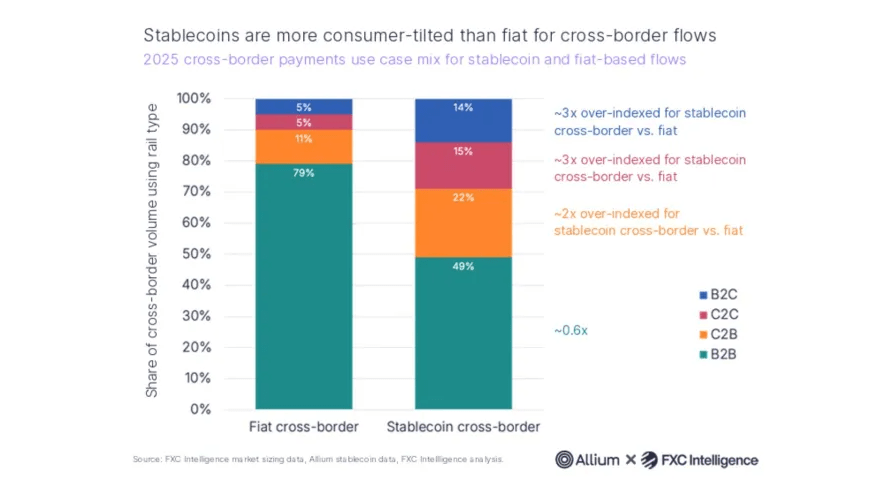
Consumer-to-consumer transfers accounted for 15% of stablecoin volumes, compared with 5% of traditional currency payments. Business-to-consumer payments recorded 14% of stablecoin transactions and 5% of traditional currency payments, while consumer-to-business payments accounted for 22% of stablecoin volumes, double their 11% share of traditional currency flows.

The data indicates that, although stablecoins are growing rapidly and seeing increased usage in consumer transactions, the asset still represents a minor portion of the total market for cross-border payments.
Domestic-currency stablecoins may boost demand for dollar-backed tokens: IMF
In other news, International Monetary Fund (IMF) First Deputy Managing Director Dan Katz recently said that users may prefer digital dollars due to their liquidity, network effects, and broader acceptance in cross-border transactions.
In a speech at the University of Cape Town, in South Africa, Katz emphasized that when local and dollar-denominated stablecoins share the same blockchain infrastructure, users can convert the assets through decentralized exchanges, liquidity pools, or peer-to-peer swaps. He added that this might steer foreign exchange activity away from traditional banks and currency brokers, reducing friction and allowing authorities to regulate and manage capital flows more effectively.
“In this way, local-currency stablecoins might even accelerate the adoption of FX stablecoins,” he noted. “Once a local-currency stablecoin exists on the same blockchain infrastructure as dollar stablecoins, conversion between the two becomes an on-chain transaction, meaning that depending on the use case, there may be a diminished need for traditional financial intermediaries.”
The IMF director pointed out the situation in South Africa, where dollar-pegged stablecoins have seen limited success while rand-linked tokens have gathered even less demand.
Although it is too early to draw definitive conclusions, Katz mentioned that many users might be inclined toward dollar tokens due to their liquidity, network effects, and acceptance across various platforms and borders.
He warned that the implications of stablecoins could differ significantly depending on the country. Stablecoins may largely replace the existing dollar holdings in highly dollarized economies, but they could also increase foreign-currency demand in countries where access to dollars is restricted and where economic frameworks are weak.
“The impact of FX stablecoins on emerging markets depends on country circumstances: the strength of macro frameworks, whether currency substitution is already prevalent and in what form, the financial market structure, and the availability of local-currency stablecoins,” he said.
In the end, Katz called on authorities to create regulatory frameworks that include onramps, offramps, and on-chain exchange mechanisms.
The IMF director revealed that market capitalization of stablecoins nearly tripled between 2021 and 2025, but has remained flat over the last year at around $300 billion. Over 99% of the stablecoins are in U.S. dollars, with reserves largely held in short-term T-bills and reverse repos.
In addition, Katz said that the total stablecoin transaction volume exceeded $30 trillion in 2025, of which $6.1 trillion was cross-border. Most of the activity remains within the crypto ecosystem, and is driven by bots and algorithmic arbitrage, he explained. Also, according to his research, the Bank for International Settlements estimated that there were only $390 billion in payment-related stablecoin flows in 2025.
Watch | Cut Costs & Streamline Payments: The Case for Stablecoins


Be the first to comment