


VanEck said on Aug. 18 that Bitcoin may be approaching an accumulation phase after eight of its 12 capitulation indicators remained active as of Aug. 12.
Summary
- Eight of VanEck’s 12 Bitcoin capitulation signals were active on August 12, indicating late cycle stress.
- All 12 indicators entered capitulation territory during the three months preceding VanEck’s August research update.
- Long term holder supply dropped 356,534 BTC, leaving 11.84 million BTC untouched for over one year.
- U.S. spot Bitcoin ETPs absorbed $663 million while realized volatility declined to 27.2% over 30 days.
- Historical capitulation clusters lagged Bitcoin’s baseline for six months, outperforming only across one year holding periods.
The asset manager’s latest report placed the current correction in its tenth month, measured from Bitcoin’s October 2025 peak. VanEck estimated that the next turning point could arrive between September and November if the current cycle follows earlier patterns.
However, the firm did not present the historical timetable as a reliable price forecast. VanEck disclosed that it has exposure to Bitcoin and warned that its forward return study uses a small number of heavily overlapping observations.

Bitcoin capitulation signals point to late cycle stress
VanEck considers a signal active when its latest reading reaches an extreme historical percentile. Most indicators must fall within the bottom 15% of their recorded history, or the top 10% when a high reading represents stress.
Price drawdown uses a separate threshold. VanEck activates this signal when Bitcoin falls at least 35% from its peak. Bitcoin was down approximately 49% from its October record in the firm’s analysis, although that decline ranked only in the 35th percentile of its own history.
Applying the same percentile rule to the drawdown would reduce the total from eight active signals to seven. VanEck defended the separate threshold by arguing that institutional ownership and spot ETP demand could produce a shallower bear market than previous cycles.
The firm said it “expects a shallower trough this cycle,” but acknowledged that this remains an assumption rather than a confirmed market outcome. Earlier Bitcoin bear markets produced drawdowns ranging from 78% to 94%.
Historical returns offer no clear six month advantage
VanEck’s backtest provides a cautious reading for investors expecting an immediate rebound. When between eight and 12 indicators were in capitulation territory, Bitcoin returned an average 12.8% over the following 90 days. Its baseline return for all comparable periods was 15.2%.
The same group generated an average 32% return over 180 days, below the 36.3% baseline. Outperformance appeared only across the one year horizon.
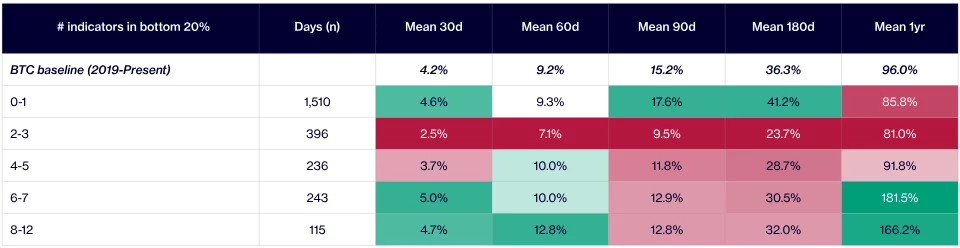
VanEck warned that the one year result came from 115 observation days that overlapped heavily. Those observations represent only a small number of separate market episodes. The firm said it does not place substantial weight on that result.
The findings suggest capitulation readings may identify late cycle conditions without identifying an exact bottom. They also leave room for prolonged sideways trading before a durable recovery begins.
U.S. fund inflows absorb long term holder selling
U.S. spot Bitcoin ETPs recorded approximately $663 million in net inflows during the 30 days covered by VanEck. The total represented about 10,400 BTC at prevailing prices and reversed roughly $2.4 billion of outflows during the preceding month.
Fund flows remained uneven after VanEck’s measurement period. U.S. spot funds lost about $385.2 million across the week ending Aug. 14, as crypto.news reported in its analysis of why liquidity has yet to return.
Demand then recovered. Farside data showed $297.5 million of net inflows on Aug. 17 and another $189.3 million on Aug. 18. The combined $486.8 million partly reversed the previous week’s withdrawals.
Those inflows followed earlier signs of ETF demand supporting the $64,000 area. Bitcoin traded near $64,250 on Aug. 19, above VanEck’s Aug. 11 closing reference of $63,549 but still below its 200 day moving average.
Long term holders complicate the accumulation case
Coins held for longer than one year declined by 356,534 BTC over 30 days, according to VanEck’s Glassnode based figures. Holdings fell 2.9% to 11.84 million BTC, equal to 59.1% of circulating supply.
All six long term age groups contracted. Coins aged between one and two years recorded the largest reduction at approximately 156,000 BTC. Holdings older than ten years fell by only about 4,000 BTC, suggesting the oldest wallets remained comparatively inactive.
VanEck said some movements may have involved wallet security rather than sales. The firm cited concern following the Coldcard security failure, which crypto.news examined in its coverage of the $89 million wallet drain.
It nevertheless called the security explanation difficult to verify. Confirmed losses were far smaller than the total movement by aged coins. Exchange inflows separated by coin age could help determine whether holders transferred funds to trading venues or moved them between private wallets.
The period from September through November now provides the next test of VanEck’s cycle framework. A sustained increase in spot demand, stronger trading volume and stabilization in long term holdings would support the accumulation case. Continued distribution or renewed fund outflows would weaken it.



Be the first to comment