



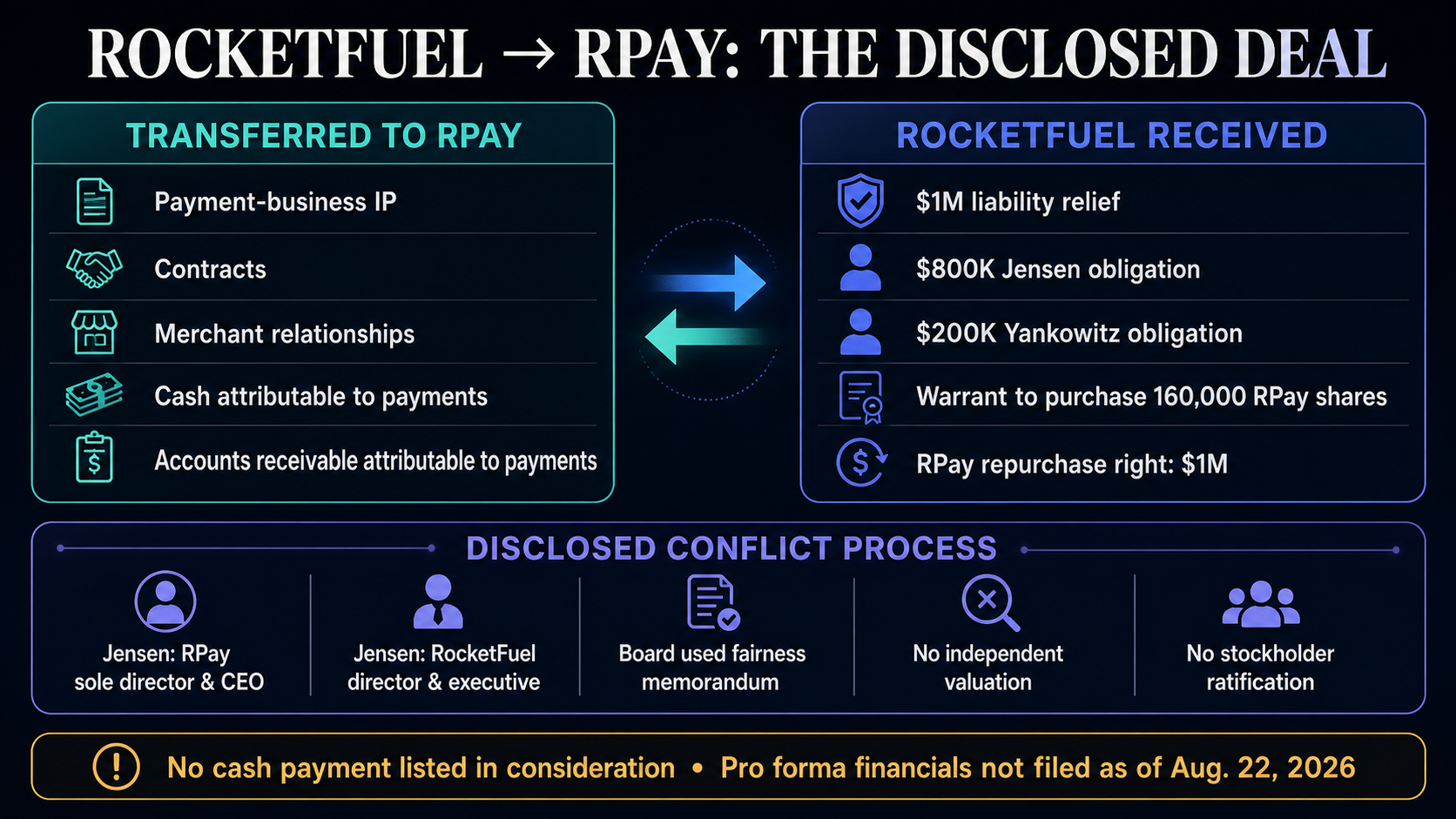
RocketFuel Blockchain transferred substantially all assets used in its payments business to RPay, whose sole director and CEO, Peter M. Jensen, also serves as a RocketFuel director and executive officer.
The related-person deal closed Aug. 13 and was disclosed in an Aug. 21 regulatory filing. RocketFuel said the assets used primarily in payments included intellectual property, contracts, merchant relationships and other assets, together with cash and accounts receivable attributable to that business.
The disclosed consideration centered on debt relief. RPay assumed $800,000 in deferred compensation that RocketFuel owed Jensen and $200,000 owed to Bennett J. Yankowitz, a former RocketFuel director and executive who remained on its advisory board. RocketFuel was released from both obligations at closing.

The filing’s consideration section did not list a cash payment to RocketFuel. It described consideration received by the company, not a distribution to its stockholders.
RocketFuel also received a warrant to purchase 160,000 RPay common shares. The warrant is subject to a $1 million repurchase right exercisable by RPay at any time, meaning the filing did not describe RocketFuel as receiving either the underlying shares or $1 million in cash at closing.
RocketFuel said Jensen’s interests differed from those of stockholders generally, citing the assumption of his compensation claim and the warrant terms. Yankowitz’s assumed obligation is payable at $0.25 for each $1 paid to Jensen, at the discretion of RPay’s board.
RocketFuel’s board determined that a stockholder vote was not required under NRS 78.565. The company said the board approved the transaction using a fairness memorandum that addressed the disclosed conflicts, rather than obtaining an independent valuation or stockholder ratification.
The final disclosure differs from a March non-binding term sheet covering proposed sales to RPay and RPoints, the proposed buyer of RocketFuel’s loyalty and rewards business. That preliminary two-buyer package contemplated about $1.5 million in deferred-compensation assumptions, a payments-revenue earn-out and warrants for 20% fully diluted stakes in both companies. A separate RPoints filing was not visible in RocketFuel’s Aug. 22 SEC submissions, so those combined preliminary terms cannot be compared with the RPay-only package as if they covered the same scope.
The full financial effect remains unresolved. RocketFuel called the RPay sale a significant disposition under SEC asset and income tests, but its Aug. 21 filing did not include the required unaudited pro forma financials. The company said it would provide them in a later Form 8-K/A; its SEC submissions history showed no such amendment as of Aug. 22.



Be the first to comment