



Stablecoins are once again in focus, with the Bank for International Settlements (BIS) casting doubt on their ability to become a consistent source of currency as authorities implement new regulatory policies for the industry.
Pablo Hernández de Cos, general manager of BIS, said stablecoins cannot be seen as a credible payment method. Rather, he believes that tokenized bank deposits will serve as an alternative route to integrating blockchain into the financial system, Reuters reported.
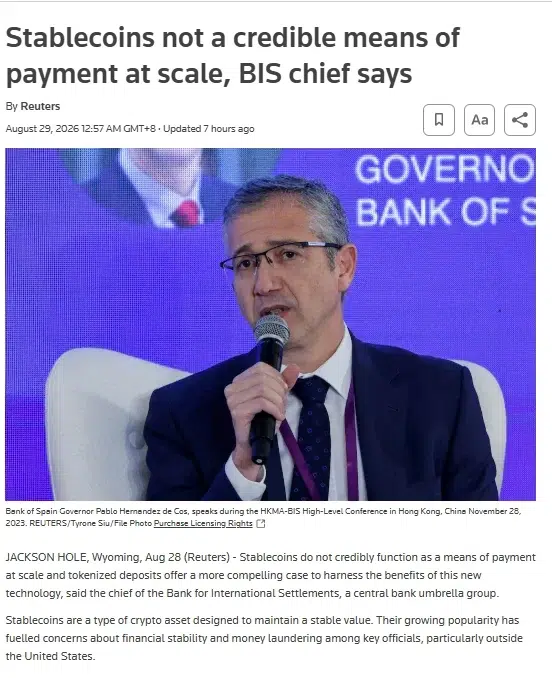
“Tokenized deposits will make it easier to use the benefits of tokenization and keep the basics of the monetary system intact,” de Cos said.
These remarks follow ongoing efforts by regulators in key economies to formulate regulations related to stablecoins. A recent research report published by the Financial Stability Institute (FSI), an arm of BIS, reveals this fact as well.

Also Read | Bitcoin’s $81,000 Resistance Sets 1 Key Test in This Cycle
Stablecoins Face Questions Over Wider Adoption
De Cos admitted that stablecoins could bring some advantages, including the ability to lower the cost of borrowing by the government. Scott Bessent, US Treasury Secretary, made the same point.
Nevertheless, De Cos also noted that increased use of stablecoins would lead to additional consumer expenses if a lot of funds were transferred from bank deposits into digital coins.
If consumers move their savings into stablecoins, then the banks will be losing one of their sources of funding, which may become expensive for them and eventually for consumers and firms in terms of borrowing.
De Cos further mentioned that another issue was low interconnections among various stablecoin platforms and difficulties in implementing anti-money laundering rules.
Another problem could arise from the increasingly popular usage of stablecoins that are pegged to the US dollar in other parts of the world apart from the US. According to De Cos, the broad use of stablecoins would compromise the monetary sovereignty of certain nations.
Global Stablecoin Rules Take Different Paths
The FSI study released on Thursday analyzed stablecoin regulations in the US, EU, UK, Hong Kong and Singapore. It was noted that there are notable differences in the issuance of stablecoins and other services that the firms involved may provide.
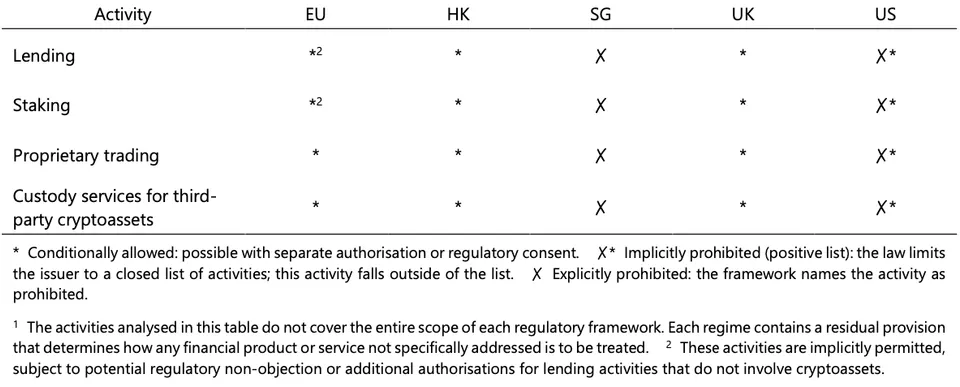
The US and Singapore have imposed relatively stringent laws on the issuance of stablecoins by non-banks. In the US, under the GENIUS Act, non-bank stablecoin issuers may not undertake such activities as loans, staking, proprietary trading, and holding of cryptoassets on behalf of third parties.
In the case of Hong Kong, the UK and the EU, the approach is more relaxed. The company may engage in certain additional activities if the company receives necessary regulatory approval or any other permission.
The FSI researchers also observed that the restrictions applicable in all five countries are applied to the stablecoin issuer company and not the whole corporate group.
As such, other companies belonging to the same corporate group may engage in certain activities which cannot be performed by the regulated stablecoin issuer company.
This reveals the increasing attention of regulators towards stablecoin issuers as governments try to strike the right balance between innovation and financial stability.
Also Read | Lazarus Group Bitcoin Wallets Stir Again With $19.4M Move


Be the first to comment