


On Aug. 21, 2026, decentralized exchanges across the chains tracked by DeFiLlama processed about $10.5 billion in spot volume over 24 hours.
Summary
- Solana handled about $48.5 billion in monthly decentralized exchange volume, according to DeFiLlama data reviewed.
- Five leading venues generated roughly 62% of daily volume, showing liquidity remained highly concentrated overall.
- Low network fees support frequent trading, but priority auctions can raise execution costs during congestion.
- AMMs, order books and hybrid venues offer different tradeoffs involving depth, transparency, execution and custody.
- Traders should examine pair-specific depth, slippage, incentives and custody arrangements before routing large orders onchain.
Solana accounted for roughly $2.8 billion. The picture was similar over 30 days: $48.5 billion of the market’s $181.2 billion total, or just under 27%.

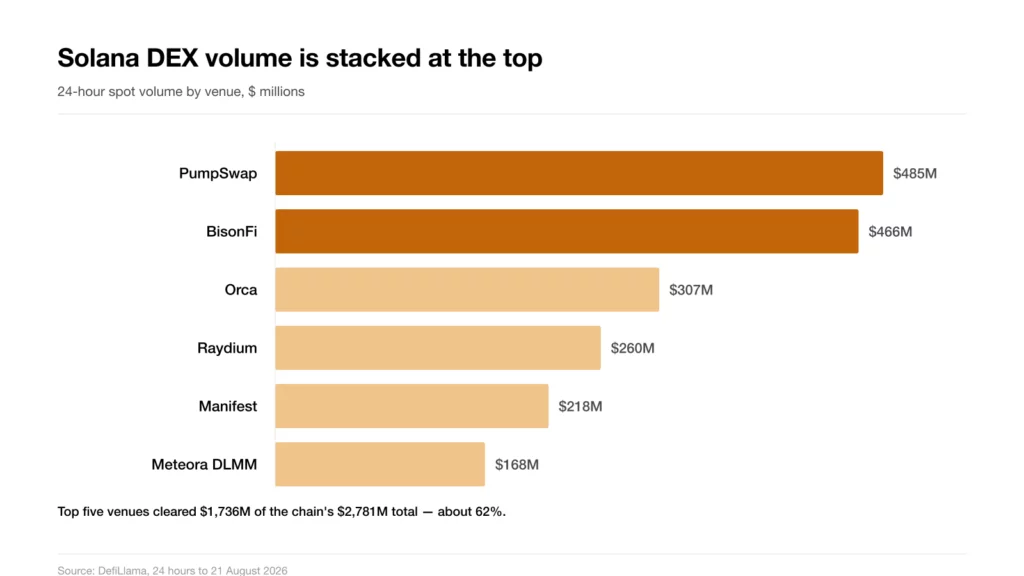
That is a large share for one layer-1 network, but the headline figure does not tell traders where they can get a reliable fill.
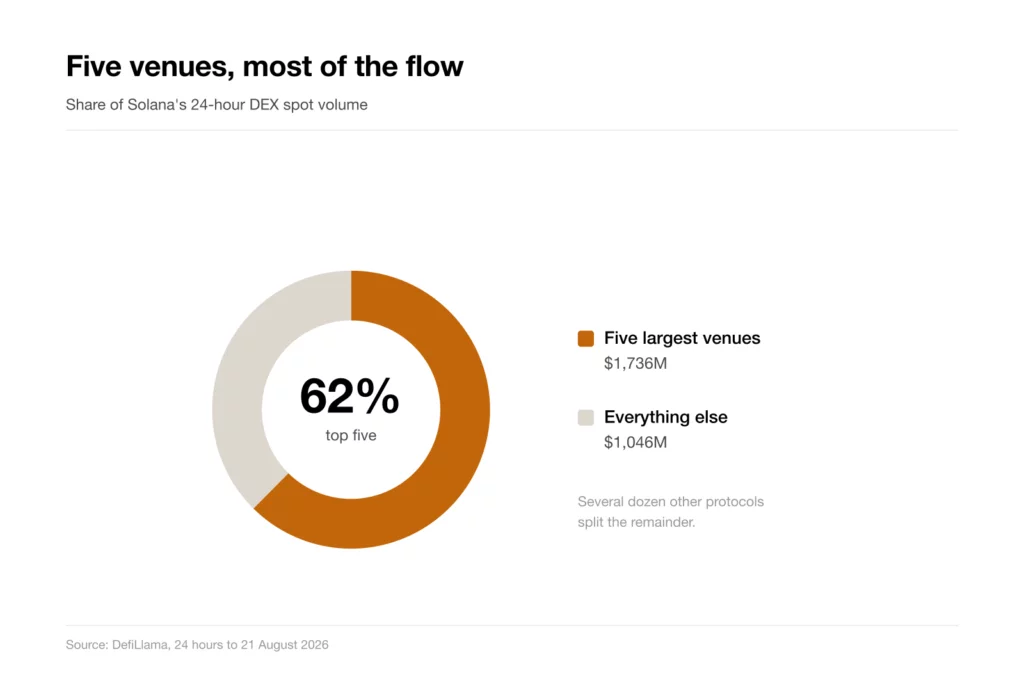
Aggregate volume measures how much value changed hands, not where usable liquidity sits. On the same day, PumpSwap processed about $485 million, BisonFi $466 million, Orca $307 million, Raydium $260 million and Manifest $218 million. Together, those five venues handled roughly $1.74 billion, or 62% of Solana’s total. Dozens of other protocols shared the remainder. The practical question is therefore not how many pairs a DEX lists. It is whether the venue can absorb a specific order when the trader needs to execute, and how much slippage appears when it cannot. SOL is not limited to Solana-based venues either; it also trades as a perpetual contract on platforms built on other networks, including Arbitrum.
1. The fee model quietly shapes how people trade
Solana’s cost structure is unusual enough to change behavior. Every transaction pays a base fee of 5,000 lamports per signature, with an optional prioritization fee priced in micro-lamports per compute unit, as the protocol documentation lays out. At current prices the base component rounds to fractions of a cent.
Those low costs influence trading in two distinct ways.
The advantage is straightforward. Cheap transactions make frequent retail trading possible where the same strategy could be uneconomical on Ethereum mainnet. Splitting a position into 15 smaller orders adds little network cost.
The drawback becomes clearer during congestion. Cheap failed transactions also make it inexpensive to flood the network. Priority fees can then become the real cost of getting a transaction included, with traders competing in an auction they may not win. Anyone budgeting only for the base fee can face delays or failed execution when timing matters most.
2. Volume charts have three blind spots
Routing can inflate totals. An aggregator may split one order across several pools. Each venue records the portion it fills, while the aggregator may also record the complete trade. The activity is genuine, but adding every reported figure can count the same order more than once.
Incentives can make liquidity look more durable than it is. Volume attracted by token rewards often leaves when those rewards end. A busy pool can become much thinner within a quarter, while historical charts offer little warning.
MEV creates another hidden cost. A large order submitted to a public mempool can attract sandwiching, backrunning and priority-fee competition. The loss does not appear as a separate charge; it appears in a worse execution price.
Onchain volume remains useful, but it should be treated as a starting point rather than a final verdict.
3. Automated market makers and order books are answering different questions
Most of the Solana venues above are variations on the constant-product idea Uniswap popularized, where a pool prices assets against a formula instead of against resting bids and offers, a mechanic the protocol’s own documentation still describes more clearly than anyone else has managed. It works remarkably well for long-tail assets, because a pool can exist for a token nobody would bother quoting by hand.
The limitation is depth. Price impact on an AMM rises as an order consumes more of a pool, and liquidity outside leading pairs can be thinner than the interface suggests. Order books reverse that tradeoff: they can offer stronger execution where market makers are active, but may have little usable depth elsewhere.
Derivatives venues concentrate liquidity differently from spot exchanges. Perpetual platforms focus activity in a smaller group of heavily traded contracts instead of spreading it across thousands of tokens. A BTC or SOL perpetual order book can therefore be deeper than a spot market for the same asset. Some hybrid platforms match orders offchain and settle them onchain, aiming to provide order-book execution without requiring users to give up custody.
4. The decentralization question does not resolve itself
The Bank for International Settlements made an argument back in its December 2021 Quarterly Review that has aged well: DeFi protocols exhibit what the authors called a decentralization illusion, since governance, sequencing and upgrade authority almost always concentrate somewhere identifiable.
Five years later, Solana’s DEX market offers a useful example. Its settlement layer is permissionless, but liquidity remains concentrated, a few aggregators route much of the order flow, and incentive programs controlled by small teams can shape activity. This is not evidence that the network has failed to decentralize. It shows that a decentralized ledger does not automatically create a decentralized market structure.
How the three venue models compare
| Venue type | How the price is set | Best at | Where it breaks |
| AMM pool | A formula against pool reserves | Long-tail tokens nobody quotes by hand | Price impact grows fast with size |
| On-chain order book | Resting bids and offers | Transparent, verifiable matching | Thin books outside the top pairs |
| Hybrid perpetual venue | Off-chain matching, on-chain settlement | Depth concentrated in a few contracts | The matching engine is not public |
What to check before routing a large order
Check depth, not just volume. Review the order book or pool reserves for the exact pair and model the expected fill at the intended trade size. Two venues with similar daily volume can produce very different results.
Separate protocol fees from network fees. Solana’s network fee may be small, but venue charges, spreads and price impact can still materially change the final cost.
Identify the source of liquidity. Organic market-maker activity can behave differently under stress from liquidity attracted mainly by temporary rewards.
Understand the custody model. Assets held in an exit-ready smart contract present different risks from collateral placed with an intermediary whose balance sheet cannot be inspected. Execution quality does not answer the custody question.
Test the venue against difficult conditions. A market can look deep during calm trading and deteriorate quickly during a sharp hourly move.
Solana’s onchain trading market has earned a large share of decentralized exchange activity. Still, a chain processing $48 billion in monthly volume does not prove that every venue can handle every order. Traders need pair-specific evidence before choosing where to execute.
Trading-volume data: DeFiLlama, retrieved Aug. 21, 2026.



Be the first to comment