



The US Securities and Exchange Commission (SEC) wants to let Wall Street’s official shareholder records move onchain while keeping regulated transfer agents in control.
On Sept. 1, the financial regulator proposed its first major overhaul of transfer-agent rules since regulations were adopted in the late 1970s and early 1980s, explicitly allowing blockchain or other distributed-ledger technology to serve as a company’s master securityholder file, or part of it.
That would bring tokenized securities deeper into the machinery that determines who legally owns shares, rather than limiting blockchain to a parallel record or digital representation.
One recordkeeping transfer agent would still retain exclusive control over the official shareholder file and remain responsible for its accuracy, security, and production to regulators.
SEC Chairman Paul Atkins said the proposal reflects the growing use of electronic communications and blockchain technology in securities offerings and share transfers. The broader rewrite would also replace paper-based requirements with electronic recordkeeping standards and update reporting around tokenization and distributed ledgers.
Securitize, a registered transfer agent already using blockchain infrastructure for digital securities, said the proposal moves regulation toward a model it has advocated to the SEC. Securitize is a tokenized real-world asset manager, with over $4 billion in assets under management.
The company has previously argued that public blockchains should be incorporated into securities recordkeeping while transfer agents continue overseeing the official ownership record.
“Modernization should raise standards, not lower them,” Securitize said, calling the regulatory shift and growing adoption of digital securities a tailwind for the sector.
Blockchain enters the official shareholder ledger
The proposal would formalize a direction SEC staff had already signaled.
Staff guidance has allowed registered transfer agents to use distributed-ledger technology as the official master securityholder file without maintaining a separate offchain duplicate, provided they meet existing regulatory requirements.
Transaction data, including wallet addresses, balances, ownership percentages, and purchase information, can reside onchain while sensitive personal information remains in separate systems.
The proposed rules would put that approach directly into the transfer-agent framework.
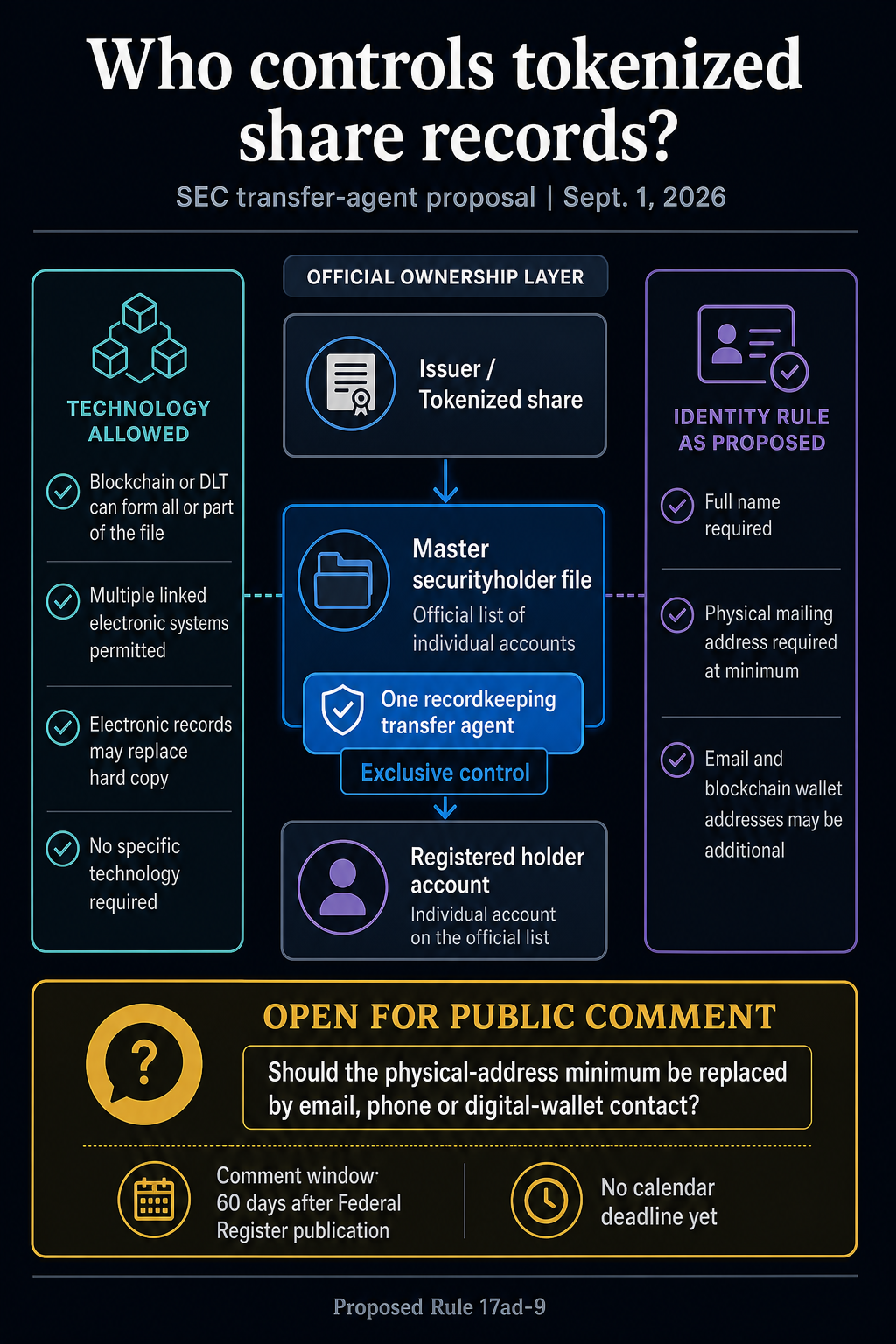
However, they would not mandate blockchain. Instead, transfer agents could choose the technology used to maintain their records, but the SEC said the system must remain secure, current, and accessible whether the underlying infrastructure is a conventional database or a distributed ledger.
Transfer agents would also have to give regulators more visibility into tokenization. Proposed changes to Form TA-2 would require reporting around securities using distributed ledgers, tokenization agents and platforms involved in those arrangements.
The technology provider would not inherit the transfer agent’s regulatory responsibility simply because the shareholder record runs through its infrastructure.
Wallet-only shareholders will have to wait
The proposal stops short of making corporate ownership fully wallet-native.
The SEC’s drafted framework would continue requiring the master securityholder file to include a holder’s full name and contact information, including a physical mailing address.
This means that a digital-wallet address can form part of the identifying information attached to a tokenized security, but it would not replace those traditional identity requirements.
The agency is nevertheless asking whether that should change.
Among the questions opened for public comment is whether transfer agents should have to collect a shareholder’s full name and physical mailing address and what consequences eliminating those requirements could have for other securities laws and market participants.
Commissioner Hester Peirce has separately raised the possibility of using email or digital-wallet addresses instead of names and physical addresses in some circumstances to facilitate onchain securities trading.
That leaves the SEC drawing a line between modernizing the shareholder ledger and replacing the identity system built around it.
Under the proposal, blockchain could become the authoritative infrastructure recording legal share ownership. The regulated transfer agent, however, would remain the gatekeeper connecting those on-chain positions to identifiable shareholders.
Comments are due 60 days after publication in the Federal Register. As of Sept. 1, the SEC had not provided a fixed publication date.



Be the first to comment