



Too Long; Didn’t Read [TL;DR]
- Senator Cynthia Lummis warns Congress that failing to pass the Clarity Act this term pushes market-structure legislation to 2030.
- XRP holds $1.40–$1.42 as spot ETF inflows top $1.61 billion and Polymarket odds on the bill fall to 13–18%.
- Bitcoin consolidates at $79,600–$80,100 while spot ETFs post a third straight day of inflows, with net assets past $101 billion.
- Derivatives markets liquidate $197.84 million across 65,155 traders as the Liquid Network sidechain exploit rattles Bitcoin.
- Anthropic’s IPO filing advances with Morgan Stanley and Goldman Sachs as GPT-6 Astra fuels rallies in Bittensor, Near Protocol, and Worldcoin.
- Fed rate-cut odds fall to 50/50 after August payrolls nearly triple forecasts, with CPI data due September 12.
On Monday, September 7, 2026, the cryptocurrency market moved into tight consolidation. The industry’s market capitalization remained locked in the $2.77–$2.80 trillion range, while Bitcoin is holding the $79,600–$80,100 range, consolidating Friday’s short squeeze toward $82,000.
Spot BTC ETFs recorded three consecutive days of inflows, accumulating $770–$987 million in inflows for the week through September 4, while their net assets surpassed $101 billion (6.35% of the total market supply).

You Might Also Like

At the same time, the derivatives market underwent a local cleanup — positions held by 65,155 traders were forcibly closed over 24 hours, totaling $197.84 million (with $45.86 million in ETH longs liquidated as the coin fell to $2,490–$2,510, and $47.67 million in BTC shorts liquidated) as per Coinglass.
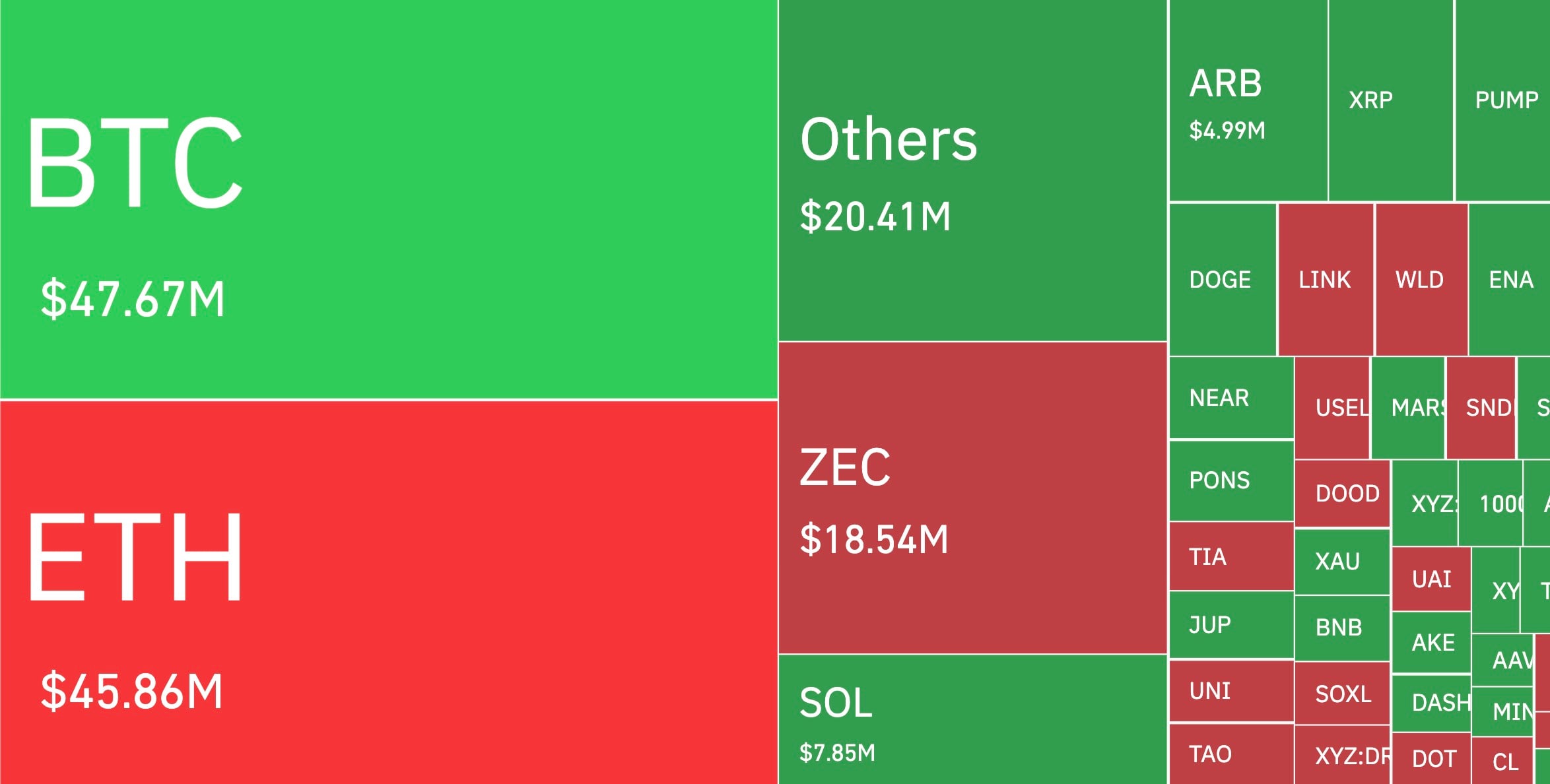
Against this backdrop, “smart money” is using the dip for treasury purchases. European company Capital B SA completed a €28.7 million share placement (investors included TOBAM and Blockstream CEO Adam Back), purchasing 376 BTC at an average price of ~$78,100 right during the panic surrounding a vulnerability in the Liquid Network sidechain code (from which 4,000 BTC worth $320 million were withdrawn).
Back aggressively bought real Bitcoin from the market, following the example of Michael Saylor and Strategy, which recently purchased 4,603 BTC at $80,300 (bringing the company’s total holdings to 845,050 BTC).
Lummis’ ultimatum and the Senate calendar crunch: How this affects XRP’s status
The main political trigger of the past 24 hours was a statement by Senator Cynthia Lummis (R-WY), who directly warned: “If the Clarity Act does not pass in this Congress, the next real opportunity to bring market-structure legislation back will not come until 2030.”
Lummis’ logic is tied to a severe calendar crunch in Washington, which has pushed the odds of the bill passing on Polymarket down to 13–18%:
- September 15: The Senate will hold only a procedural cloture vote — requiring 60 votes merely to begin debate.
- 4 working days: The remaining time for votes in the House of Representatives after September 14, before lawmakers leave Washington on September 17 ahead of the November 3 elections.
- January 2027 factor: Lummis’ own term comes to an end. She is retiring, depriving the industry of a key Senate advocate ahead of the 2028 electoral cycle.
You Might Also Like
For major assets such as XRP and Solana (SOL), this political deadlock means maintaining the current status quo rather than a legal failure. The assets’ current positions are firmly supported by three factors:
- Commodity status: The official joint classification of XRP and SOL as “digital commodities” by the SEC and CFTC on March 17, 2026, reinforced by Judge Torres’ ruling and the regulator’s withdrawal of its judicial appeals.
- Institutional gateways: The operating multi-structure T. Rowe TKNZ fund and spot XRP ETFs with cumulative inflows of $1.61 billion (2.05% of the token’s market capitalization).
- Liquidation density: A protected spot floor, with on-chain Max Pain metrics showing long risks only at $0.98, while the short pool is squeezed tightly against current prices at $1.4644.
The absence of a federal statute would leave the assets’ status at the agency level (through internal regulatory memoranda), theoretically allowing a future White House administration to change the rules of the game. This is precisely why major players are now engaged in a fierce battle on exchanges, holding XRP in the narrow $1.40–$1.42 range.
Anthropic IPO euphoria and the new GPT-6 Astra are driving the crypto AI sector
While major tokens remain caught in a regulatory sideways market, speculative capital has flowed into the artificial intelligence sector. The catalyst came from the traditional stock market: Morgan Stanley and Goldman Sachs are preparing the Anthropic IPO, with the filing of its S-1 form expected as early as this week.
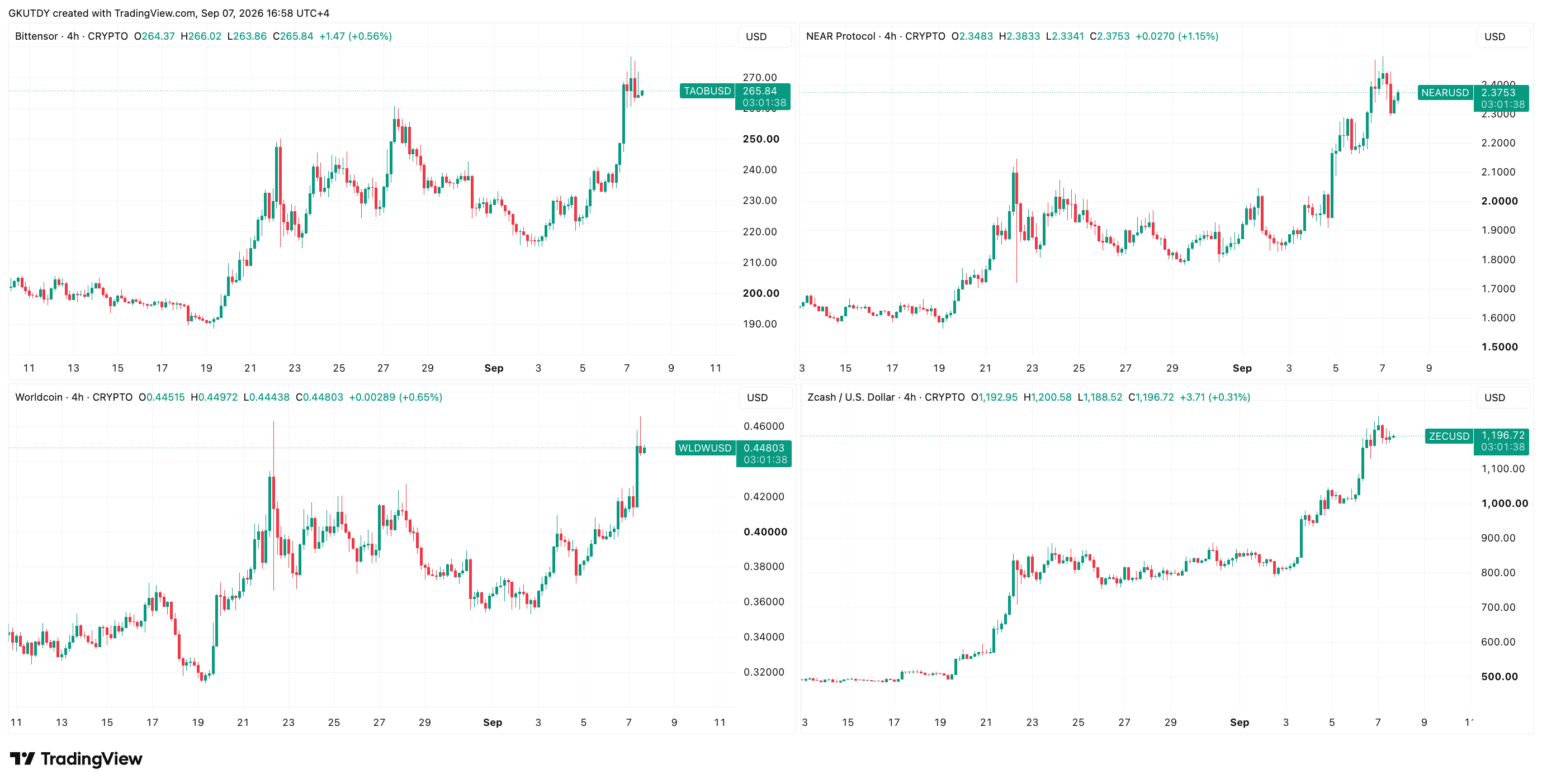
Against this backdrop, Bittensor (TAO) reached a multi-month high near $270 (+50% from its summer lows). Near Protocol (NEAR) rose to $2.35 (+26.24% over seven days, with daily trading volume of $341 million), while Sam Altman’s Worldcoin (WLD) recorded a price of $0.4492 (+25.58% over the week) according to TradingView chart data.
At the same time, OpenAI released a limited preview of the GPT-6 Astra model with claimed AGI capabilities. It operates computer interfaces (Computer Use) twice as fast as its predecessors, while the new Codex memory allows the AI to autonomously perform complex tasks for hours without losing context.
The Astra launch was accompanied by an anomaly: on September 3, server components of OpenAI, Anthropic (Claude), xAI (Grok), and Google (Gemini) all went down simultaneously for one hour, which was described as a rare infrastructure coincidence.
Astra became the first model to exceed the critical risk threshold in OpenAI’s cybersecurity system due to its ability to autonomously find and exploit vulnerabilities in code.
The technological leap is putting direct pressure on the crypto market through a new generation of AI agents: the updated Codex allows AI to continuously audit smart contracts, monitor portfolio risks in real time, and instantly identify on-chain arbitrage opportunities without losing the context of the task for an entire day.
Crypto market news: Where is the liquidity heading?
The macroeconomic backdrop tightened sharply after the release of the August labor market report (NFP): the number of jobs increased by 162,000 versus a forecast of 55,000 (unemployment at 4.1%). Futures markets shifted the odds of the Fed cutting rates at the September 15–16 meeting to a hard 50/50.
External political pressure on the central bank and demands for immediate monetary easing have complicated the overall trajectory. This triggered a wave of local market volatility through HFT bots, which are actively buying dips in the technology sector and semiconductors (NVDA), while regulatory officials remain silent ahead of the critical inflation data release (CPI) on September 12.
In the domestic market, liquidity is flowing into strong local narratives:
- Robinhood Chain: It set a new record, processing $3.8 billion in DEX volume over 24 hours (surpassing Ethereum). The network’s main launchpad, PONS, generated $5.95 million in fees over 24 hours, while its key beneficiary — Arbitrum (ARB) — surged +91.68% to $0.1683.
- Privacy sector: Zcash (ZEC) is holding at $1,197 (+43.20% over the week, with daily trading volume of $898 million). The momentum is tied to institutional recognition: Grayscale launched a spot Zcash ETF (ticker ZCSH) on NYSE Arca, selecting Coinbase as its official custodian. The coin has emerged as a protective shield for large capital amid regulatory and tax pressure.
You Might Also Like

The current balance of power clearly divides the market. Short-term traders are reacting to macroeconomic indicators, resulting in volatility and local leveraged-position liquidations.
At the same time, institutional capital continues to absorb supply on the spot market. Treasury purchases by Strategy and Capital B, along with steady ETF inflows from BlackRock and Grayscale, are forming the current support levels, keeping major assets within their trading ranges ahead of the key mid-September deadlines.



Be the first to comment